
Travel Guide
Plan your visit around War Remnants Museum, Independence Palace, and more of Ho Chi Minh City, Vietnam.
Discover the best things to do in Ho Chi Minh City, Vietnam, from signature sights to memorable local experiences.
Start in the compact core where French boulevards, pagodas, markets and landmark museums sit within easy walking loops.
District 1 and nearby districts concentrate highlights. Notre‑Dame Cathedral Basilica, Saigon Central Post Office, Ben Thanh Market and the Independence (Reunification) Palace.
While short day trips reach the Cu Chi tunnels and Mekong waterways. The city is high‑energy and best explored on foot, by short rides, and with time set aside for museum visits and evening promenades.
Why Visit Ho Chi Minh City
Visit for a concentrated introduction to modern Vietnamese history, colonial-era architecture and an intense urban food culture. Museums such as the War Remnants Museum and Independence Palace provide grounding context for twentieth‑century events, while Notre‑Dame, Jade Emperor Pagoda and Ben Thanh Market reveal religious life and daily commerce.
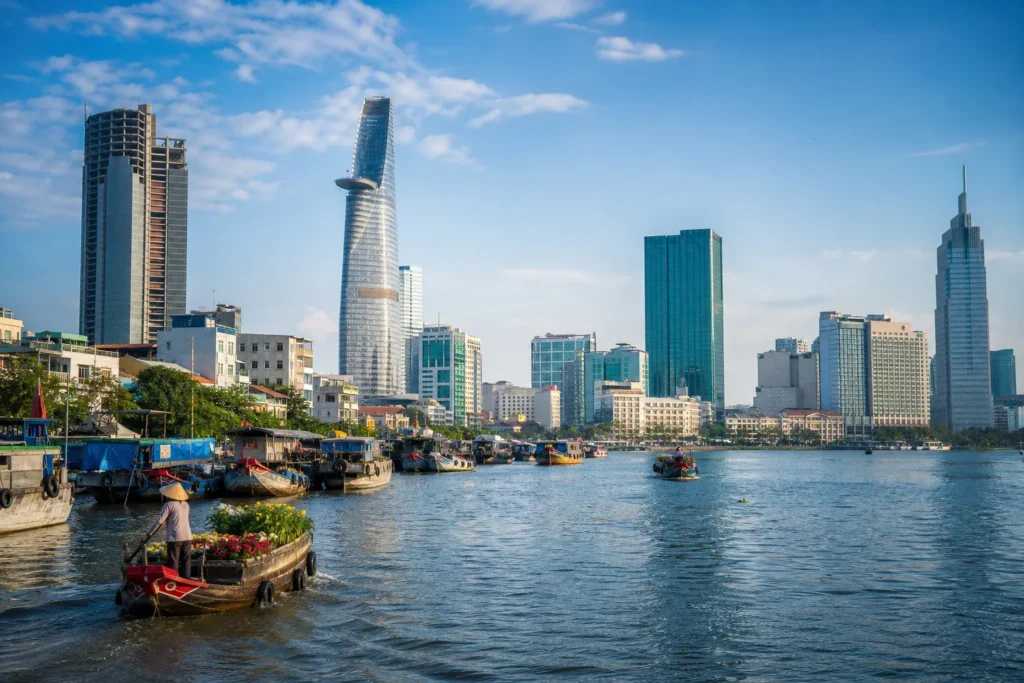
The city also serves as a gateway for short excursions to the Cu Chi tunnel complex, the Mekong Delta and coastal preserves. Evenings offer riverfront promenades, pedestrian Nguyen Hue and rooftop viewpoints for a different city tempo.
Top Things to Do in Ho Chi Minh City, Vietnam
These signature attractions combine history, architecture and lively street scenes. Easy to group into a walking loop in District 1 or to visit as short rides from the central hub.
War Remnants Museum
The War Remnants Museum presents a documentary‑style account of modern conflict and its human costs. Located at 28 Võ Văn Tần in District 3 near other central landmarks, the museum opens with an outdoor courtyard of captured military hardware—tanks, helicopters and artillery—that immediately signals the subject matter.
Inside, thematic galleries use large photojournalism, artifacts and documents to address wartime experiences, prisoners’ stories and the aftermath of Agent Orange.
Exhibits are direct and often graphic, intended to prompt reflection about the consequences of war rather than to glorify combat. The museum preserves thousands of documents, photographs and films and offers bilingual labels, audio guides and printed maps to help non‑Vietnamese visitors follow the narrative.
Independence Palace (Reunification Palace)
Independence Palace, commonly known as Reunification Palace, stands on Nam Kỳ Khởi Nghĩa Street in District 1 and is a preserved mid‑twentieth‑century government complex. The modernist building, designed by Ngô Viết Thụ and completed in the 1960s, preserves reception rooms, family apartments, and a presidential office furnished in period style.
Visitors move from formal state rooms to more intimate private quarters and terraces that reflect the building’s diplomatic and administrative roles.
A key highlight is the bunker and communications centre below ground, where maps, wartime telephones and equipment illustrate how the palace functioned during crises.
Official Independence Palace (Reunification Palace) website →
Notre-Dame Cathedral Basilica of Saigon
The Notre‑Dame Cathedral Basilica of Saigon sits in District 1 with a warm red‑brick façade and twin bell towers that anchor a formal square. Built in the late nineteenth century with many materials imported from France, the neo‑Romanesque church remains an active Catholic cathedral hosting daily masses and religious processions alongside tourists exploring the plaza.
Inside, stained‑glass panels and a calm nave create a reflective interior contrast to bustling Saigon streets. A marble statue of Our Lady of Peace in the forecourt is a focal point for visitors.
Because the cathedral is a living church, access and photography rules can change during services or restoration—check official communications before visiting and treat the interior as a place of worship.
Saigon Central Post Office
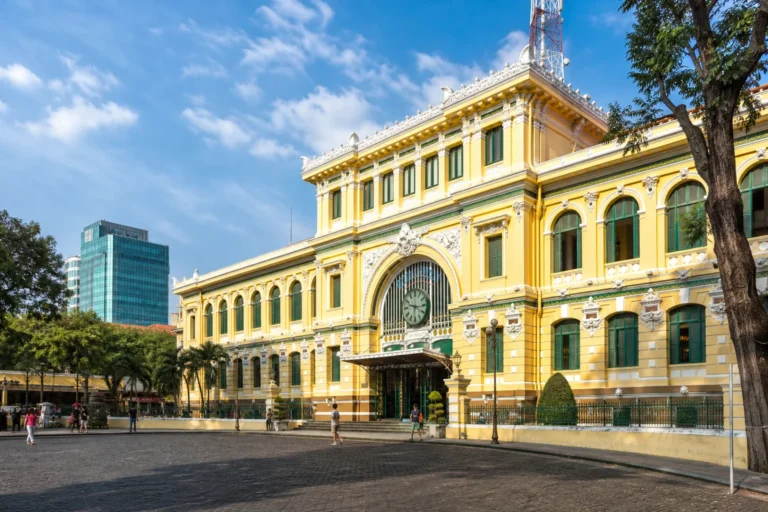
The Saigon Central Post Office stands opposite Notre‑Dame and is one of the city’s most photographed colonial buildings, noted for its bright yellow façade and arched windows.
Opened around 1891 and commonly associated with French architectural influence, the functioning post office welcomes visitors to admire its barrel‑vaulted interior, slender cast‑iron columns and a long central counter that once handled telegraph and telephone traffic.
Two large painted maps and vintage telephone booths add period atmosphere while the building continues to operate as a working postal facility. Visitors can buy stamps and combine this stop easily with the cathedral and nearby book street for a compact heritage circuit.
Ben Thanh Market
Ben Thanh Market occupies a central block in District 1 beneath its distinctive clock tower and has been a symbolic commercial hub since the early twentieth century.
The covered hall divides into functional zones and narrow alleys lined with hundreds of small stalls offering textiles, handicrafts, dried goods and a food court serving regional street meals and snacks. Perimeter night stalls and neon‑lit alleys add evening vibrancy.
Visitors should carry small cash, check the origin and quality of packaged items, and haggle politely at many stalls. Early mornings see wholesalers restocking, while evenings draw more tourist and local trade.
Combine Ben Thanh with nearby Notre‑Dame and the Central Post Office for convenient walking connections.
Cu Chi Tunnels
The Cu Chi Tunnels lie northwest of Ho Chi Minh City and form an extensive underground network originally expanded for guerrilla warfare and shelter. Visitor areas include preserved tunnel sections, reconstructed chambers, trapdoors, field hospital and kitchen reconstructions, plus outdoor exhibits that explain tunnel life and wartime strategies.
Some sites display weapons, documentary panels and veterans’ testimonies to help interpret the experience.
Short, visitor‑friendly tunnel stretches are widened compared with originals; crawling is optional but conveys the constricted scale. Two main visitor sites—Ben Dinh (closer and busier) and Ben Duoc (larger and quieter)—are commonly offered by tour operators.
Allow a half‑day for travel, guided interpretation and short exploration.
Bitexco Financial Tower (Saigon Skydeck)
Saigon Skydeck occupies the 49th‑floor observation level of Bitexco Financial Tower and offers panoramic views across District 1 and the Saigon River. The compact observation deck has wraparound glazing framing the dense urban fabric, riverfront and skyline—an efficient stop for photos and orientation that usually takes thirty to forty‑five minutes.
The tower’s lotus‑bud design and prominent helipad make it a modern city symbol, while interior interpretation highlights Saigon’s growth and skyline.
Weather and haze can limit visibility, and the Skydeck can be busy at peak times—check ticketing, timed entry and the official Skydeck page before you visit and consider combining this stop with a riverside walk or evening cruise.
Jade Emperor Pagoda (Chua Ngoc Hoang)
Jade Emperor Pagoda (Chua Ngoc Hoang) occupies a compact lot in District 1 and feels instantly atmospheric with incense‑scented courtyards and richly carved altars. Constructed in the early twentieth century by a Cantonese founder, the shrine combines Taoist, Mahāyāna Buddhist and popular devotional practices.
Inside, theatrical papier‑mâché courts of deities, carved reliefs and sculptural ensembles guide worship and moral storytelling.
The pagoda remains an active spiritual site—dress modestly and move respectfully when photographing. Mornings are quieter for contemplative visits, while festival days draw dense crowds.
Check local tourism pages for guidance on ceremonies and visitor rules to ensure a culturally sensitive visit.
Nguyen Hue Walking Street
Nguyen Hue Walking Street is the principal pedestrian promenade in District 1 beside City Hall, offering a broad paved mall for strolling, people‑watching and evening performances.
By day it functions as an open civic space framed by colonial façades and contemporary towers; after dusk the avenue livens with lights, street musicians and crowds gathered around a lotus‑shaped musical fountain and public artworks.
The walk links City Hall with riverfront blocks and major shopping centres, making it a convenient spine for downtown exploration. Expect variable programming during holidays and weekends—combine the promenade with nearby museums, the opera house or riverside walks for a compact evening circuit.
Best Time to Visit Ho Chi Minh City
Ho Chi Minh City has a tropical monsoon climate. The dry months—typically December through April—are the most comfortable for outdoor activities and day trips.
The wet season from May through November brings frequent afternoon or evening downpours and higher humidity. Travel is still possible but expect intermittent flooding on low streets and occasional transport disruption.
Plan outdoor excursions with flexible timing and check local forecasts.
SPECIAL EVENTS IN Ho Chi Minh City
Techcombank Ho Chi Minh City International Marathon
The Techcombank Ho Chi Minh City International Marathon is Ho Chi Minh City's flagship mass-participation running event, offering marathon, half-marathon, 10K, 5K and kids distances. AIMS-certified and sponsored by Techcombank, it draws large domestic and international fields and a race expo, creating a festival atmosphere across the city. Travelers may enjoy racing or spectating amid central District 1 landmarks, convenient transport connections, and cultural food and entertainment nearby. The event is suitable for both competitive runners seeking qualifying times and casual participants wanting an urban running experience.
- Dates
- December 6, 2026
- Venue
- Le Duan – Nguyen Binh Khiem (District 1) — official start/finish area
VIFA EXPO (Vietnam International Furniture & Home Accessories Fair)
VIFA EXPO is Vietnam’s largest specialized trade fair for furniture, home accessories and handicrafts, organized by Lien Minh VIFA EXPO Corporation. It attracts hundreds of domestic and international exhibitors and thousands of trade visitors seeking sourcing, OEM partnerships, and market expansion in Southeast Asia. Travelers interested in industry tours, buyer-supplier meetings, or product sourcing will find strong B2B networking, large exhibit halls, and nearby logistics and accommodation services in Ho Chi Minh City. The organizer also runs a related VIFA ASEAN event focused on ASEAN markets.
- Dates
- February 26, 2027 - March 1, 2027
- Venue
- WTC EXPO; SKY EXPO Vietnam
Automechanika Ho Chi Minh City
Automechanika Ho Chi Minh City is Messe Frankfurt’s major trade fair for Vietnam’s automotive aftermarket, workshop services and electrification supply chain. The show draws manufacturers, distributors and trade professionals who come to source parts, see EV and diagnostic technology, attend technical sessions, and make industry contacts. Travelers visiting for business will find concentrated product displays, demonstrations and networking opportunities in Ho Chi Minh City, while leisure visitors interested in automotive culture may enjoy public exhibits, product launches and related events.
- Dates
- June 16, 2027 - June 18, 2027
- Venue
- Saigon Exhibition and Convention Center (SECC)
Getting Around Ho Chi Minh City
District 1 and nearby central neighborhoods are compact and highly walkable for short sightseeing routes. Motorbike taxis and app-based ride-hailing services (cars and two‑wheelers) are ubiquitous and convenient for medium-length trips; metered taxis and ride apps provide straightforward point-to-point service.
Public buses are inexpensive for longer horizons but slower. For Cu Chi or Mekong day trips, book through reputable tour operators or arrange private transfers, and allow extra time for heavy traffic at peak hours.
Location
Map of Ho Chi Minh City, Vietnam
The interactive map loads only when you choose to view it.
Plan Your Visit to Ho Chi Minh City
Allow generous travel time between Districts 1, 3 and suburban sites—Cu Chi can take 1.5–3 hours each way by road. Use Tan Son Nhat (SGN) for international arrivals and consider completing a digital arrival card in advance.
Carry small cash for markets and street food; ATMs and international cards work at hotels and larger shops. The metro (Line 1) has partial operations; most visitors rely on buses, taxis and ride‑hail apps.
Check attraction websites for hours, closures or temporary works before you go.
Local Tips for Ho Chi Minh City
Cluster District 1’s central attractions—Nguyen Hue, Notre‑Dame and the Central Post Office—into a single walking loop if you enjoy busy sidewalks and street vendors. Haggle politely at Ben Thanh Market and inspect packaged goods; refrigerated stalls sell prepared food.
For Cu Chi, choose the official relic parks (Ben Duoc or Ben Dinh) and wear closed shoes and light clothing. Guided visits provide context and safer access.
Start museum days early to avoid heat and combine nearby sites to reduce transfers.
Live conditions
Current Weather

Updated 2026-09-22 00:45
- Feels like
- 30°C / 85°F
- Today’s high / low
- 32°C / 89°F · 26°C / 78°F
- Humidity
- 86%
- Wind
- ← 4 km/h
- Precipitation
- 1.56 mm
- Chance of rain
- 88%
- Local time
- 2026-09-22 00:55
Safety
Take standard urban precautions: petty theft and opportunistic scooter snatchings are the most common risks, so keep bags zipped and phones out of obvious reach in crowded areas and markets. Traffic is busy—use care when crossing streets and when riding or hiring motorbikes.
After dark, prefer reputable taxis or ride‑hail services and avoid displaying large amounts of cash or valuables. Consult your government travel advice for authoritative updates and local emergency contacts if needed.