
Travel Guide
Plan your visit around Great Barrier Reef, Daintree Rainforest and Cape Tribulation, and more of Cairns, Australia.
Discover the best things to do in Cairns, Australia, from signature sights to memorable local experiences.
The compact tropical city is the practical gateway to two UNESCO World Heritage areas: the offshore Great Barrier Reef and the inland Wet Tropics rainforests. Downtown is flat and walkable along the Esplanade and Lagoon, while nearby suburbs host botanic gardens, markets and accommodation clusters.
Most reef and rainforest operators run day trips and combined packages from Cairns, making it an efficient base for short excursions to islands, reef moorings, Kuranda and Daintree/Cape Tribulation.
Why Visit Cairns
Visitors use Cairns’ accessible location as a launch point for world-class natural experiences: snorkelling or diving on the Great Barrier Reef, exploring ancient lowland rainforest in the Daintree and Cape Tribulation, and taking scenic rail or cableway journeys to Kuranda.
The Esplanade and Lagoon deliver relaxed urban waterfront time, Flecker Botanic Gardens offers rainforest plant collections within town, and nearby islands like Green Island provide quick reef-access day trips. The city’s mix of outdoor operators, family-friendly facilities and conservation-focused attractions such as Cairns Aquarium make it suitable for multi-day itineraries.

Top Things to Do in Cairns, Australia
Explore reef day trips, Wet Tropics boardwalks, heritage rail and cableway journeys, plus family-friendly waterfront leisure. All easily reached from Cairns as a practical base for short excursions.
Great Barrier Reef (day trips from Cairns)
Day trips from Cairns provide a compact introduction to the Great Barrier Reef and its protected Marine Park. Visitors typically travel by high-speed catamaran, fast launch or scenic flight to inshore and outer-reef sites, with a focus on snorkelling and introductory scuba around coral bommies and shallow reef slopes.
Trips commonly include purpose-built pontoons or semi-permanent platforms that supply sheltered snorkel zones, gear hire and basic interpretation for guided snorkels and introductory dives.
Many operators include an accredited reef naturalist or marine biologist who explains reef ecology, conservation measures and responsible reef practices. Because conditions and permitted access zones vary, choose a permitted operator and verify trip details with official resources.
Daintree Rainforest and Cape Tribulation
The Daintree Rainforest and Cape Tribulation form part of the Wet Tropics World Heritage Area, where ancient lowland and upland rainforest meet sandy beaches and headlands. Visitors explore via short walks, river tours, scenic drives and boardwalks that reveal layered forest structure and ancient plant lineages.
Highlights include Mossman Gorge, with clear granite rivers and interpretive visitor services run in partnership with Traditional Owners, and Cape Tribulation’s beaches and lookouts where rainforest slopes meet the Coral Sea.
The area is jointly managed with Indigenous landholders and many experiences include cultural interpretation. Plan for wet-season conditions, river crossings and follow park rules to protect fragile habitats.
Kuranda Scenic Railway
The Kuranda Scenic Railway is a heritage mountain line linking Cairns with the village of Kuranda. Built in the late 19th century, the journey climbs from near sea level to a rainforest plateau, showcasing engineering feats, curved bridges, deep cuttings and repeated framed views of the Barron River, gorge walls and waterfalls.
Restored timber carriages and audio commentary explain construction history, pioneers and natural features that shaped the route.
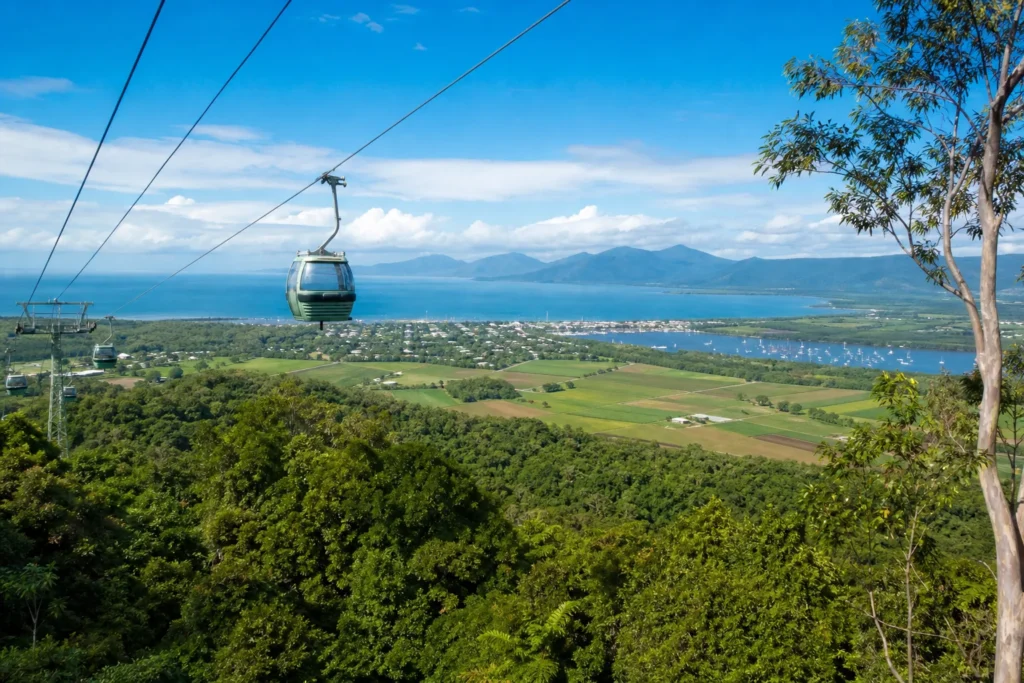
The railway pauses at historic points and terminates in Kuranda, where markets, wildlife attractions and cultural experiences await. Many visitors combine the train one-way with a Skyrail return for contrasting perspectives.
Skyrail Rainforest Cableway (Kuranda)
Skyrail Rainforest Cableway carries visitors 7.5 kilometres above World Heritage-listed Wet Tropics rainforest, offering canopy-level views and interpretive stops. The gondola system emphasises low-impact viewing and includes stops at Red Peak, with a Rainforest Discovery Zone and boardwalks, and Barron Falls, with lookouts over the Barron Gorge and interpretive panels.
Guided short walks and ranger-led interpretation explain forest ecology and Djabugay connections to Country.
Skyrail is designed as an interpretive ecotourism experience and pairs well with a Kuranda Scenic Railway return to combine canopy and ground-level perspectives. Check the official site for current operations before planning.
Cairns Esplanade and Lagoon
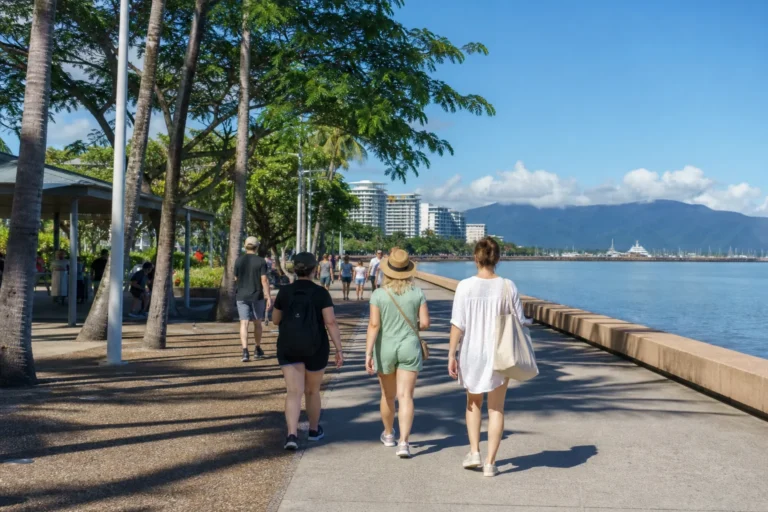
The Cairns Esplanade is the city’s principal foreshore park and civic spine, stretching along Trinity Inlet with wide promenades, lawns, public art and coastal views. It supports a range of informal uses from jogging to evening picnics, and hosts community markets and events.
The adjacent Esplanade Lagoon is a large, tidal-style swimming pool that provides a safe, family-friendly salt-water-feel alternative where beach swimming may be unsafe; lifeguards patrol during operating seasons.
The reserve includes playgrounds, fitness stations, beach volleyball and extensive picnic and barbecue facilities. Check council resources for up-to-date lifeguard patrols and event notices.
Flecker Cairns Botanic Gardens
Flecker Cairns Botanic Gardens showcases one of Australia’s finest tropical plant collections on the lower slopes of Mount Whitfield. The gardens emphasise living collections for scientific, conservation and educational value, with themed precincts including an Aboriginal Plant Use Garden, rainforest boardwalks and the Watkins Munro Martin Conservatory.
Shaded paths and boardwalks reveal layered rainforest structure from canopy palms to groundcovers, helping visitors understand ecological relationships and plant adaptations to wet tropical climates.
The gardens are historically significant and supported by volunteer groups that run interpretation and guided walks. Verify any temporary closures with official garden resources before visiting.
Green Island National Park
Green Island National Park is a coral cay about 27 kilometres east of Cairns where closed-canopy rainforest grows on coral sand adjacent to reef.
The compact island features an interpretive boardwalk that explains how some 120–130 plant species survive on shallow soils, and offers sheltered beaches and snorkelling in nearshore bommie areas protected within Marine Park zoning.
Visitor experiences focus on guided boardwalk tours, short reef swims and interpretive sessions run by resort or park staff rather than long technical dives.
Green Island’s compact combination of rainforest and reef makes it suitable for a single relaxed beach-and-snorkel day; check ferry bookings and operator advisories before travel.
Cairns Aquarium
Cairns Aquarium presents freshwater and marine ecosystems of northern Australia, emphasising the ecological links between Wet Tropics rivers, estuaries and the Great Barrier Reef. The facility houses more than sixty live exhibits, including multi-habitat billabongs, an outer-reef gallery and a Coral Sea oceanarium for large predatory fish, sharks and rays.
The aquarium operates a visible husbandry and veterinary program, a Turtle Rehabilitation Centre and a research arm collaborating on regional fisheries, aquaculture and reef science.
Staff-led talks, timed feedings and encounter programs offer interpretive ways to learn about species and conservation challenges; check official resources for current exhibits and booking requirements.
Best Time to Visit Cairns
Cairns has a tropical climate: a warm, wet summer (roughly November–April) and a milder, drier winter (roughly May–October). The dry-season months generally offer lower humidity, fewer heavy-rain days and better walking conditions in the rainforest.
Summer brings warmer sea temperatures and some peak marine-visibility windows but also higher rainfall and cyclone-season risk. For more reliable road and trail access, choose the dry season.
Shoulder months at the start and end of the dry season can balance weather and fewer crowds.
SPECIAL EVENTS IN Cairns
Cairns Tropical Pride (Cairns Pride Festival)
Cairns Tropical Pride is the annual LGBTIQ+ festival for Far North Queensland, featuring community-focused fairs, parties, exhibitions, and social activities across Cairns. The program spotlights local queer culture, supports sistergirl and brotherboy communities, and attracts residents and visitors with colourful parades, live music, and inclusive events. Travelers often time their visits to participate in community-led gatherings, enjoy hospitality and nightlife, and experience Cairns’s tropical setting, making the festival useful for event-aware trip planning and cultural engagement in the region.
- Dates
- October 9, 2026 - October 25, 2026
Cairns Airport IRONMAN Cairns & IRONMAN 70.3 Cairns
A headline triathlon weekend that brings full-distance IRONMAN and IRONMAN 70.3 racing to Tropical North Queensland. The event draws professional and age‑group athletes from the Asia‑Pacific region, fills the Cairns precinct with race expos and spectator villages, and creates major visitor demand for local accommodation, tours and reef access. Travelers may plan to combine racing or spectating with reef visits and tropical sightseeing, but should expect road closures and high local demand during race week.
- Dates
- June 13, 2027
- Venue
- Cairns Esplanade (Athlete Village & Finish) and Palm Cove Beach (Swim start / Transition)
7Cairns Marathon Festival
The 7Cairns Marathon Festival is a community-focused running festival that draws domestic and international runners to tropical Cairns. It offers a range of distances from family fun-runs and 5km events through to a half and full marathon, plus relay and wheelchair categories. The festival combines race weekend expo activity, charity fundraising, and spectator-friendly coastal scenery, making it attractive to destination runners, teams, and active travelers seeking both competition and tourism opportunities in Tropical North Queensland.
- Dates
- July 11, 2027
- Venue
- Fogarty Park
Getting Around Cairns
Cairns’ Esplanade and central precinct are compact and walkable; taxis, rideshares and local buses link suburbs, the airport and trailheads. Reef ferries and coach services depart from central waterfront terminals.
Kuranda Scenic Railway and Skyrail require advance booking for peak times. Car hire helps for flexible coastal and rainforest drives north of the city; guided tours simplify logistics for reef and World Heritage excursions.
Location
Map of Cairns, Queensland, Australia
The interactive map loads only when you choose to view it.
Plan Your Visit to Cairns
Most visitors base themselves in Cairns and book licensed day trips to the Great Barrier Reef, Green Island, or combined land tours to the Daintree, Cape Tribulation and Kuranda. Arrange reef and charter boat trips in advance with permitted operators and check Marine Park zoning and permit guidance before diving or snorkelling.
For Kuranda and Skyrail, consider a one-way rail/cable combination to avoid return transfers. Pack reef-safe sunscreen, sun protection, a light rain jacket and insect repellent, and plan for sudden tropical showers during the November–April wet season.
Local Tips for Cairns
Use the Esplanade and lagoon for easy family-friendly waterfront access and collect maps from Cairns Regional Council visitor services. On Daintree and Cape Tribulation visits, respect Indigenous-led experiences and follow signage at Mossman Gorge and other jointly managed sites.
For reef trips, prefer operators that provide snorkel instruction and environmental briefings. Public transport and shuttle buses connect to Skyrail and Kuranda terminals; taxis and rideshares can be limited during peak transfer times.
Live conditions
Current Weather

Updated 2026-09-22 02:15
- Feels like
- 15°C / 59°F
- Today’s high / low
- 24°C / 76°F · 15°C / 59°F
- Humidity
- 84%
- Wind
- ↓ 6 km/h
- Precipitation
- 0 mm
- Chance of rain
- 20%
- Local time
- 2026-09-22 02:32
Safety in Cairns
Coastal and rainforest areas present distinct risks: strong sun, seasonal marine stingers (box jellyfish/Irukandji in warmer months), and crocodile warnings in estuaries and some beaches. Obey lifeguard directions and local signage.
The Great Barrier Reef is a protected Marine Park with rules on anchoring, wildlife interactions and coral contact; use permitted operators who follow responsible reef practices. On remote rainforest roads, drive cautiously, check conditions and carry water.
For accessibility needs, consult operators and park authorities before booking.