
🔒 Your Request Stays With You
Most travel apps rely on tracking. Roamn does not. Instead, the system separates your identity from the AI request itself. As a result, you receive smart travel recommendations without creating a long-term behavioral profile.
Roamn protects privacy by design, not by optional settings.
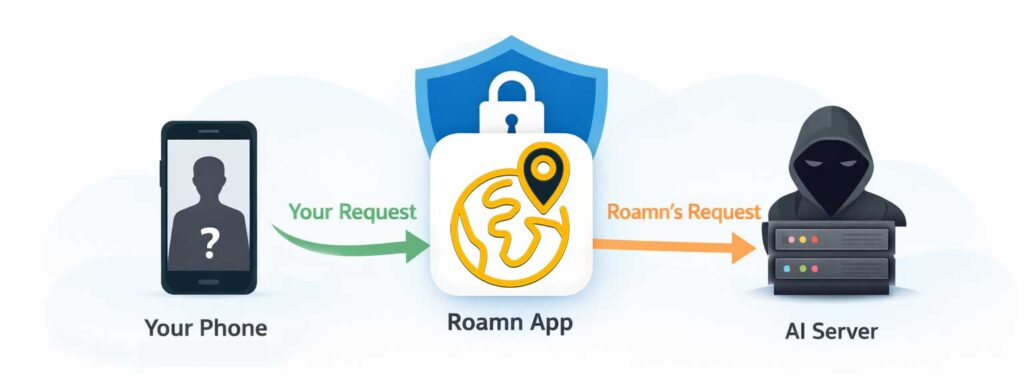
When you search inside Roamn, your phone does not contact the AI system directly. Instead, the app receives your request first. From there, Roamn sends a generalized request outward.
Because of this structure, the AI sees Roamn — not you.
Unlike many platforms, Roamn does not attach personal device identifiers to AI calls. Therefore, the AI cannot connect searches across sessions to your identity.
In simple terms, your request stays separated from your device identity.
🔄 How the Request Flow Works
Here is the model:
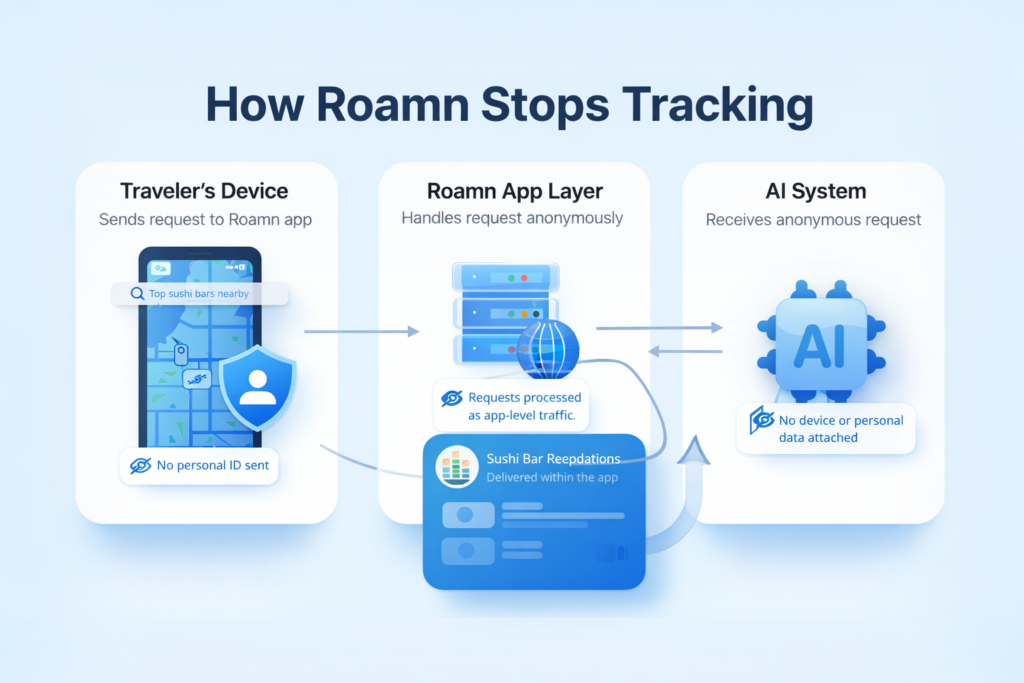
Your Device → Roamn → AI → Roamn → You
Notice what does not happen. The AI never receives a personal device ID. It does not see an account-linked tracking token. It does not build a user profile tied to your phone.
Consequently, your searches do not accumulate into a personal tracking history.
🚫 No Persistent Behavioral Tracking
Many apps log repeated searches. Others combine movement patterns with device fingerprints. Over time, those signals create advertising profiles.
Roamn avoids that model entirely.
Each request functions as a discrete task. After the AI responds, the session ends at the AI layer. Because there is no persistent identity connection, long-term profiling cannot occur through the AI request itself.
That architectural separation limits tracking at its source.
👀 What the AI Actually Sees
From the AI’s perspective, the request appears as:
• A structured travel query
• Sent by the Roamn application
• Without personal identifiers
• Without persistent tracking tokens
The AI processes the request. Then Roamn delivers the result back to you. At no point does the AI need to know who you are.
That boundary protects your privacy.
🏗 Privacy by Architecture
Some platforms offer privacy toggles. However, Roamn builds privacy into the system itself. The design limits identity exposure before any request reaches the AI layer.
Additionally, Roamn does not sell user location data. It does not create advertising dossiers. It does not package travel history for resale. Instead, the platform focuses on real-time discovery.
Because of this structure, privacy remains part of the foundation — not an afterthought.
🌍 Intelligent Travel Without Being Followed
AI does not require identity tracking to generate helpful answers. Modern systems respond effectively to structured prompts. Roamn uses that capability while removing identity linkage.
You still receive restaurant recommendations. You still get walking directions. You still discover local experiences. Meanwhile, your digital footprint does not expand through AI profiling.
That balance matters.
🧭 How To’s & Where To’s Blog
Want to get even more out of Roamn? Visit our How To’s & Where To’s Blog for practical tips and travel inspiration. There, you’ll find step-by-step guides on using Roamn’s multilingual search, navigating in 22 languages, and discovering local attractions, hidden gems, and must-see spots around the world. Whether you’re planning ahead or exploring on the fly, the blog helps you travel smarter and with confidence.
🏢 Built by PageGravy
Roamn is developed and maintained by PageGravy, a technology company focused on building practical, privacy-conscious digital solutions. PageGravy designs AI-powered systems that prioritize user control, transparency, and responsible architecture.
Learn more at PageGravy.com
🔐 Security Commitment
Roamn follows a privacy-by-architecture approach. AI requests are separated from personal device identity at the application layer, which limits exposure to tracking or persistent profiling. The platform does not sell user data, build advertising dossiers, or attach AI requests to long-term personal identifiers.
Privacy protection is not a feature toggle. It is part of the structural design.