
Panduan Perjalanan
Panduan ringkas untuk tempat, peta dan petua perjalanan di Salerno.
Mencari Perkara untuk Dilakukan di Salerno? Gunakan panduan ini untuk membandingkan tarikan utama, petua tempatan, peta dan cuaca.
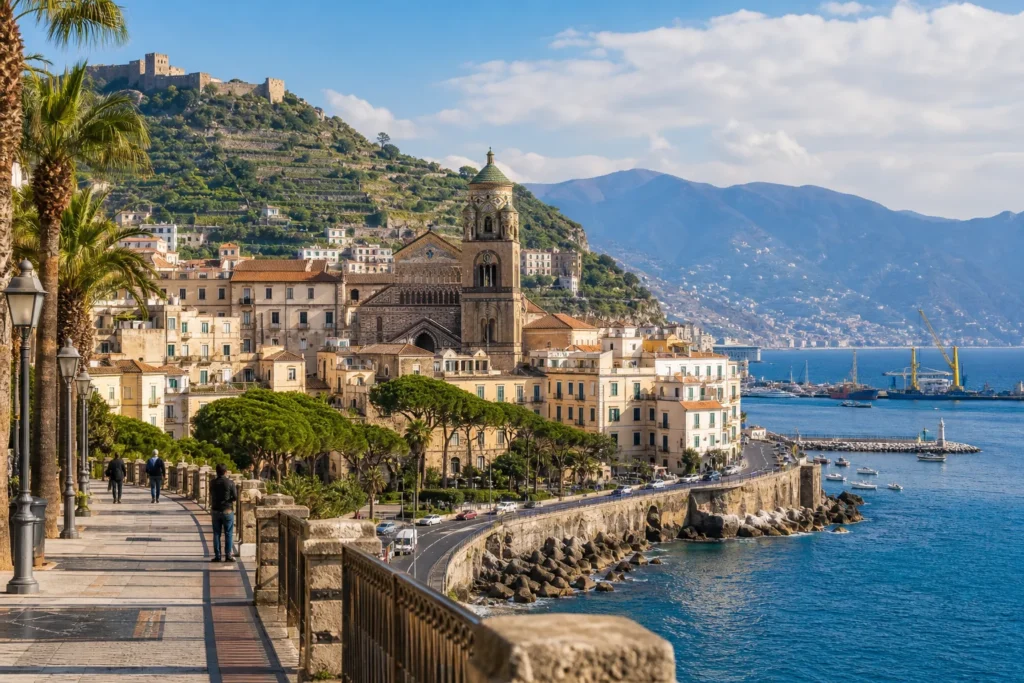
Kalau anda mencari Perkara untuk Dilakukan di Salerno, bandar ini memberi ganjaran untuk lawatan singkat dengan seni bina abad pertengahan, sebuah taman ubatan yang dipulihkan dan pesisiran yang meriah. Pusat bersejarahnya menyimpan Duomo dan tapak Scuola Medica Salernitana, manakala Lungomare Trieste dan Castello Arechi menawarkan akses mudah ke kehidupan pesisir dan pemandangan panorama.
Mengapa Melawat Salerno
Salerno menggabungkan warisan abad pertengahan yang mudah diakses, sejarah botani dan suasana pesisir yang santai. Duomo dan tapak Scuola Medica Salernitana menjejak pengajaran perubatan Eropah awal.
Giardino della Minerva yang dipulihkan memaparkan tanaman ubatan bersejarah dan menawarkan pemandangan bandar. Castello Arechi menempatkan puncak bukit dengan pandangan meliputi Teluk.
Sambungan keretapi yang boleh dipercayai dan feri bermusim menjadikan Salerno pangkalan praktikal dan kurang sesak untuk lawatan sehari ke Pantai Amalfi.
Perkara untuk dilakukan di Salerno
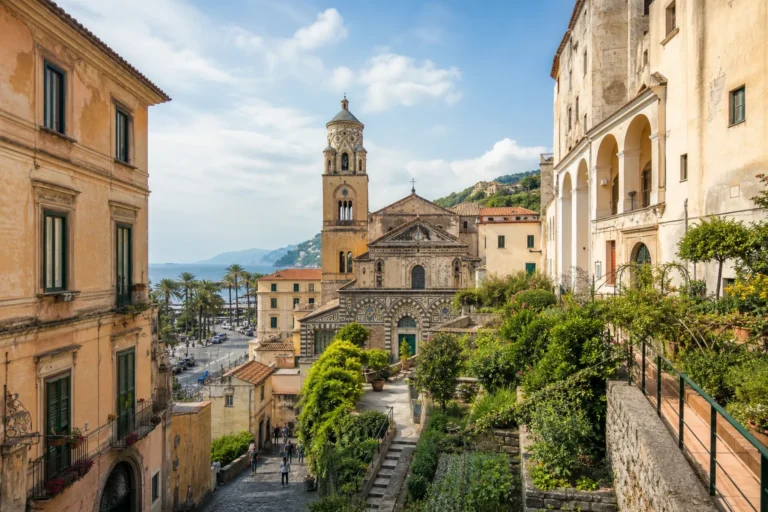
Pusat bandar Salerno yang padat mengumpulkan mercu tanda abad pertengahan, taman ubatan yang dipulihkan dan sebuah persisiran berbaris palma. Kebanyakan tarikan utama boleh dicapai dengan berjalan kaki jika anda bersedia menghadapi lorong curam dan teres.
Cathedral of San Matteo (Duomo di Salerno)
The Duomo di San Matteo is Salerno’s principal medieval church and civic landmark: a Norman-era cathedral consecrated in 1084 that shelters the revered relics of Saint Matthew.
Visitors experience a layered architectural sequence — a porticoed atrium, the richly decorated basilica interior with important altarpieces and fresco cycles, and the 18th‑century crypt where the saint’s relics are venerated and displayed in a dedicated chapel.
The site’s significance lies in its role as both a living parish and a repository of Salerno’s religious and artistic history (Norman foundation, later Baroque interventions and restorations).
Practical visit implications supported by official information: the Duomo is an active liturgical church (services and feast‑day observances affect access), visitors are asked to observe silence and appropriate dress, flash photography is restricted to protect artworks, guided visits are allowed but the use of auricular/headset systems is recommended, and some areas (crypt/chapels) may be subject to temporary closure for religious functions or conservation.
Because schedules for services, special liturgies, conservation work or temporary restrictions change, verify current access rules and any special closures on the cathedral’s official visitor information before planning an indoor visit.
Giardino della Minerva (Garden of the Minerva)
The Giardino della Minerva is a restored medieval ‘hortus simplicium’ — a terraced medicinal garden on the Bonadies slope associated with Matteo Silvatico and the medieval Schola Medica Salernitana.
Its stepped terraces, period plantings and interpretation explain the cultivation and use of medicinal plants in medieval and early modern medicine; the site offers panoramic views over Salerno and an engaging, tangible complement to the city’s medical history.
Visitor‑use details from official sources: the garden is managed as a cultural/botanical attraction with an entrance point on Vicolo Ferrante Sanseverino; group visits normally require advance booking and there is an on‑site refreshment point run by a local association.
The garden’s terraced layout involves many steps and limited level access, so mobility constraints are a practical consideration.
There is no indication in the official materials of an ongoing prolonged closure or relocation, but opening arrangements, guided‑visit booking requirements, and any temporary access restrictions (conservation works or events) can change — confirm current visitor access, reservation rules and accessibility details on the garden’s official contact channels before you go.
Laman rasmi Giardino della Minerva (Garden of the Minerva) →
Castello Arechi (Arechi Castle and archaeological complex)
A fortified medieval complex set high on the Bonadies hill overlooking Salerno and the Gulf, Castello Arechi is both a historic military stronghold (expanded by the longobard prince Arechi II) and a cultural site with terraces that offer panoramic views of the coastline.
Visitors experience a sequence of fortified walls, towers and internal courtyards; restored areas now host exhibition spaces (including archaeological finds and ceramic displays), a specialized library on fortifications and a multifunctional hall used for cultural events.
Practical visit implications supported by official sources: the site is ticketed (including combined ticket options with nearby provincial museums), managed with visitor regulations, and offers scheduled public access rather than unconditional entry; the castle sits on steep terrain and involves steps and sloped paths so mobility limitations are a real consideration; parts of the complex are used for exhibitions and events, which can affect access to specific rooms or terraces.
Because management, programming and access rules (including conservation closures or event bookings) are controlled by local authorities, verify current ticketing, reservation and temporary-closure information on the castle’s official visitor channels before planning an indoor visit.
Laman rasmi Castello Arechi (Arechi Castle and archaeological complex) →
Lungomare Trieste (Salerno seafront promenade)
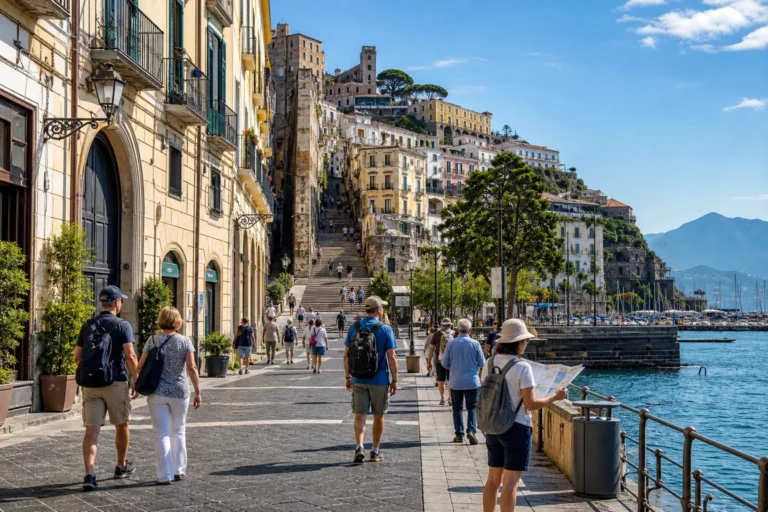
The Lungomare Trieste is Salerno’s principal seafront promenade: a long, palm‑lined waterfront avenue that connects the historic centre and port area, provides wide pedestrian walks and green spaces, and frames open views toward the Amalfi Coast.
Visitors typically use it for long walks, sunset views, seaside cafés and access to lido/beach facilities and the modern Stazione Marittima terminal; the promenade also functions as a linear public park and an urban connector between the train station, port and old town.
Practical visit implications supported by municipal sources: the lungomare is principally an open public space with informal amenities (benches, cafés, beach accesses) rather than an admission attraction; sections are shared with vehicular carriageways in places and local events, maintenance works or temporary closures for festivals can change access patterns.
Confirm any planned events, temporary works or restricted-access sections with the city’s official visitor or municipal notices if those possibilities would affect your plans.
Laman rasmi Lungomare Trieste (Salerno seafront promenade) →
Historic Centre & Scuola Medica Salernitana (historic medical school sites)
The Historic Centre of Salerno is a dense, walkable matrix of medieval streets, churches, monasteries and small civic spaces that preserve the dispersed sites of the medieval Schola Medica Salernitana rather than a single campus.
Visitor value: the ensemble explains why Salerno was a European centre for medical learning from the early Middle Ages — you can follow a short interpretive route that links the Cathedral complex (site of ceremonies and relic‑associated graduation rites), the medieval churches and cloisters that functioned as teaching and clinical spaces, the small Museo Virtuale della Scuola Medica Salernitana (hosted in the Church of San Gregorio) and the Giardino della Minerva (the hortus of Matteo Silvatico).
What visitors experience is a layered combination of preserved architecture, street‑level interpretation, museum‑style multimedia reconstructions and outdoor material culture that together tell the story of medieval medical practice and teaching.
Practical visit implications: the sites are managed by different authorities (municipal, diocesan and provincial) and therefore access conditions vary — some elements (church interiors, crypts, the virtual museum) are indoor, ticketed or scheduled, while many important traces are visible only on the streets and in courtyards.
Group visits and guided tours are commonly organised and some museum or chapel spaces may require advance booking; liturgical services, conservation work or temporary exhibitions can restrict access to specific rooms. Mobility considerations are important (steep streets, steps and limited level access in parts of the historic centre).
Because management and scheduling are fragmented, confirm current opening status, booking rules, combined‑ticket options and any prolonged closures or off‑site programming on the official municipal and individual‑site channels before planning indoor visits.
Laman rasmi Historic Centre & Scuola Medica Salernitana (historic medical school sites) →
Pinacoteca Provinciale di Salerno (Provincial Art Gallery)
The Pinacoteca Provinciale di Salerno is the principal provincial picture gallery with a regional collection rooted in local donations and curated holdings that illustrate Salerno‑area artistic activity alongside selected national works.
Visitor value: housed in a historic palazzo in the old town, the gallery presents paintings and altarpieces that contextualise the city’s artistic development and link to nearby religious and civic monuments — it is a useful complement to walking the historic centre for visitors interested in local schools, devotional art and the material culture of the province.
Practical visit implications: the Pinacoteca is administered through provincial cultural services and operates as a museum space with regulated visitor access; it is subject to scheduled exhibitions, conservation interventions and occasional temporary closures or restricted‑access periods (for loans or events).
Because these operational details change, verify current visitor rules (ticketing, temporary closures, group‑visit procedures and whether particular rooms are closed for rotation or conservation) with the Pinacoteca’s official provincial pages or the Province of Salerno cultural office before planning an indoor visit.
Laman rasmi Pinacoteca Provinciale di Salerno (Provincial Art Gallery) →
Museo Diocesano / Museo Diocesano San Matteo
Identity and visitor value: The Museo Diocesano “San Matteo” is Salerno’s diocesan museum housed in the former archiepiscopal seminary immediately adjacent to the Duomo; it preserves one of the city’s richest ecclesiastical collections (medieval ivories and reliquaries, altarpieces and tempera panels, liturgical textiles, a large medagliere of coins and archival material) and interprets the religious and artistic history tied to the cathedral complex.
What visitors experience: a compact, museum‑style route of galleries that complements a visit to the Duomo (including a lapidary and liturgical‑art displays) and provides context for Salerno’s medieval and early‑modern devotional culture.
Practical visit implications and access notes: the museum is an institutional site managed in coordination with the diocese and municipal cultural services and is normally open to the public as a ticketed indoor museum; because it sits next to an active cathedral some rooms and displays can be affected by liturgical uses, temporary conservation work or special religious events, and combined tickets or passes that include the Duomo are commonly offered.
There is no widely published indication of a prolonged closure or permanent relocation, but visitors should verify current opening status, booking or guided‑visit rules, and any temporary closures on the museum’s official visitor channels before planning an indoor visit.
Mobility and onsite details: galleries are within a historic building footprint and may include steps or limited level access in places; check official accessibility information if mobility constraints are a concern.
Teatro Municipale Giuseppe Verdi / city cultural venues
The Teatro Municipale “Giuseppe Verdi” is Salerno’s principal municipal theatre — a 19th‑century theatre long used for opera, ballet, prosa and civic cultural programming and managed by municipal cultural services.
What visitors experience: a historic auditorium and seasonal programme of opera, ballet, concerts and theatrical productions (the theatre is a focal point for the city’s annual seasons and special events, often coordinated with larger city festivals).
Practical visit implications and access notes: the theatre performs scheduled, ticketed events and also makes spaces available for third‑party productions under a permit/concession regime; public access to the interior is therefore event‑driven (you can attend performances by buying tickets or sometimes join organised guided visits), and parts of the building may be closed to visitors during rehearsals, technical set‑up or private hires.
There is no current official indication that the theatre has moved or is under prolonged closure, and recent municipal programme information shows active seasons being planned; nevertheless confirm performance schedules, ticketing, visitor‑access rules and any temporary closures or venue use limitations on the theatre’s official municipal/cultural pages before making indoor‑visit plans.
Laman rasmi Teatro Municipale Giuseppe Verdi / city cultural venues →
Bila Masa Terbaik Melawat Salerno
Akhir musim bunga (Mei–Jun) dan awal musim luruh (September–awal Oktober) memberikan keseimbangan terbaik antara cuaca yang hangat dan kurang pengunjung. Angin laut membuatkan promenade dan kafe luar selesa.
Tempoh ini mengelakkan kepanasan dan kesesakan puncak pada pertengahan Julai–Ogos. Musim sejuk ringan dan lebih tenang, tetapi beberapa perkhidmatan bermusim dan tarikan kecil mungkin mempunyai waktu operasi terhad.
Cara Bergerak di Salerno
Pusat bersejarah padat dan boleh diterokai dengan berjalan kaki tetapi berbukit, jadi bersedia untuk tangga dan pendakian pendek. Bas tempatan menghubungkan kawasan kejiranan dan bukit ke Castello Arechi.
Salerno Centrale ialah hab keretapi serantau dengan sambungan berkelajuan tinggi ke Naples dan Roma. Feri bermusim dan hydrofoil beroperasi dari pelabuhan ke Amalfi dan Capri; teksi dan sewa kereta turut disediakan.
Lokasi
Peta Salerno, Italy
Peta interaktif hanya dimuatkan apabila anda memilih untuk melihatnya.
Rancang Lawatan Anda ke Salerno
Semak waktu buka dan peraturan tempahan untuk Giardino della Minerva, Castello Arechi dan Museo Diocesano sebelum berangkat. Salerno mengenakan cukai pelancong bandar—sahkan kaedah pembayaran dengan tempat penginapan anda.
Bandingkan feri bermusim dengan bas serantau untuk lawatan pantai; hotel di pusat berhampiran pelabuhan atau stesen memudahkan pindahan bagasi.
Petua Tempatan untuk Salerno
Terokai dengan berjalan kaki dan pakai kasut yang selesa untuk lorong curam dan teres taman. Rancang berjalan di Lungomare Trieste awal pagi atau waktu matahari terbenam untuk mengelak panas musim panas dan nikmati makanan laut di tepi laut.
Gunakan Salerno Centrale sebagai hab keretapi untuk lawatan sehari. Cuba kafe di sekitar katedral dan kunjungi pasar mingguan untuk hasil segar.
Bawa botol air boleh guna semula—air pancuran dan tempat isi semula biasa ditemui.
Keadaan semasa
Cuaca semasa

Dikemas kini 2026-09-22 04:15
- Terasa seperti
- 21°C / 69°F
- Tertinggi / terendah hari ini
- 26°C / 79°F · 19°C / 65°F
- Kelembapan
- 69%
- Angin
- ↗ 8 km/h
- Kerpasan
- 0.1 mm
- Kemungkinan hujan
- 36%
- Waktu tempatan
- 2026-09-22 04:16
Keselamatan di Salerno
Secara amnya Salerno selamat tetapi gunakan langkah berjaga‑jaga bandar biasa. Kawasan pelancong dan hab pengangkutan boleh menarik pencopet—guna beg berkunci atau money belt.
Sesetengah pantai pesisir terbuka mempunyai arus kuat; patuhi bendera penyelamat dan notis. Tapak bersejarah duduk di kawasan berbukit dengan akses terhad—sahkan butiran capaian jika anda mempunyai keperluan mobiliti.
Untuk kecemasan hubungi 112 dan rujuk laman rasmi perbandaran untuk notis penutupan.