
Travel Guide
Plan your visit around Belfry of Bruges, Market Square, and more of Bruges, Belgium.
Things to do in Bruges focus on a compact, well-preserved medieval centre where Market Square and the Belfry form the visual and civic heart.
Centuries-old canals, narrow cobbled lanes and intact guildhouses create a strong sense of continuity, while concentrated museums and canal-boat tours make the city unusually walkable for experiencing Flemish art, religious heritage and everyday urban life.
Many highlights sit within a short walking radius, so allow at least a full day and ideally two to visit museums, take a canal boat tour and stroll quieter corners like the Begijnhof and Minnewater Park.

Why Visit Bruges
Visitors come for Bruges’ unusually coherent medieval urban fabric and a handful of concentrated cultural highlights. The Belfry and Market Square provide the emblematic skyline.
The Basilica of the Holy Blood offers layered religious and civic history. And the Groeningemuseum anchors a world-class collection of Early Netherlandish painting.
Historium and canal boat tours translate the city’s medieval trade and waterways into accessible experiences, while Begijnhof and Minnewater Park reward those seeking tranquil green space amid dense historic streets.
Top Things to Do in Bruges, Belgium
Below are the core experiences that orient visitors to Bruges’ medieval centre: civic landmarks, compact museums, waterside views and peaceful historic quarters.
Belfry of Bruges (Belfort)
The Belfry of Bruges is the city’s medieval civic tower and a symbol of municipal independence. Built from the 13th century, it once housed charters, a treasury and the city’s administrative archives and now forms part of Bruges’ UNESCO-recognised group of civic towers.
Visitors who enter climb 366 steps through narrow staircases to a viewing platform about 83 metres above street level. The ascent rewards visitors with panoramic views across canals, gabled roofs and West Flanders.
The belfry also contains an important mechanical carillon; carillon concerts still sound across Market Square and underline the tower’s continuing civic role. Check the official site for current access and visitor arrangements.
Market Square (Grote Markt)
Market Square (Grote Markt) is Bruges’ social and historic heart: a broad, cobbled plaza framed by stepped gables, cafés and the imposing Belfry. Historically the city’s main trading and ceremonial stage, the square’s façades recall Burgundian-era wealth and the public functions of a Hanseatic port city.
The eastern side is dominated by the Provinciaal Hof, a 19th-century neo‑Gothic complex that now hosts representative functions and events. The Markt is a practical starting point for walking tours toward the Burg and canal quays and is frequently used for seasonal markets and civic processions.
For detailed event schedules, consult official tourism sources before you go.
Basilica of the Holy Blood (Heilig-Bloedbasiliek)
The Basilica of the Holy Blood sits on the Burg and comprises two stacked chapels: a Romanesque lower chapel and a more ornate upper chapel. The building’s layered architecture shows nearly a millennium of local devotion and civic importance, and the upper chapel’s painted murals, carved woodwork and stained glass reward close looking.
The basilica houses a revered relic kept in the church treasury and displayed in special contexts tied to Bruges’ religious traditions, including an annual procession. Interiors are compact and can feel crowded at peak times; visitors should allow time for quiet viewing and respect liturgical activity and any photography restrictions.
Official Basilica of the Holy Blood (Heilig-Bloedbasiliek) website →
Groeningemuseum
Groeningemuseum presents a concentrated survey of Belgian visual art across six centuries, anchored by a world-class collection of early Netherlandish painting. Works by Jan van Eyck, Hans Memling, Gerard David and Hugo van der Goes illustrate Bruges’ pivotal artistic role in the late medieval period.
The museum is arranged for comparative viewing of stylistic developments and pairs major panels with smaller devotional works so visitors can study technique and symbolic detail. The collection continues through Renaissance, Baroque, nineteenth-century and modern Belgian art.
Check Musea Brugge pages for temporary exhibitions and practical visitor information.
Historium Bruges
Historium Bruges is an immersive, narrative attraction on the Markt that uses film, themed sets and interpretation to tell the story of a young apprentice in fifteenth-century Bruges. The experience combines seven themed rooms with cinematic sequences, followed by exhibition material explaining the city’s mercantile life and layout.
Historium offers an optional Virtual Reality flight that recreates medieval cityscapes and a panoramic terrace that links the reconstructed past to the present skyline. The visitor route is fixed and works best taken in order; families can use a child-friendly trail and multi-language audio guides.
Check visitor information for accessibility and group arrangements.
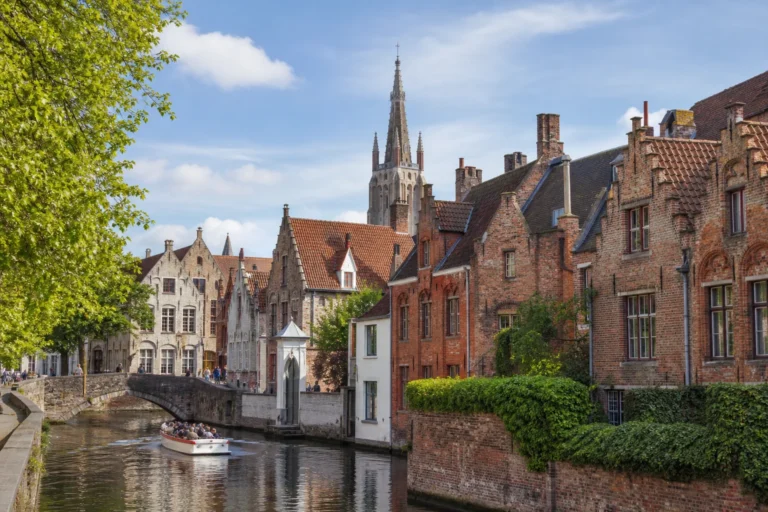
Canal boat tour on Bruges' canals
A canal boat tour provides a waterside view of Bruges on a licensed, fixed thirty-minute circuit between Jan van Eyckplein and the Begijnhof. The route passes Rozenhoedkaai, Groenerei and the Gruuthuse quarter, with guides pointing out architectural details and local stories from the water.
The city has five official jetties (typical boarding points include Rozenhoedkaai, Dijver and Huidenvettersplein). Boats run a continuous loop and cannot be hopped off midroute; most require steps to board and are not wheelchair-accessible.
Arrive early to avoid queues and verify scheduling and accessibility with official boat pages or the operator.
Begijnhof (Old St. Elisabeth Beguinage)
The Begijnhof (Princely Beguinage ‘Ten Wijngaarde’) is an enclosed historical quarter recognised as one of the Flemish beguinages on the UNESCO World Heritage List.
The complex groups a small monastery, a church, 37 traditionally arranged houses and ancillary buildings around a broad inner garden, approached through an 18th-century gate surmounted by an image of Saint Elisabeth.
Tall poplars and linden trees shape the garden’s quietly enclosed atmosphere, contrasting with busy streets outside. The Begijnhof remains partly residential and is managed to balance privacy with visitor access; gates close overnight.
Visitors should respect the site’s contemplative tone and check municipal or Visit Bruges pages for any closures.
Minnewater Park (Lake of Love)
Minnewater Park, known as the Lake of Love, is a small urban park at the south-west edge of Bruges’ historic centre. Its rectangular lake, a low arched ‘Lovers’ Bridge’ and surrounding lawns create a highly photographed scene; local tradition and romantic stories have contributed to the site’s enduring popularity for couples and photographers.
The park adjoins the medieval ramparts and lies next to the Begijnhof, so a brief walk links two distinct historic atmospheres. Visitors typically stroll lakeside paths, pause on benches and photograph swans and reflections at dawn or dusk.
The site is compact and usually visited briefly; check official pages for any maintenance or event-related closures.
Best Time to Visit Bruges
Bruges is rewarding year-round, but it’s easiest to enjoy outside the peak summer crowds. Spring and early autumn offer milder weather and better light for walking and photography without the height of visitor volumes.
Winter provides an atmospheric, quieter cityscape suitable for short cultural breaks, though some outdoor services run less frequently. Because many highlights lie close together, short stays can be satisfying.
Aim for at least a full day and ideally two to experience museums, a boat tour and quieter parks.
Getting Around Bruges
The historic core is compact and best explored on foot; major sights (Belfry, Markt, Basilica of the Holy Blood, Groeningemuseum, Historium, Begijnhof, Minnewater) are within a short walking radius. Canal boat tours add a waterside perspective.
For trips beyond the centre, regional trains and buses serve Brugge station; local buses connect the station with the Markt. Cycling is common but narrow cobbles and crowded streets require caution.
Limited parking and pedestrian-priority streets mean driving in the centre is often unnecessary.

Location
Map of Bruges, Belgium
The interactive map loads only when you choose to view it.
Plan Your Visit to Bruges
Bruges’ medieval centre attracts many visitors, so plan to arrive early or late afternoon to avoid peak crowds around the Markt and Belfry. A single-day walking loop can cover the main sites with intermittent canal-boat stops.
Trains from major Belgian cities arrive at Brugge station with frequent direct services; local buses run between the station and central Markt. Buy tickets for museums or timed attractions in advance and consult official accessibility pages if you have mobility needs.
Local Tips for Bruges
Use the Visit Bruges tourist office at the Historium/Markt for maps, combined museum tickets and walking-route guidance. Canal-boat departures concentrate near the Markt and Reien; boats are useful for a concise orientation but reserve during high season.
Begijnhof and Minnewater are quieter early morning or late afternoon. If you plan multiple museums, check whether a Musea Brugge pass is worthwhile.
Carry a compact umbrella and comfortable shoes: cobbles and narrow alleys make walking the most practical transport.
Live conditions
Current Weather

Updated 2026-09-21 23:00
- Feels like
- 12°C / 54°F
- Today’s high / low
- 19°C / 65°F · 12°C / 54°F
- Humidity
- 71%
- Wind
- ↑ 4 km/h
- Precipitation
- 0 mm
- Chance of rain
- 10%
- Local time
- 2026-09-21 23:09
Safety in Bruges
Bruges is generally low-crime for tourists, but pickpocketing and opportunistic theft occur in crowded spots such as the Markt, boat queues and the train station. Keep valuables secure in zipped bags or a money belt and stay aware in busy areas.
Follow local signage and police instructions in restricted vehicle zones; large coaches are prohibited from parking in the historic centre. If you need assistance after a theft or an emergency, contact the local police station or ask the tourist office at the Markt for guidance.