
Travel Guide
Plan your visit around Marienplatz and Neues Rathaus, Englischer Garten, and more of Munich, Germany.
Discover the best things to do in Munich, Germany, from signature sights to memorable local experiences.
Munich (München) is Bavaria’s capital and Germany’s third-largest city, anchored by a compact historic core and ringed by broad avenues, parks and cultural institutions. Its cityscape combines late 19th‑century Neo‑Gothic landmarks, Baroque and Rococo palaces, major museums of science and art, and expansive green spaces along the Isar.
The approved attractions. Marienplatz with the Neues Rathaus, the Englischer Garten, Nymphenburg Palace, Deutsches Museum, the Residenz, Viktualienmarkt, Olympiapark, BMW Museum/BMW Welt and Theresienwiese.
Concentrate visitor activity while also pointing to nearby neighborhoods offering local food, Bavarian traditions and modern architecture.
Why Visit Munich
Munich blends civic history, royal palaces, and world‑class museums with accessible outdoor life. The medieval and 19th‑century core around Marienplatz and the Residenz showcases Bavarian civic and dynastic history, while institutions like the Deutsches Museum and BMW Museum illustrate science, technology and design.
Large parks. Notably the Englischer Garten and Nymphenburg’s landscaped grounds.
Plus Viktualienmarkt’s year‑round food stalls and the event traditions of Olympiapark and Theresienwiese give the city a lively, local character.
Top Things to Do in Munich, Germany
These highlights cluster in the walkable centre and near transit links. They include historic squares, palace parks, flagship museums and large event grounds that define Munich’s public life.
Marienplatz and Neues Rathaus (New Town Hall)
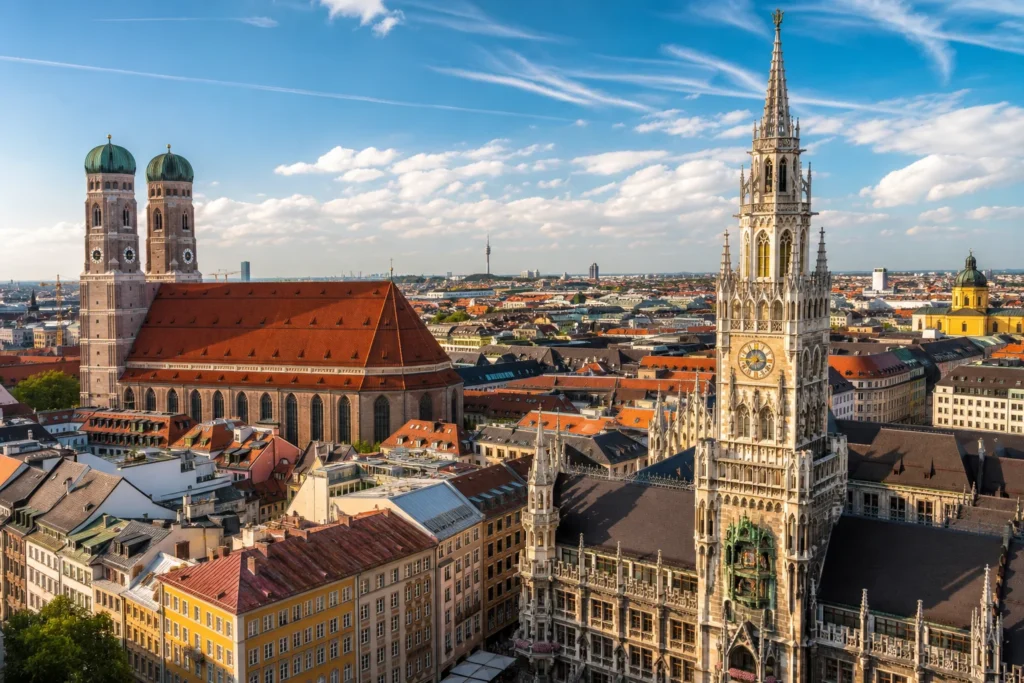
Marienplatz forms Munich’s historic heart and functions as the city’s main public square, lying between the Altes Rathaus and the ornate Neues Rathaus. The Neues Rathaus, built in the late 19th century, presents an ornate Neo‑Gothic façade with sculpted figures and the bronze Münchner Kindl crowning the tower.
The Glockenspiel in the Rathaus tower mechanically re‑enacts two episodes from Munich’s past and draws regular crowds; the tower also contains a visitor viewpoint offering broad panoramas of the old town. Street‑level life here mixes tram stops, markets and pedestrian streets, and visitor services and guided tours explain the building’s civic history and decorative programs.
Official Marienplatz and Neues Rathaus (New Town Hall) website →
Englischer Garten (English Garden)
The Englischer Garten is Munich’s largest and most varied urban park, stretching from the university area to the northern districts. Laid out from the late 18th century, the park combines formal structures and informal lawns with water features like the Eisbach and the Kleinhesseloher See.
Visitors encounter lively southern sites — the Chinese Tower beer garden and the Eisbach standing wave — and quieter northern meadows. Paths, streams and varied planting support recreation for cyclists, joggers, picnickers and river surfers; use the Monopteros or Chinese Tower as orientation points when planning a visit.
Schloss Nymphenburg (Nymphenburg Palace and Park)
Nymphenburg Palace began as a small summer residence in 1663 and expanded into a Baroque palace complex with formal gardens, canals and decorative pavilions. Architects and garden designers across the 17th–19th centuries shaped axial parterres, a long canal system and later English‑style landscape interventions by Friedrich Ludwig von Sckell.
The site includes lavish palace state rooms and pavilion palaces such as Amalienburg, Badenburg and Pagodenburg. Visitors should allow time to walk between water basins, bridges and historic trees and check the Bavarian palace administration for seasonal closures or restoration work.
Official Schloss Nymphenburg (Nymphenburg Palace and Park) website →
Deutsches Museum (Science and Technology Museum)
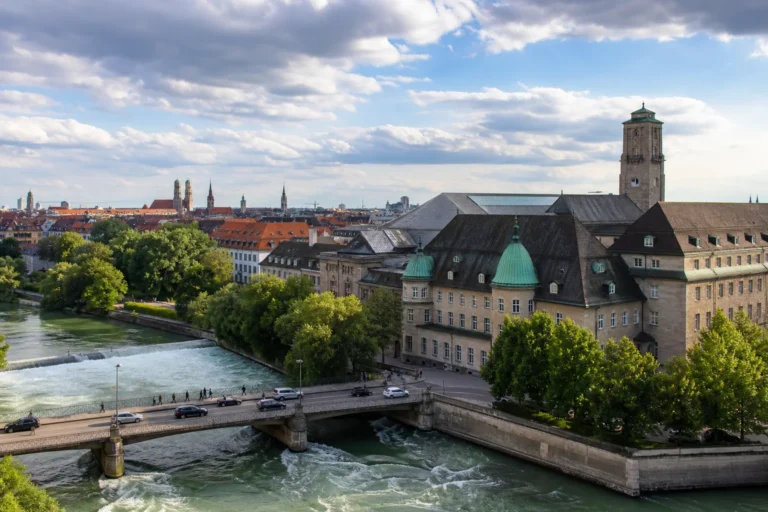
The Deutsches Museum, founded in 1903, grew into one of the world’s largest science and technology museums. The main site sits on an island in the Isar river and groups large halls that display historic machines, aircraft and demonstrable steam engines across themed collections.
Halls are organized by subject — transport, energy, communications and more — allowing visitors to focus on interests such as early computers or monumental industrial equipment. The museum runs branch sites for specialised topics, publishes guides and recommends booking tickets online to reduce queuing at busy times.
Official Deutsches Museum (Science and Technology Museum) website →
Residenz München (Munich Residenz)
The Residenz München served for centuries as the principal palace and administrative centre of the Wittelsbach rulers. The accretive complex includes a medieval fortress core expanded through Renaissance, Baroque and Neoclassical wings into a sequence of courtyards, ceremonial apartments and richly decorated state rooms.
Highlights include the Renaissance Antiquarium, the Baroque and Rococo ceremonial halls and the intimate Cuvilliés Theatre. The Residenz’s museum holdings and treasury illuminate princely collecting and court ritual; many rooms retain original fittings or carefully restored surfaces, and guided tours and audio guides provide context for visitors.
Viktualienmarkt (central food market)
Viktualienmarkt is Munich’s central open‑air food market and a longstanding civic hub. Established in its current location in the early 19th century, the compact pedestrian square trades regional cheeses, meats, seasonal fruit and specialty foods, and includes a central beer garden with a decorative maypole.
The market functions as both everyday shopping and a visitor destination; vendor schedules and seasonal offerings vary, so arriving in the morning gives the freshest selection and a chance to watch traders set up. Practical rules such as pedestrian‑only access apply in the market area.
Olympiapark (Olympic Park)
Olympiapark was created for the 1972 Olympic Games as a multi‑use landscape combining engineered architecture, sculpted topography and open greenery. The translucent tensile roof of the Olympiastadion is the park’s architectural signature; nearby structures include the Olympic Tower, Olympiahalle and other venues that host sports and concerts.
The park’s lake, broad lawns and the Olympiaberg hill provide relaxed walks and skyline views. Since 1972 the site has been adaptively reused for festivals, concerts and everyday recreation; guided tours and event programming are offered by the park operator.
BMW Museum and BMW Welt
BMW Museum and BMW Welt form a compact cluster at the northern edge of Olympiapark that interprets the company’s design and mobility history. The museum preserves historic vehicles, prototypes and themed exhibitions; BMW Welt operates as a public showroom, event space and vehicle delivery centre with free entry to its exhibition areas.
The museum’s bowl‑like original design and BMW Welt’s folded‑roof architecture create a visible architectural ensemble beside the four‑cylinder BMW tower. Guided tours, workshops and special experiences are offered at both sites, while some plant tours require separate advance booking.
Theresienwiese (Oktoberfest grounds)
Theresienwiese is Munich’s large fairground and the traditional site of Oktoberfest, a multifunctional open space in Ludwigsvorstadt‑Isarvorstadt. The meadow, roughly thirty‑five to forty‑two hectares depending on measurement, hosts dozens of tents and fair streets during the main festival and includes the historic Oide Wiesn subsection.
Outside Oktoberfest, the grounds stage seasonal festivals such as the spring folk festival and the winter Tollwood event. The easiest access is the U‑bahn to Theresienwiese station (U4/U5); layouts and services change with each event, so consult official festival or city sources before visiting.
Best Time to Visit Munich
Munich is worth visiting year‑round. Late spring through early autumn (May–September) offers long daylight, beer‑garden life and outdoor events.
Autumn draws many for Oktoberfest and harvest‑season food culture; winter is compact and atmospheric with Christmas markets. For fewer crowds and lower costs, choose shoulder seasons (April–May, late September–October).
Check festival dates and museum schedules before you go.
SPECIAL EVENTS IN Munich
Oktoberfest (Wiesn)
Oktoberfest, locally called the Wiesn, is Munich’s internationally renowned folk festival held on the Theresienwiese. Visitors attend for large brewery tents, traditional music, Bavarian cuisine, fairground rides and cultural parades. The celebration draws millions and requires planning—reservations, public transit routing and early bookings are often necessary. It highlights Bavarian customs with family-friendly programming alongside late-night festivities, making it a major seasonal draw for cultural tourists and beer enthusiasts seeking an authentic local experience.
- Dates
- September 19, 2026 - October 4, 2026
- Venue
- Theresienwiese
MARATHON MÜNCHEN by Brooks
MARATHON MÜNCHEN by Brooks is Munich’s principal city marathon, offering a largely urban one-lap course that threads notable neighborhoods and landmarks. The weekend includes multiple distances (marathon, half marathon, 10K, relays and a children’s run) plus a Runners Festival, making it appealing for both participants and spectators. Travelers will find a lively city atmosphere, easy public-transit access, and ample spectator zones and festival programming — useful for planning accommodation, transport, and sideline sightseeing during a busy race weekend.
- Dates
- October 11, 2026
- Venue
- Olympiapark (Hans-Jochen-Vogel-Platz / Olympic Hall vicinity)
Auer Dult
Auer Dult is Munich’s traditional triannual market and fair held on Mariahilfplatz in the Au district. Comprised of three distinct markets — Maidult, Jakobidult and Kirchweihdult — it blends open-air shopping, regional food, antiques, and small fairground rides. Travelers enjoy local crafts, bargain hunting, and a lively neighborhood atmosphere away from larger tourist masses. It’s family-friendly, easily reachable by public transit, and often paired with exploring the Au district’s cafés, historic streets, and nearby cultural sites.
- Dates
- October 17, 2026 - October 25, 2026
- Venue
- Mariahilfplatz
Münchner Christkindlmarkt (Marienplatz)
The Münchner Christkindlmarkt at Marienplatz is Munich’s principal, municipal-run Christmas market and a major Advent attraction for travelers. Visitors come for traditional Bavarian crafts, regional foods, seasonal drinks, and the nearby Kripperlmarkt (nativity market). The market is organized by the City of Munich’s Referat für Arbeit und Wirtschaft and draws locals and international visitors to the historic city center. It’s an important cultural experience for travelers seeking festive atmosphere, handcrafted gifts, and a compact stroll through Munich’s old town during the holiday season.
- Dates
- November 20, 2026 - December 24, 2026
- Venue
- Marienplatz; Rindermarkt
Munich Security Conference (MSC)
The Munich Security Conference (MSC) is a major annual gathering of heads of state, ministers, military leaders, and security experts that shapes high-level international defense and foreign-policy discussions. Travelers may care because the conference concentrates diplomatic activity, high-profile side events, and related business programming across the city—creating opportunities for networking, public briefings, and themed forums—as well as causing increased demand for hotels, transport, and heightened local security measures during the event period.
- Dates
- February 12, 2027 - February 14, 2027
- Venue
- Hotel Bayerischer Hof; Rosewood Munich
Tollwood Sommerfestival (Tollwood Summer Festival)
The Tollwood Summer Festival is Munich’s major open-air cultural fair blending international concerts, theatre, street performance and the long-running ‘Markt der Ideen’ craft and organic food market. Held on the southern grounds of the Olympiapark, the festival emphasizes sustainability, bio-gastronomy and family-friendly programming alongside headline concerts in the Musik-Arena. Travelers value Tollwood for its lively atmosphere, diverse live music, local artisan shopping and easy transit access, making it a compact cultural highlight in Munich’s summer event calendar.
- Dates
- June 18, 2027 - July 18, 2027
- Venue
- Olympiapark Süd (Musik-Arena and festival grounds)
Getting Around Munich
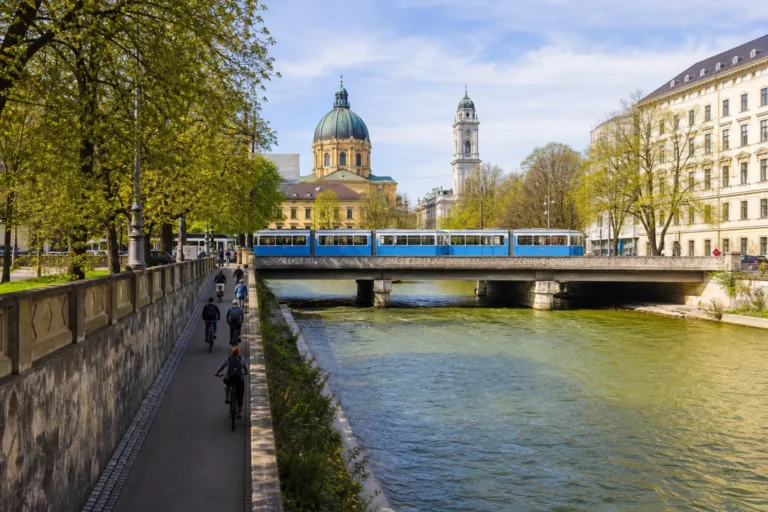
Munich’s MVV network (U‑Bahn, S‑Bahn, trams and buses) provides frequent, integrated service across the city and region, including links to the airport. The centre is highly walkable and many sights cluster for easy on‑foot exploration.
Bicycles and shared micromobility are common for short trips, and regional trains from Hauptbahnhof or S‑Bahn lines serve day trips to lakes and castles. Use MVV maps or the official MVV app for timetables and ticketing.
Location
Map of Munich, Bavaria, Germany
The interactive map loads only when you choose to view it.
Plan Your Visit to Munich
Most central attractions (Marienplatz, Viktualienmarkt, Residenz, Deutsches Museum) are walkable from each other; plan longer trips (Nymphenburg, Olympiapark, BMW Welt) by S‑Bahn/U‑Bahn or tram. Buy single tickets, day passes or consider the Munich City Pass for transit and attraction bundles.
Summer brings heavy park and beer‑garden use; winter has shorter daylight—pack layers. Many museums and palaces recommend timed entry or advance booking, so verify current visitor information before you go.
Local Tips for Munich
Start early at popular sites (Neues Rathaus tower, Deutsches Museum) to avoid queues. Visit Viktualienmarkt mid‑morning for fresher produce and smaller crowds; choose different areas of the Englischer Garten (Chinese Tower for beer‑garden atmosphere, Monopteros for viewpoints).
Use MVV journey planners for real‑time connections and validate platform transfers. Tap water is safe—bring a reusable bottle.
If you plan to sit in a beer garden, follow local etiquette (order food or a Maß and keep table space tidy). Tourist information at Marienplatz provides maps and visitor cards.
Live conditions
Current Weather

Updated 2026-09-20 21:15
- Feels like
- 15°C / 60°F
- Today’s high / low
- 21°C / 70°F · 13°C / 56°F
- Humidity
- 52%
- Wind
- ← 12 km/h
- Precipitation
- 0 mm
- Chance of rain
- 14%
- Local time
- 2026-09-20 21:25
Safety
Munich is generally safe with low violent‑crime rates, but petty theft such as pickpocketing is the main concern in crowded tourist areas, public transport and large events. Keep valuables secure, use front‑worn bags, and stay alert on platforms and at festival exits.
The Isar river has strong currents—avoid swimming alone or after drinking. For emergencies dial 112; for police in Germany dial 110.