
Travel Guide
Plan your visit around Dubrovnik City Walls, Dubrovnik Old Town, and more of Dubrovnik, Croatia.
The best things to do in Dubrovnik combine a UNESCO-listed Old Town, exceptionally preserved medieval fortifications, Mediterranean landscapes and a deep maritime heritage. Walk along the City Walls, follow Stradun through the limestone centre, visit palaces and museums, then take a short boat trip to Lokrum Island for wooded paths and rocky swimming areas.
Why Visit Dubrovnik
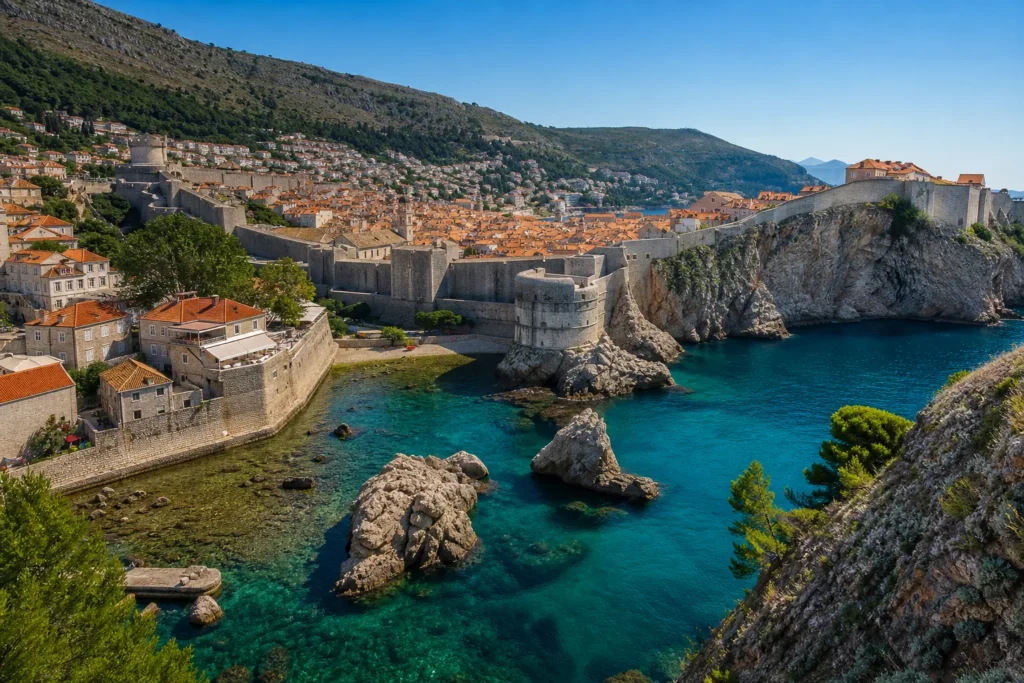
Dubrovnik brings a remarkably preserved walled city and dramatic Adriatic scenery together in a compact, walkable setting. A circuit of the City Walls reveals towers, fortresses, terracotta rooftops, the harbour, surrounding hills and open sea, while the Old Town gathers churches, monasteries, palaces, squares and museums within its limestone streets.
Stradun is an easy starting point for exploring this historic core. Beyond the walls, Fort Lovrijenac offers a striking cliffside perspective, and Lokrum Island provides a contrasting natural escape close to the shore.
Dubrovnik is particularly rewarding for travellers interested in history, architecture, culture, scenic walks, coastal excursions and slower exploration.
Top Things to Do in Dubrovnik, Croatia
Start with the City Walls and Old Town, then follow the city’s history through Stradun, its palaces, churches and museums. When you want a change of pace, climb to Fort Lovrijenac or take a boat to Lokrum Island.
Dubrovnik City Walls
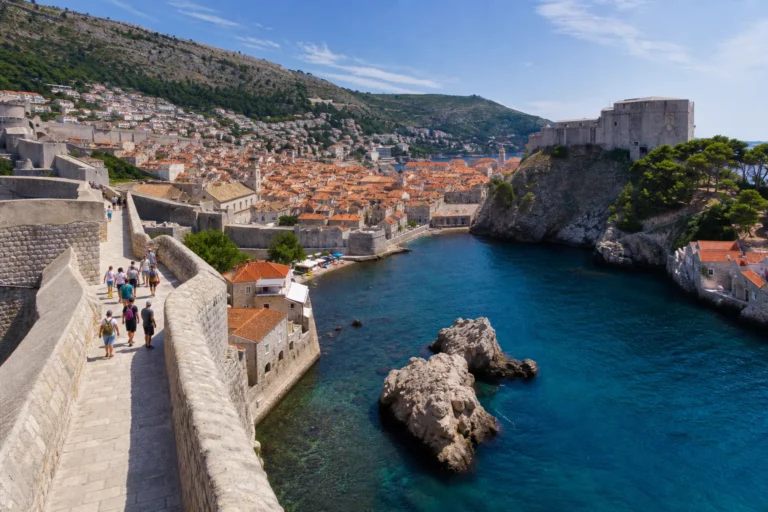
Dubrovnik’s City Walls form one of Europe’s best-preserved medieval fortification systems. The circuit extends for approximately 1,940 metres around the historic core, with towers, bastions, fortresses, parapets and sea-facing defences.
A complete walk provides changing views of terracotta roofs, the Adriatic, nearby islands, Mount Srđ and the old harbour. Minčeta Fortress protected the northern approach, Bokar guarded the western corner and Pile approach, and St John’s Fortress defended the southeastern harbour entrance.
Expect exposed stone, stairs and limited shade, so comfortable footwear and water are useful. Check the official walls authority for current access arrangements and visitor requirements.
Dubrovnik Old Town
Dubrovnik Old Town is a remarkably preserved historic city on the southern Dalmatian coast. Its compact streets, squares, churches, monasteries, palaces, fountains and harbour create a dense architectural ensemble beside the Adriatic.
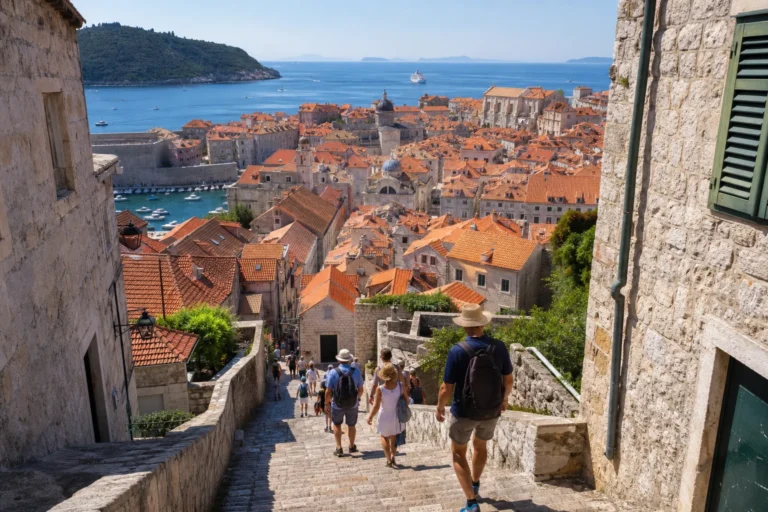
Stradun runs between the western and eastern gates, while side streets climb towards the northern walls and lead to markets, courtyards and quieter residential corners. Walking is essential because the core is a pedestrian zone, with polished stone and steep steps in many streets.
Notable landmarks include Rector’s Palace, Sponza Palace, the Cathedral, the Franciscan and Dominican monasteries, Orlando’s Column and the Large Onofrio Fountain. Allow time to explore beyond the busiest central route.
Stradun
Stradun, also called Placa, is Dubrovnik’s principal pedestrian street and public meeting place. It crosses the Old Town between the western and eastern gates, dividing the historic core into northern and southern sections.
The street follows a former shallow sea channel that separated two settlements before they became one urban unit. Its present appearance reflects rebuilding after the earthquake of 1667, with pale limestone paving, orderly façades, regular doorways and aligned upper windows.
Important landmarks along or near the route include the Franciscan Monastery, Large Onofrio Fountain, St Blaise’s Church, Orlando’s Column, Sponza Palace and the City Bell Tower. Look into the side streets for stairways, smaller squares and quieter details.
Fort Lovrijenac
Fort Lovrijenac, or St Lawrence’s Fortress, stands on a 37-metre-high sea cliff west of Dubrovnik’s Old Town. Its position above Pile and Kolorina Bay controlled approaches from both sea and land, making it an important part of the city’s wider defences.
The fortress follows the irregular triangular shape of its rocky site, with three defensive terraces around a central courtyard. Its terraces provide views towards the Old Town, City Walls, open sea and nearby cliffs.
Lovrijenac is also an open-air venue for Dubrovnik Summer Festival performances, especially Shakespeare’s Hamlet. Expect stairs, uneven stone, exposed sunlight and strong wind, and verify current access arrangements before visiting.
Lokrum Island
Lokrum Island lies just offshore from Dubrovnik’s Old Port and offers a compact escape into protected Mediterranean nature. Marked paths pass through holm-oak woodland, olive groves, landscaped gardens and rocky coastal areas, while the botanical garden presents plants introduced from tropical and subtropical regions.
The island also preserves the Benedictine monastery of St Mary, its Renaissance cloister and the Church of the Annunciation. At the highest point, Fort Royal occupies Glavica, about 96 metres above sea level, rewarding the climb with views over Dubrovnik and the Adriatic.
Designated coastal areas include the seawater lake traditionally called the Dead Sea. Wear sturdy footwear, bring water and check official information about boat transport and access.
Rector’s Palace
Rector’s Palace was the political heart and official residence of the Dubrovnik Republic. The elected rector lived there during his one-month mandate, while the building housed government offices, council functions, a courtroom, prison spaces, an armoury and a gunpowder store.
The palace combines Gothic, Renaissance and Baroque elements. Visitors enter an atrium with arcades, a fifteenth-century fountain and the bust of Miho Pracat.
Today, the Cultural History Museum presents period rooms, state offices, reception rooms, the chapel, rector’s apartment, courtroom areas and jail spaces. Collections include furniture, paintings, textiles, documents, coins, weapons, seals, portraits and objects connected with the historic Domus Christi pharmacy.
Check official museum information for current access arrangements and exhibitions.
Franciscan Monastery and Museum
The Franciscan Monastery stands beside Stradun near Pile Gate, within Dubrovnik’s western fortifications. Its present complex began developing in 1317, and the church was rebuilt in Baroque form after the earthquake of 1667.
The lower cloister is the architectural highlight, with 120 Romanesque-Gothic columns, carved capitals and a central fountain with a statue of Saint Francis. The museum occupies a Renaissance hall reached from the cloister and documents the Friars Minor Pharmacy, founded in 1317.
Displays include pharmacy furniture, ceramic vessels, mortars, presses, scales, measuring containers, a distillation apparatus and handwritten recipes. Other holdings include manuscripts, choir books, religious objects, paintings, jewellery, vestments and rare relics.
Check official information before arrival.
Sponza Palace
Sponza Palace stands at the eastern end of Stradun and is one of Dubrovnik’s finest Gothic-Renaissance buildings. Constructed in the sixteenth century, it has a rectangular plan, elegant street façade, shaded portico and internal atrium.
The palace originally functioned as the city’s customs house, where merchants registered and weighed goods. It also contained a mint and an arsenal, linking it to Dubrovnik’s commercial and administrative life.
The building survived the earthquake of 1667 with its essential form preserved. Today it houses the State Archives in Dubrovnik, whose records document political, legal, commercial and social life over centuries.
Because it remains a working archive, public access can differ by area; verify current visiting arrangements before planning an interior visit.
Dubrovnik Cathedral
Dubrovnik Cathedral, formally dedicated to the Assumption of the Blessed Virgin Mary, stands beside Rector’s Palace and Poljana Marina Držića. Its prominent dome creates a strong Baroque focal point in the Old Town.
The present cathedral was built between 1671 and 1713 after the earlier Romanesque cathedral was destroyed by the earthquake of 1667. Inside, visitors can see valuable paintings and altarpieces, including Titian’s Assumption of the Virgin Mary.
The treasury preserves relics, liturgical objects, precious-metal work and reliquaries connected with Saint Blaise, Dubrovnik’s patron. Archaeological remains beneath the building include earlier Christian structures.
Visit the cathedral with its treasury and nearby historic buildings, dress respectfully and check official information for current access conditions.
Maritime Museum
The Maritime Museum occupies the first and second floors of Fort St John beside Dubrovnik’s Old Port. The fortress once protected the harbour entrance, so its setting connects the displays directly with the waterfront it defended.
Founded in 1949, the museum documents the maritime history of Dubrovnik and the wider region from Antiquity onward. More than eleven thousand objects are arranged across fifteen collections, including ship models, nautical charts, documents, paintings, ship equipment, instruments, flags, coins and underwater archaeological finds.
Displays of galleons and carracks, sailors’ portraits, anchors, weapons, traditional shipbuilding tools, logs and navigation records explain the city’s relationship with the Adriatic and the former Republic. Expect stairs and verify current access arrangements before visiting.
Best Time to Visit Dubrovnik
Late spring and early autumn are generally the most comfortable periods for walking, sightseeing and boat outings, with the historic centre typically less pressured than during peak summer.
Summer offers the fullest choice of coastal activities and a lively cultural atmosphere, but the Old Town, City Walls and narrow streets can feel crowded, especially around the middle of the day.
Winter is quieter and can suit visitors who prioritise architecture, museums, local life and atmospheric walks, although some seasonal visitor services may be reduced. For a balanced visit, plan outdoor sightseeing for mornings or later afternoons, and use indoor museums and churches during the hottest or busiest periods.
Getting Around Dubrovnik
Dubrovnik’s Old Town is a pedestrian zone, so walking is the most practical way to experience its streets, squares, churches, palaces, museums and City Walls. Enter through Pile or Ploče Gates, and expect steep steps and uneven stone surfaces in older lanes.
Local bus services connect the Old Town with neighbourhoods such as Gruž and Lapad and with other parts of the city. Boats from the Old City Harbour provide access to Lokrum Island, while Gruž is an important port for wider coastal and island connections.
Parking near the historic centre is limited; a peripheral car park followed by a walk is generally more convenient than driving into the core.
Location
Map of Dubrovnik, Croatia
The interactive map loads only when you choose to view it.
Plan Your Visit to Dubrovnik
The historic centre is compact and best explored on foot, while the surrounding districts, airport, port and beaches require transport. Libertas operates frequent local bus routes connecting the city’s main areas.
Tickets are available through designated sales points, newspaper kiosks and, where offered, from drivers; carry small change when buying onboard.
Dubrovnik Airport is near Čilipi, outside the city, so plan a bus, taxi or pre-arranged transfer. The county has regular intercity buses and seasonal ferry or catamaran connections to nearby islands and coastal destinations.
In summer, reserve longer-distance bus and boat journeys ahead, especially for popular island routes.
Local Tips for Dubrovnik
Use the Old Town as a walking base, allowing extra time for steep approaches, stairs and polished stone surfaces. Stradun and the main gates can become congested, particularly when cruise visitors arrive, so early mornings or later afternoons are usually more comfortable.
Public buses are practical for reaching areas beyond the centre, while Gruž is the main transport hub for many regional connections. For Lokrum and other coastal or island trips, check the relevant operator before departure because schedules can vary by season and sea conditions.
Keep valuables secure in crowded streets, and avoid blocking narrow passageways when stopping for photographs.
Live conditions
Current Weather

Updated 2026-11-04 21:30
- Feels like
- 7°C / 44°F
- Today’s high / low
- 17°C / 62°F · 6°C / 43°F
- Humidity
- 70%
- Wind
- ↗ 13 km/h
- Precipitation
- 0 mm
- Chance of rain
- 7%
- Local time
- 2026-11-04 21:36
Safety in Dubrovnik
Dubrovnik is a well-established visitor destination, but normal urban precautions remain appropriate. Keep wallets, phones and documents secure in crowded areas, use official transport or reputable pre-arranged transfers, and confirm the destination before boarding.
Wear sturdy footwear for the City Walls, forts and uneven historic streets. Heat, glare and limited shade can make exposed routes strenuous, so drink water and use sun protection.
Take care on steep steps or wet stone, follow local instructions near the shoreline, harbour and boats, and check conditions before sea travel. Emergency assistance in Croatia is reached through the European emergency number 112.