
Travel Guide
Find top sights, local places, maps, weather, and simple trip tips for Rome, Italy.
Looking for Things to Do in Rome, Italy? Use this guide to compare top sights, local tips, maps, weather, and nearby places.
If you’re searching for things to do in Rome, start where ancient, Renaissance and Baroque landmarks cluster close enough to explore on foot. The city’s core.
Anchored by the Colosseum, Roman Forum and Palatine Hill. Unfolds into piazzas, churches and museums while the independent Vatican City contains the Vatican Museums and St. Peter’s Basilica.
Rome rewards both planned museum visits and slow wandering: neighbourhoods such as Trastevere and the Borghese Gardens provide quieter cultural and culinary experiences that complement the headline monuments.
Why Visit Rome
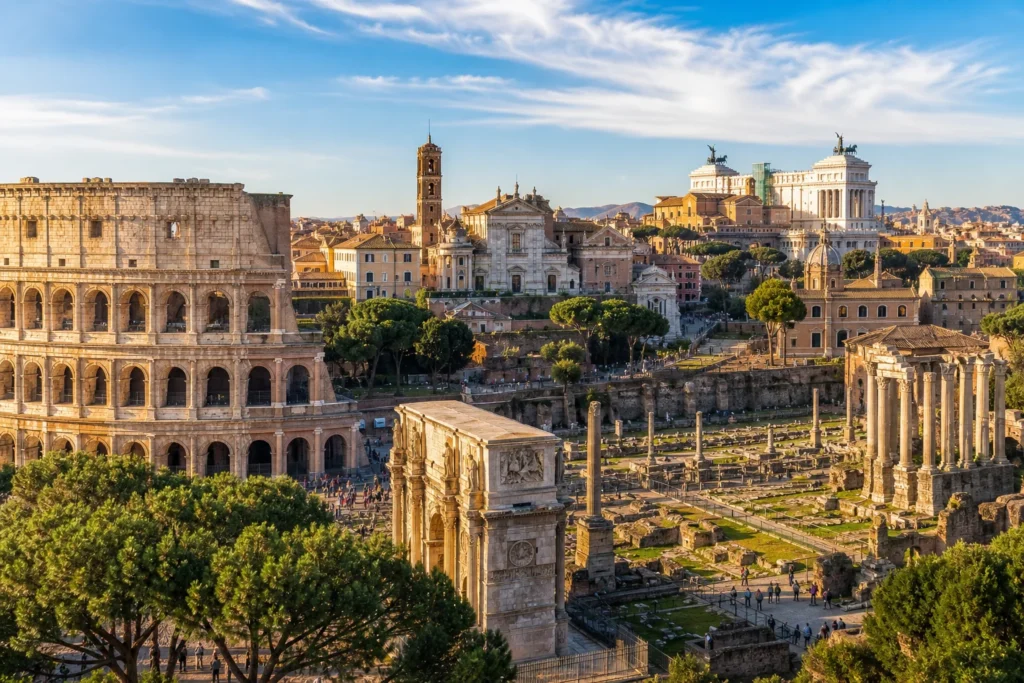
Visitors come to Rome for concentrated access to world-class antiquities and Renaissance and Baroque art: imperial monuments like the Colosseum and Palatine Hill sit within sightlines of the Pantheon and lively piazzas, while the Vatican Museums and St. Peter’s Basilica hold masterpieces from antiquity through the High Renaissance.
Beyond major sites, neighbourhoods such as Trastevere, the Borghese Gallery and local markets offer layered cultural, culinary and social experiences suitable for both structured itineraries and unhurried exploration.
Top Things to Do in Rome, Italy
These are the core sites travelers return to again and again: imperial ruins that explain Rome’s civic life, concentrated museum sequences in the Vatican and Borghese, and neighbourhoods and fountains that show the city’s daily rhythms.
Colosseum
The Colosseum presents as a monumental archaeological ruin and a lived public space. Visitors encounter massive outer arches, surviving seating tiers and long views into the central arena; the site sits within a larger archaeological park that includes the Palatine Hill and Roman Forum, offering layered perspectives across ancient Rome.
Built in the first century AD under the Flavian emperors, the amphitheatre embodied imperial spectacle. Architectural features—travertine and tufa masonry, concrete vaults and the subterranean hypogeum—reveal engineering and the logistics of ancient performances.
Check the archaeological park’s official channels for current visitor routes and interpretive tools before you go.
Roman Forum
The Roman Forum occupies the low valley between the Palatine and Capitoline hills, where visitors walk amid temples, basilicas and triumphal monuments. The site reads as an open‑air palimpsest: ruined columns, podiums and fragmentary paving mark public life across many centuries and invite attention to plan, alignments and inscriptions.
Functionally the Forum served as Rome’s political, legal, religious and commercial centre for more than a millennium. Key monuments include the Curia, the Rostra, the Temple of Saturn and the Basilica Julia.
The Forum is managed together with the Palatine and Colosseum as a single archaeological park; consult official park material for the latest arrangements.
Palatine Hill
The Palatine Hill rises above the Roman Forum and is noted as Rome’s oldest inhabited hill. Archaeology shows continuous human presence from Iron Age settlements through imperial palaces; myths also link the hill to Romulus and the city’s foundation.
Imperial remains include parts of the Domus Tiberiana and Domus Augustana alongside terraced gardens and monumental substructures. The Palatine Museum displays many finds from the hill, and viewpoints provide long visual links to the Forum and Circus Maximus.
Routes and access are managed with the Colosseum and Forum, so check official channels in advance.
Vatican Museums
The Vatican Museums form one of the world’s most concentrated museum complexes, tracing art history from ancient Roman statuary through the High Renaissance. Successive papal collections produced specialized galleries—the Pio‑Clementine halls for classical sculpture, the Raphael Rooms, the Gallery of Maps and richly decorated state commissions—culminating in the Sistine Chapel.
The Sistine Chapel anchors the route with Michelangelo’s ceiling and Last Judgment; it remains a liturgical space with rules of silence and no photography. Visitor flows and access regulations change periodically, so consult the Museums’ official information and allow generous time to move between galleries.
St. Peter's Basilica
St. Peter’s Basilica sits above the traditional burial site of the Apostle Peter and functions both as a major pilgrimage destination and an active papal church. The basilica’s vast interior links altar, tomb and liturgy and rewards patient looking at chapels, tombs and monumental mosaics.
Architecturally, Renaissance and Baroque hands shaped the church: Michelangelo redesigned the dome and Bernini composed the baldachin and the piazza’s colonnade. Practical visit notes include security screening, a dress code and occasional restricted areas; consult official basilica channels for special access and dome-visit information.
Pantheon
The Pantheon is Rome’s best‑preserved ancient monumental interior, rebuilt in its present form under Emperor Hadrian in the early second century. The building combines a classical portico with a vast domed rotunda; its 9‑metre oculus and coffered ceiling demonstrate Roman concrete mastery and produce a calm geometric order as daylight moves across the space.
Consecrated as a church in 609, the Pantheon retained continuous use and later became a burial place for notable Italians. It functions as both a historical monument and an active church; check national cultural authority channels for the latest visitor arrangements before you go.
Galleria Borghese
Galleria Borghese occupies a compact Baroque villa within Villa Borghese park where rooms still read like a princely apartment. The collection, assembled by Cardinal Scipione Borghese, concentrates Baroque sculpture and early modern paintings—Bernini’s marble groups, Canova’s portrait of Paolina Borghese and works by Titian, Correggio and Caravaggio—installed in historically resonant settings.
The museum’s intimate scale encourages close looking; narrow galleries and timed‑entry tickets shape circulation and conservation. Book timed tickets through official channels, follow photography and bag rules, and pair the visit with a walk in the surrounding gardens to complete the villa experience.
Trevi Fountain
The Trevi Fountain is Rome’s grand Baroque water monument and the visual terminus of the ancient Aqua Virgo aqueduct. Designed in the eighteenth century, the fountain transforms a palace façade into a dramatic rock‑and‑water stage with a central Oceanus flanked by tritons and sea‑horses, and sculpted reliefs that recall aqueduct founding legends.
The fountain is primarily an outdoor spectacle experienced from fixed viewpoints; crowds often cluster for photos and the coin‑tossing custom. Visit early or late to avoid peak crowds, respect barriers and local conservation rules, and consult official heritage pages for restoration or access updates.
Trastevere
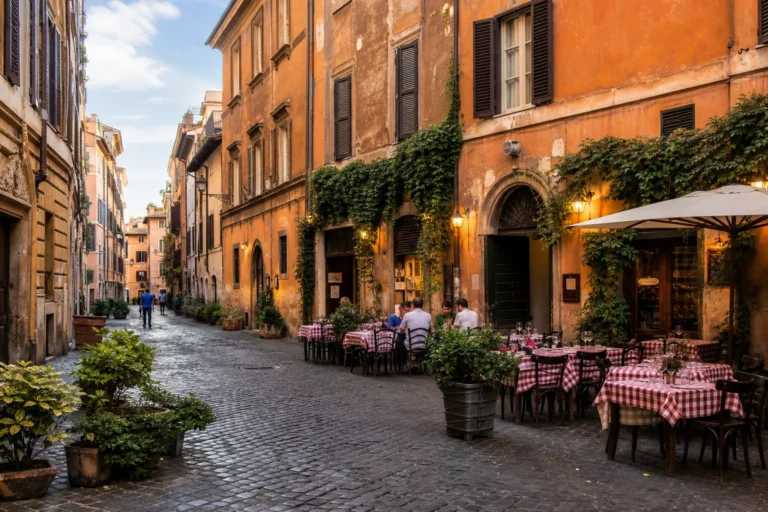
Trastevere sits on the west bank of the Tiber and preserves a medieval street plan of narrow, cobbled lanes, warm-coloured buildings, botteghe and small trattorie. At its heart is Piazza di Santa Maria in Trastevere and its basilica, noted for luminous mosaics and a lively evening square.
The neighbourhood rewards slow on‑foot exploration: artisan shops, a local market rhythm by day and clustered restaurants and terraces by night. Cultural anchors such as Villa Farnesina and the nearby Gianicolo viewpoint provide quieter detours; treat Trastevere as a lived residential quarter to find more authentic dining and peaceful streets away from main tourist routes.
Best Time to Visit Rome
Spring (April–June) and early autumn (September–October) offer milder temperatures, longer daylight and many cultural programmes, making walking between sites more comfortable. Summer is hotter and busier at major attractions; winter is quieter and useful for museum-focused visits, though some services may operate on reduced schedules.
Plan around seasonal climate and allow extra time for queues at top sites.
Getting Around Rome
Central Rome’s main attractions lie within a compact area best visited on foot; archaeological sites and Vatican attractions are often most easily reached this way. ATAC operates metro lines, buses and trams for longer hops—many visitors combine walking with short metro rides on Line A or B, buses or trams.
Use integrated Metrebus tickets or the official ATAC app and consult official transit maps and journey planners for route and ticket planning.
Location
Map of Rome, Italy
The interactive map loads only when you choose to view it.
Plan Your Visit to Rome
Plan Rome by neighbourhood clusters: the historic centre (Colosseum, Forum, Pantheon, Trevi), the Vatican area (Vatican Museums, St. Peter’s Basilica), and Trastevere/Giannicolo for evenings. Buy timed tickets for the Vatican Museums, Galleria Borghese and the Colosseum in advance through official sites to avoid long queues.
Allow extra time for security checks at major sites and plan walking routes—many sights are clustered and walkable.
Local Tips for Rome
Carry a small refillable water bottle—public drinking fountains (nasoni) are widespread. Dress respectfully for religious sites (cover shoulders and knees) and expect security inspections at the Vatican and major churches.
Book Galleria Borghese and Vatican Museums well in advance because of limited entry slots. For food, try midday aperitivo neighbourhoods such as Trastevere, Monti and Testaccio and avoid restaurants that solicit on the street.
Live conditions
Current Weather

Updated 2026-08-24 07:30
- Feels like
- 23°C / 73°F
- Today’s high / low
- 36°C / 96°F · 22°C / 72°F
- Humidity
- 65%
- Wind
- ↑ 7 km/h
- Precipitation
- 0 mm
- Chance of rain
- 3%
- Local time
- 2026-08-24 07:48
Places to Visit Near Rome
Arch of Constantine, Via dei Fori Imperiali and the Capitoline Museums sit within easy walking distance of the Colosseum and help extend an archaeological visit into civic and museum contexts.
Largo di Torre Argentina and the Jewish Ghetto are nearby and pair well with Forum/Palatine walks for both history and local cuisine options.
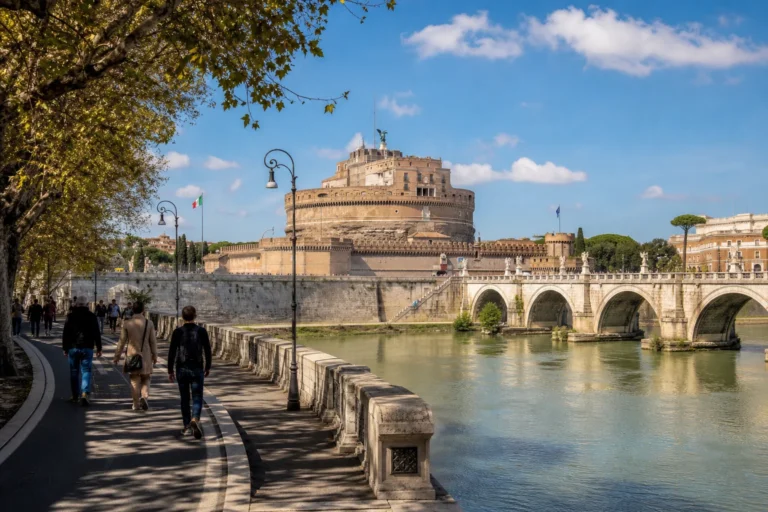
Castel Sant’Angelo and the Borgo Pio district lie close to the Vatican and are convenient for a post-museum stroll along the river.
Piazza Navona and Campo de’ Fiori are short walks from the Pantheon and offer lively squares, markets and architectural sights.
Santa Maria in Trastevere, the Gianicolo viewpoint and Villa Farnesina reward a slower, on-foot exploration of the neighbourhood.
Major transport nodes to note: Roma Termini and Roma Tiburtina provide regional and high-speed rail connections for day trips and onward travel.
Safety in Rome
Rome is generally safe for visitors, but petty theft and pickpocketing occur in crowded areas, public transit and around major monuments; keep valuables secure and use front-zip bags or money belts. At night, prefer well-lit streets and licensed taxis or official ride services from marked ranks.
Purchase transport passes and attraction tickets through official providers and consult local police or tourist information points for current advisories in an emergency.