
Travel Guide
Plan your visit around Diocletian's Palace, Peristyle (Peristil) in Diocletian's Pala, and more of Split, Croatia.
Discover the best things to do in Split, Croatia, from signature sights to memorable local experiences.
Start where the city begins: Diocletian’s Palace. This compact Adriatic city is woven into a late‑Roman imperial complex whose Peristyle, cathedral and substructures sit amid medieval streets, cafés and waterfront life.
Within walking distance you’ll find the Riva promenade, sandy Bačvice beach and the pine‑covered slopes of Marjan. A short, satisfying mix of heritage, seaside leisure and green space.

Why Visit Split
Visitors come to Split to stand inside one of the best‑preserved Roman imperial complexes while enjoying a living city where archaeology, café life and coastal recreation meet.
The Peristyle and the Cathedral of Saint Domnius anchor layered palace streets, the Palace Cellars reveal Roman engineering beneath medieval houses, and small museums interpret local archaeology and folk traditions. Riva’s harborfront and nearby Bačvice and Marjan provide easy seaside and green escapes, making Split unusually compact and efficient for short stays.
Top Things to Do in Split, Croatia
Split’s historic core concentrates major sights within a short walk. Below are the essential places and experiences that explain the city’s Roman origins, medieval reuse and seaside life.
Diocletian's Palace
Diocletian’s Palace is best understood as a living urban quarter rather than a single monument. Constructed for Emperor Diocletian around the turn of the fourth century, its high Roman walls and four main gates form the oldest core of modern Split.
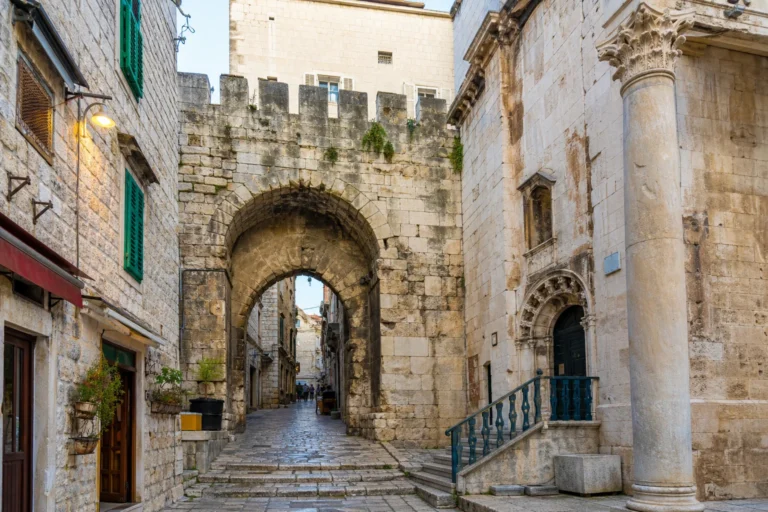
Inside, narrow medieval streets follow the palace’s original grid while Roman stonework, Renaissance windows and Baroque façades sit side by side.
The palace substructures (cellars) underlie the emperor’s former apartments and make the original plan legible; the mausoleum became the Cathedral of Saint Domnius, illustrating dramatic reuse over time. Many important palace spaces require separate admission or guided explanation, and conservation work can affect access, so check official guidance before visiting.
Peristyle (Peristil) in Diocletian's Palace
The Peristyle, or Peristil, is the ceremonial heart of Diocletian’s Palace: a colonnaded imperial courtyard that once hosted official reception and display. Today it reads as an open, paved square framed by Roman columns, arcades and a semicircular vestibule that historically formed a theatrical threshold into the emperor’s inner space.
The eastern octagonal building that anchors the square later became the Cathedral of Saint Domnius.
Ancient decorative pieces, including several Egyptian sphinxes and reused stones, hint at the palace’s original ornamentation. The Peristyle functions as a free public square and an occasional performance venue; expect crowds and brief interpretive panels, and verify event schedules or access with official sources if you hope to attend special programs.
Official Peristyle (Peristil) in Diocletian's Palace website →
Cathedral of Saint Domnius
The Cathedral of Saint Domnius occupies the octagonal core of Diocletian’s original mausoleum, a rare example of an imperial tomb converted into a Christian cathedral. Thick Roman masonry is reworked with medieval and later fittings; notable features include carved wooden doors by Andrija Buvina and a late‑Gothic ciborium attributed to Bonino da Milano.
The cathedral’s treasury displays reliquaries and liturgical metalwork tied to Split’s ecclesiastical history.
The complex is visually anchored by a bell tower built and modified from the 13th to 16th centuries; its stairs and viewing platforms offer highly recommended panoramas over the old town and harbor, though access involves narrow steps.
Diocletian's Palace Cellars
The palace cellars are an extensive vaulted system beneath the emperor’s southern apartments, engineered in the early fourth century to raise living spaces above the waterfront and to provide storage, service rooms and drainage. Their stone vaults and piers make the palace’s original plan legible and show how Roman engineering supported the residence above.
Nineteenth‑century excavations reopened these halls and later conservation work clarified their archaeological value. Several cellar chambers are curated and interpreted with panels by the local museum system, while other areas retain a raw, atmospheric quality.
Expect low vaults, uneven stone floors and limited accessibility; parts of the cellars are ticketed or subject to conservation access, so verify visitor arrangements in advance.
Riva (Split harbour waterfront promenade)
The Riva is Split’s principal seaside promenade and public living room, running along the harbour beneath the palace’s south face. A wide, paved esplanade lined with cafés, plane trees and benches, it invites long walks, people‑watching and views of moored boats, palace walls and the islands beyond.
The promenade functions as a social axis, a departure point for harbour excursions and a linear link between ferry terminals, tourist information and the old town.
The Riva assumed its current public form during early 19th‑century urban reforms and was later resurfaced for clearer sightlines. Its level surface suits strollers and short walks; combine a Riva stroll with a short ascent to Marjan for a contrasting green panorama.
Official Riva (Split harbour waterfront promenade) website →
Marjan Hill and Park-Forest
Marjan is a compact wooded peninsula west of the old town often called Split’s “lungs.” The park‑forest runs along a rocky karst ridge about 3.5 kilometres long and rises to Telegrin, roughly 178 metres above sea level.
Dense pine, Mediterranean shrub and maintained paths create a restful contrast to the urban grid, while small chapels, memorials and a botanical garden mingle with recreational installations.
Trails range from paved promenades to rough natural tracks; viewpoints such as the Vidilica terrace, Sedlo watchtower and Telegrin summit reward walkers with layered views over the city, harbor and islands. West‑facing slopes drop to small coves used for swimming.
Bačvice Beach
Bačvice is Split’s best known central sandy beach, located a short walk from the Old Town and Riva. The bay’s shallow, gently shelving sea makes it especially family‑friendly and is the traditional home of picigin, a local shallow‑water ball game played without letting the ball touch the water.
The sand and long shallow shelf also make Bačvice a convenient spot for swimming, sunbathing and people‑watching.
Historically a site for swimming contests and informal festivals, Bačvice becomes lively into the evening with terraces and small beach bars. Practical considerations include seasonal crowding and variable beach services; confirm water‑quality notices, lifeguard coverage and event restrictions through official tourism channels before you go.
Archaeological Museum Split
Founded in 1820, the Archaeological Museum in Split is one of Croatia’s oldest institutions and presents the long story of Dalmatia through material remains. Its collections span prehistory, Greek‑Hellenistic contacts, Roman provincial life, late antiquity and the medieval period, with stone monuments, inscriptions, pottery and coins that illuminate regional change.
The museum grew from excavations in Salona and maintains deep local research ties.
Displays use courtyards, a lapidarium and exhibition halls to group objects chronologically and thematically. The institution also manages external sites such as Salona and preserves specialized holdings in underwater archaeology.
Because the museum emphasizes research and education, check official visitor information for current exhibitions, branch openings and guided‑tour options.
Ethnographic Museum Split
The Ethnographic Museum Split is a compact museum housed within rooms of Diocletian’s Palace that presents Dalmatian daily life, crafts and costume. Its curated displays include regional clothing, lace, jewellery, tools and household items that make local traditions legible at human scale.
The intimate rooms and close‑packed cases create a detailed, tactile viewing experience that complements the palace’s archaeological and architectural story.
Collections emphasize craft techniques, wedding and festival customs and rural‑urban connections across the Adriatic hinterland. The museum rewards slow reading of labels and close observation of textiles; verify visitor hours, ticketing and accessibility on the museum’s official site before visiting.
Best Time to Visit Split
Late spring through early autumn offers the warmest sea temperatures and the fullest outdoor hospitality. Shoulder seasons (May–June and September–early October) are especially pleasant for walking Diocletian’s Palace, sitting outdoors on the Riva and hiking Marjan with fewer crowds.
Winters are relatively mild and suitable for low‑season cultural visits, though some coastal services and seasonal amenities may operate reduced schedules.
Getting Around Split
Split’s compact core makes walking the primary and most rewarding way to move between the palace, Peristyle, Cathedral and the Riva. Most major attractions are within short pedestrian distances.
Local buses and the nearby ferry port connect to islands and regional towns; taxis and ride apps cover point‑to‑point needs. Bicycle hire and Marjan’s trails provide easy local mobility, while car use is best reserved for inland or regional travel due to narrow streets and limited historic‑centre access.

Location
Map of Split, Croatia
The interactive map loads only when you choose to view it.
Plan Your Visit to Split
Base yourself near the Old Town or Riva for easy walking access to the Peristyle, Cathedral of Saint Domnius, palace cellars and main museums. Expect steep, narrow stone streets and steps around the palace and Marjan; wear sturdy shoes.
Use the municipal tourist information centre on the Riva for maps and official guidance. Allow separate time for Marjan’s trails and small beaches and check each museum’s official page for current visitor arrangements and any conservation‑area restrictions.
Local Tips for Split
The Riva is the city’s social hub—ideal for an early coffee or an evening stroll; it leads naturally toward Bačvice and Marjan. In the palace, treat the Peristyle as a focal point for photos and brief performances and respect conservation signage.
Bačvice is best for sandy, shallow swimming and the local ball game picigin; for quieter seaside walking, follow the shaded paths up Marjan Hill. For closures or restoration notices, consult official museum and city pages before you go.
Live conditions
Current Weather

Updated 2026-09-20 23:00
- Feels like
- 23°C / 73°F
- Today’s high / low
- 25°C / 78°F · 19°C / 67°F
- Humidity
- 71%
- Wind
- ↗ 5 km/h
- Precipitation
- 0 mm
- Chance of rain
- 4%
- Local time
- 2026-09-20 23:16
Safety
Split is generally safe for visitors, but use standard urban precautions in crowded areas such as Diocletian’s Palace, the Peristyle and Bačvice—watch belongings against pickpocketing and stay alert on busy promenades. Stone streets and palace steps can be slippery when wet, so wear sturdy shoes and use handrails where available.
Marjan’s trails can be steep and uneven; carry water, sun protection and a map or phone navigation, and stick to marked paths.