
Przewodnik
Zobacz najważniejsze zabytki, lokalne miejsca i praktyczne wskazówki dla Pekinu.
Atrakcje w Pekinie. Szukasz atrakcji w Pekinie?
Ten przewodnik pomoże porównać najważniejsze zabytki, lokalne wskazówki, mapy i pogodę.
Jeśli szukasz rzeczy do zrobienia w Pekinie, zacznij od skoncentrowanego zespołu imperialnych miejsc i warstwowych dzielnic.
Pekin to polityczna i kulturalna stolica Chin, gdzie Zakazane Miasto i Tiananmen tworzą oś pałaców i parków, a pobliskie kompleksy świątynne, klasyczne ogrody, hutongi i nowoczesne obszary sztuki (jak 798) warto odkrywać przez kilka dni.
Dlaczego warto odwiedzić Pekin?,
Do Pekinu przyjeżdża się, by zobaczyć skondensowane przykłady chińskiego dziedzictwa: Pałacowe Muzeum (Zakazane Miasto), ceremonialne centrum Tiananmen, rytualny krajobraz Świątyni Nieba, rozległe jeziora Letniego Pałacu i dostępne odcinki Wielkiego Muru, jak Badaling.
Poza pomnikami, zachowane hutongi (np. Nanluoguxiang), wielkie sale buddyjsko‑lamaistyczne jak Yonghe Temple oraz strefa sztuki 798 oferują bliskie doświadczenia kulturowe i żywą scenę współczesną.
Atrakcje w Pekinie
Poniżej znajdziesz charakterystyczne miejsca i dzielnice Pekinu — każde ilustruje inny wymiar historii, rytuałów, krajobrazu i współczesnej kultury. Zaplanuj kilka dni, by połączyć wielkie atrakcje z powolnymi spacerami po hutongach i galeriach.
The Forbidden City (Palace Museum)
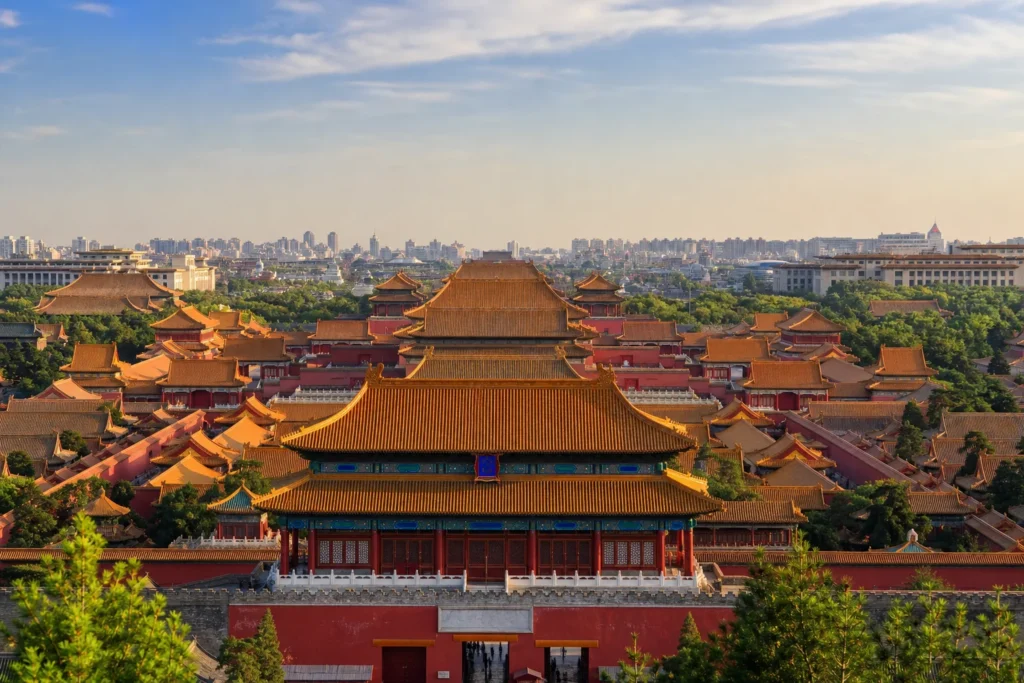
The Palace Museum, commonly called the Forbidden City, sits on Beijing’s central axis as the best-preserved imperial palace complex in China. Built beginning in 1420 under the Ming Yongle Emperor, the complex served as the political and ceremonial heart of the Ming and Qing dynasties and housed twenty-four successive emperors.
Visitors move through a formally ordered sequence of outer ceremonial courts to the more private inner court and the emperor’s living quarters, with visual highlights such as the Meridian Gate and Hall of Supreme Harmony.
Today the museum presents large collections of ceramics, paintings, calligraphy, bronzes and court objects while operating conservation and restoration programs.
Tiananmen Square
Tiananmen Square lies immediately south of the Forbidden City and functions as Beijing’s central civic plaza. Framed by major national institutions—the Monument to the People’s Heroes, the Chairman Mao Memorial Hall, the National Museum of China and the Great Hall of the People—the square conveys urban scale and modern political significance.
Its broad layout reflects nineteenth- and twentieth-century changes and serves as a stage for state ceremonies and public rituals such as the daily flag-raising.
Visiting is a practical way to read Beijing’s imperial-to-modern narratives; expect security checks and occasional restricted access during official meetings, and pair a square visit with nearby museums and the Gate of Heavenly Peace (Tiananmen) for fuller context.
Temple of Heaven (Tiantan)
The Temple of Heaven is an imperial ceremonial complex where Ming and Qing emperors performed seasonal rites to communicate with Heaven. The axis links three principal structures—the Hall of Prayer for Good Harvests, the Imperial Vault of Heaven and the Circular Mound Altar—whose forms and materials express a coherent ritual cosmology.
The Hall of Prayer for Good Harvests is a triple-gabled wooden building built without nails and noted for its circular form and layered roof.
The monuments sit within a broad park of ancient cypresses, lawns and processionways that locals use for tai chi and music. Many visitors book timed tickets in advance and combine close-looking at carved timber and painted motifs with the popular everyday life around the precinct.
Summer Palace (Yiheyuan)
The Summer Palace is a large imperial garden centred on Longevity Hill and Kunming Lake, where landscape, architecture and imperial taste combine across water, pavilions and covered walkways. Originally created in the mid-18th century and later rebuilt, it served as both a pleasure garden and a political retreat.
Framed vistas, painted verandas, classical pavilions and the Tower of Buddhist Incense create a sequence of designed views toward the lake and city beyond.
Boat piers, bridges and the Marble Boat are frequent photographic subjects. Restoration and conservation work is ongoing; check official channels for any access requirements to inner areas and allow time to read both the water vistas and compact architectural sequences.
Badaling Great Wall (Great Wall at Badaling)
Badaling is one of the most visited and best-known stretches of the Ming-dynasty Great Wall, located northwest of Beijing on a rugged ridge. Walking its ramparts highlights the Wall’s defensive logic—stepped paths, crenellated parapets and regularly spaced watchtowers that trace high ground.
The masonry largely dates to the Ming period, when fortifications were rebuilt and standardized, and the site pairs engineered architecture with panoramic mountain scenery.
Parts of Badaling are steep with uneven steps; wear comfortable shoes and pace yourself. The area is a primary visitor hub with conservation and management measures to balance preservation and tourism—check official transport and visitor information before you travel.
798 Art Zone (Dashanzi Art District)
The 798 Art Zone, also called the Dashanzi Art District, occupies former electronics and factory buildings northeast of central Beijing. Its industrial architecture—high ceilings, large windows and rectilinear concrete—was influenced by Bauhaus and German modernist designs and was repurposed by artists beginning in the early 2000s.
The result is a large arts neighbourhood of galleries, studios, institutional exhibition spaces and public art installations.
A visit mixes contemporary exhibitions with street-level cultural life: design shops, small bookstores, cafés and converted workshops. Because the district is spread across a large parcel, allow time to wander and check exhibition listings and gallery opening arrangements through official district channels.
Nanluoguxiang Hutongs (historic hutong district)
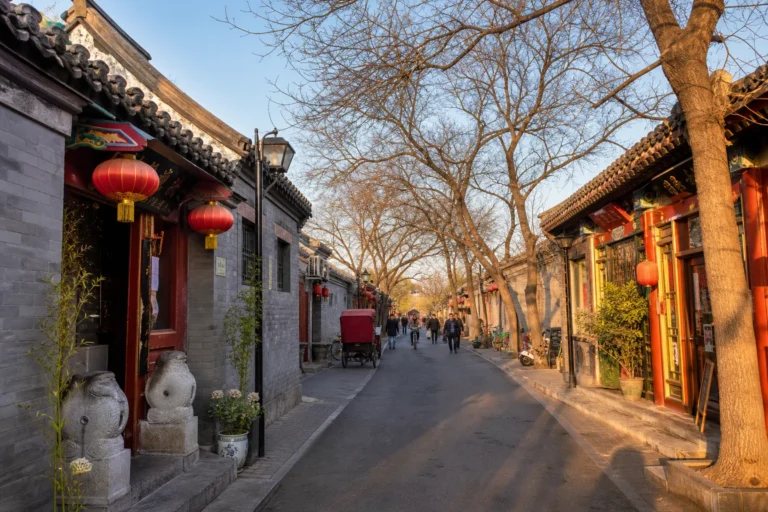
Nanluoguxiang preserves a near-continuous pattern of narrow lanes and siheyuan courtyard houses near the Drum and Bell Towers, offering a compact glimpse into historic hutong life. The street mixes surviving courtyard fronts with renovated storefronts, shops, cafés and small museums, and lies on the city’s historic central axis.
Official protection and repair schemes have retained much of the visible streetscape rather than allowing wholesale replacement.
For a richer visit, explore side alleys to quieter courtyards and small museums that interpret local crafts. Expect an intense pedestrian atmosphere and many vendors; seek quieter moments in less-traveled side lanes to read detailed rooflines, carved doors and grey-brick walls.
Yonghe Temple (Lama Temple)
Yonghe Temple, commonly called the Lama Temple, is a large lamasery that blends Chinese imperial palace architecture with Tibetan Buddhist motifs. Originally an 18th-century princely residence that became a monastery under the Qing, the complex progresses through gate courtyards to sacred halls filled with carved columns, painted ceilings and large gilt Buddhas.
The temple is noted for large images carved from single timbers and finely cast bronzes.
Incense and active devotional practice give the site a living religious atmosphere rather than a museum setting. Visitors should move slowly, respect worship practices, and check authoritative visitor guidance before attending specific ceremonies or photography-sensitive moments.
Najlepszy czas na podróż
Wiosna (kwiecień–maj) i jesień (wrzesień–październik) to najwygodniejsze pory roku: łagodne temperatury, często czystsze niebo i piękne parki. Zimy są zimne i suche, z mniejszą liczbą turystów; lato bywa gorące, wilgotne, tłoczne i miejscami zadymione.
Święta państwowe i ważne uroczystości przyciągają duże krajowe tłumy, co wpływa na transport i dostęp do miejsc.
Wydarzenia specjalne
Nadchodzące wydarzenia
Beijing International Book Fair (BIBF)
- Daty
- June 16, 2027 - June 20, 2027
- Miejsce
- China National Convention Center
Jak się poruszać po Pekinie
Sieć transportowa Pekinu jest rozległa i wydajna: rozwijane metro łączy oś centralną i wiele atrakcji, natomiast autobusy, regulowane taksówki i dłuższe transfery podmiejskie docierają do zewnętrznych miejsc, jak Badaling. Do eksploracji hutongów najlepiej chodzić pieszo lub użyć e-roweru.
Weź pod uwagę kontrole bezpieczeństwa przy głównych obiektach i dodatkowy czas w okresach świątecznych; na wycieczki do Wielkiego Muru zaplanuj dedykowany autobus, pociąg lub samochód prywatny.

Lokalizacja
Mapa: Beijing, China
Interaktywna mapa ładuje się dopiero po wybraniu opcji wyświetlenia.
Planowanie praktyczne
Planuj z uwzględnieniem rozmiaru miasta i dużych tłumów. Korzystaj z oficjalnych miejskich źródeł (np.
GO BEIJING) oraz kanałów sprzedaży biletów każdego obiektu — sale w Pałacu, Letnim Pałacu, Świątyni Nieba i na Wielkim Murze często wymagają wcześniejszej rezerwacji.
Do odbioru biletów miej przy sobie paszport/ID. W centrum polegaj na szybkiej sieci metra, a na dalsze wyjazdy poza miasto zarezerwuj osobny transport.
Planuj wizyty na zewnątrz poza szczytem południowego upału i poza największymi świętami, aby uniknąć tłumów.
Przydatne wskazówki lokalne
Płatności mobilne (Alipay/WeChat) są powszechne — miej telefon przystosowany do płatności lub drobną gotówkę. W miejscach dziedzictwa i świątyniach zachowuj ciszę, nie dotykaj eksponatów i stosuj się do oznakowania.
Przy eksploracji hutongów chodź powoli — noś wygodne buty i miej oko na wąskie uliczki oraz współdzielony ruch rowerów i skuterów. W targach targowanie jest powszechne, natomiast muzea i galerie mają ceny stałe.
Aktualne warunki
Aktualna pogoda

Zaktualizowano 2026-09-23 02:15
- Odczuwalna
- 22°C / 71°F
- Dzisiejsza maks. / min.
- 32°C / 90°F · 20°C / 67°F
- Wilgotność
- 58%
- Wiatr
- ↘ 4 km/h
- Opady
- 0.06 mm
- Szansa deszczu
- 17%
- Czas lokalny
- 2026-09-23 02:27
Bezpieczeństwo
Jakość powietrza może się zmieniać — sprawdzaj prognozy i ogranicz intensywny wysiłek na zewnątrz w dni ze złym powietrzem; osoby wrażliwe powinny mieć przy sobie maski. Uważaj przy przekraczaniu szerokich alei i korzystaj z metra tam, gdzie to praktyczne.
W zatłoczonych miejscach zdarzają się drobne kradzieże i oszustwa na turystach; zabezpiecz paszport, telefon i aplikacje płatnicze. W razie nagłych wypadków użyj lokalnych numerów alarmowych i zwróć się o pomoc do oficjalnych punktów informacji turystycznej.