
Travel Guide
Plan your visit around The Forbidden City, Tiananmen Square, and more of Beijing, China.
Discover the best things to do in Beijing, China, from signature sights to memorable local experiences.
Start with the city’s concentrated collection of imperial sites and layered neighbourhoods.
Beijing is China’s political and cultural capital, where the Forbidden City and Tiananmen Square anchor a central axis of palaces and parks, and nearby temple complexes, classical gardens, hutong lanes and contemporary art precincts (like 798) reward multi-day exploration.
Why Visit Beijing
Visitors come to Beijing to see some of China’s most iconic heritage in compact form: the Palace Museum (Forbidden City), Tiananmen’s civic core, the Temple of Heaven’s ritual landscape, the landscaped lakes of the Summer Palace, and accessible Great Wall sections such as Badaling.
Beyond monuments, preserved hutongs (Nanluoguxiang), major Buddhist-Lamaist halls like Yonghe Temple, and the 798 Art Zone offer close-up cultural variety and a vibrant contemporary arts scene.
Top Things to Do in Beijing, China
Below are the city’s signature sites and neighbourhoods, each illustrating a different aspect of Beijing’s history, ritual life, landscape design, and contemporary culture. Plan multi-day visits to mix major landmarks with slower walks through hutongs and galleries.
The Forbidden City (Palace Museum)
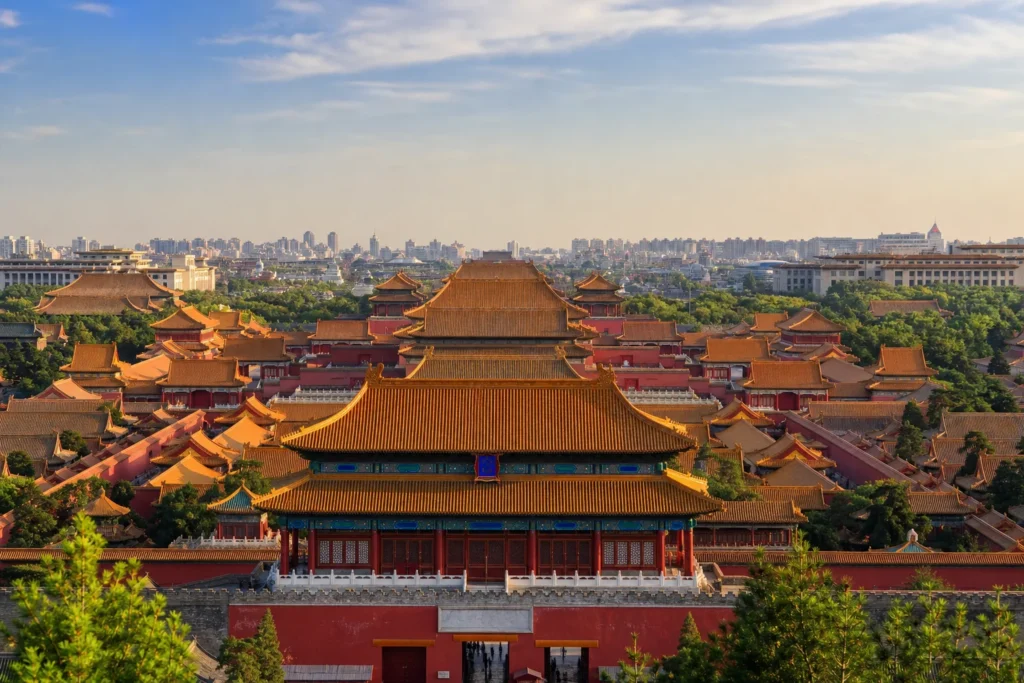
The Palace Museum, commonly called the Forbidden City, sits on Beijing’s central axis as the best-preserved imperial palace complex in China. Built beginning in 1420 under the Ming Yongle Emperor, it was the political and ceremonial heart of the Ming and Qing dynasties and housed twenty-four successive emperors.
Visitors move through a formally ordered sequence of outer ceremonial courts to the more private inner court and the emperor’s living quarters, with visual highlights such as the Meridian Gate and Hall of Supreme Harmony.
Today the museum presents large collections of ceramics, paintings, calligraphy, bronzes and court objects while operating conservation and restoration programs.
Tiananmen Square
Tiananmen Square lies immediately south of the Forbidden City and functions as Beijing’s central civic plaza. Framed by major national institutions—the Monument to the People’s Heroes, the Chairman Mao Memorial Hall, the National Museum of China and the Great Hall of the People—the square conveys urban scale and modern political significance.
Its broad layout reflects nineteenth- and twentieth-century changes and serves as a stage for state ceremonies and public rituals such as the daily flag-raising.
Visiting is a practical way to read Beijing’s imperial-to-modern narratives; expect security checks and occasional restricted access during official meetings, and pair a square visit with nearby museums and the Gate of Heavenly Peace (Tiananmen) for fuller context.
Temple of Heaven (Tiantan)
The Temple of Heaven is an imperial ceremonial complex where Ming and Qing emperors performed seasonal rites to communicate with Heaven. The axis links three principal structures—the Hall of Prayer for Good Harvests, the Imperial Vault of Heaven and the Circular Mound Altar—whose forms and materials express a coherent ritual cosmology.
The Hall of Prayer for Good Harvests is a triple-gabled wooden building built without nails and noted for its circular form and layered roof.
The monuments sit within a broad park of ancient cypresses, lawns and processionways that locals use for tai chi and music. Many visitors book timed tickets in advance and combine close-looking at carved timber and painted motifs with the popular everyday life around the precinct.
Summer Palace (Yiheyuan)
The Summer Palace is a large imperial garden centred on Longevity Hill and Kunming Lake, where landscape, architecture and imperial taste combine across water, pavilions and covered walkways. Originally created in the mid-18th century and later rebuilt, it served as both a pleasure garden and a political retreat.
Framed vistas, painted verandas, classical pavilions and the Tower of Buddhist Incense create a sequence of designed views toward the lake and city beyond.
Boat piers, bridges and the Marble Boat are frequent photographic subjects. Restoration and conservation work is ongoing; check official channels for any access requirements to inner areas and allow time to read both the water vistas and compact architectural sequences.
Badaling Great Wall (Great Wall at Badaling)
Badaling is one of the most visited and best-known stretches of the Ming-dynasty Great Wall, located northwest of Beijing on a rugged ridge. Walking its ramparts highlights the Wall’s defensive logic—stepped paths, crenellated parapets and regularly spaced watchtowers that trace high ground.
The masonry largely dates to the Ming period, when fortifications were rebuilt and standardized, and the site pairs engineered architecture with panoramic mountain scenery.
Parts of Badaling are steep with uneven steps; wear comfortable shoes and pace yourself. The area is a primary visitor hub with conservation and management measures to balance preservation and tourism—check official transport and visitor information before you travel.
Official Badaling Great Wall (Great Wall at Badaling) website →
798 Art Zone (Dashanzi Art District)
The 798 Art Zone, also called the Dashanzi Art District, occupies former electronics and factory buildings northeast of central Beijing. Its industrial architecture—high ceilings, large windows and rectilinear concrete—was influenced by Bauhaus and German modernist designs and was repurposed by artists beginning in the early 2000s.
The result is a large arts neighbourhood of galleries, studios, institutional exhibition spaces and public art installations.
A visit mixes contemporary exhibitions with street-level cultural life: design shops, small bookstores, cafés and converted workshops. Because the district is spread across a large parcel, allow time to wander and check exhibition listings and gallery opening arrangements through official district channels.
Nanluoguxiang Hutongs (historic hutong district)
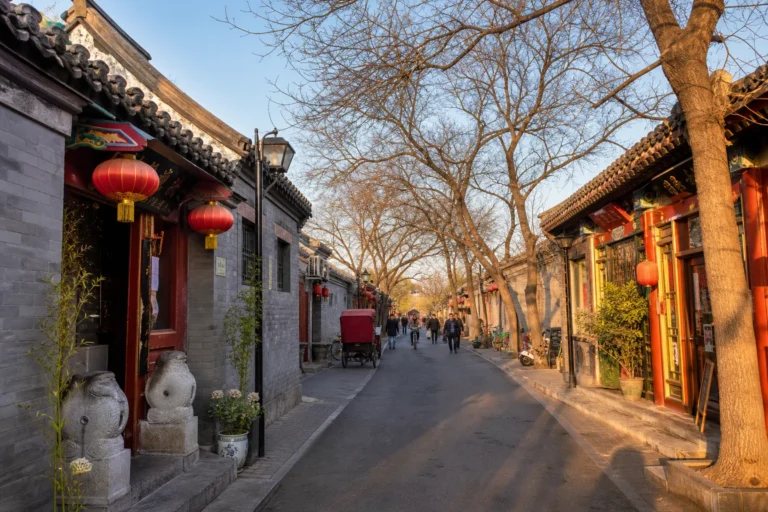
Nanluoguxiang preserves a near-continuous pattern of narrow lanes and siheyuan courtyard houses near the Drum and Bell Towers, offering a compact glimpse into historic hutong life. The street mixes surviving courtyard fronts with renovated storefronts, shops, cafés and small museums, and lies on the city’s historic central axis.
Official protection and repair schemes have retained much of the visible streetscape rather than allowing wholesale replacement.
For a richer visit, explore side alleys to quieter courtyards and small museums that interpret local crafts. Expect an intense pedestrian atmosphere and many vendors; seek quieter moments in less-traveled side lanes to read detailed rooflines, carved doors and grey-brick walls.
Official Nanluoguxiang Hutongs (historic hutong district) website →
Yonghe Temple (Lama Temple)
Yonghe Temple, commonly called the Lama Temple, is a large lamasery that blends Chinese imperial palace architecture with Tibetan Buddhist motifs. Originally an 18th-century princely residence that became a monastery under the Qing, the complex progresses through gate courtyards to sacred halls filled with carved columns, painted ceilings and large gilt Buddhas.
The temple is noted for large images carved from single timbers and finely cast bronzes.
Incense and active devotional practice give the site a living religious atmosphere rather than a museum setting. Visitors should move slowly, respect worship practices, and check authoritative visitor guidance before attending specific ceremonies or photography-sensitive moments.
Best Time to Visit Beijing
Spring (April–May) and autumn (September–October) are the most comfortable seasons: mild temperatures, clearer skies, and attractive parks and gardens. Winters are cold and dry with fewer tourists; summers can be hot, humid, crowded and sometimes hazy.
National holidays and peak festival dates attract large domestic crowds and can affect transport and site access.
SPECIAL EVENTS IN Beijing
Beijing International Book Fair (BIBF)
The Beijing International Book Fair (BIBF) is China’s largest international publishing marketplace and one of the world’s major book fairs. It attracts publishers, rights agents, authors, illustrators and trade visitors for copyright deals, acquisitions and industry forums across print, digital and children’s publishing. Travelers and industry professionals attend for networking, rights negotiation, author events, themed exhibitions and cultural programming—an efficient opportunity to source translated titles, discover emerging East Asian publishing trends, and engage with Beijing’s book and literary scene.
- Dates
- June 16, 2027 - June 20, 2027
- Venue
- China National Convention Center
Getting Around Beijing
Beijing’s transport network is extensive: an expanding metro system connects the central axis and many attractions, while buses, regulated taxis and longer suburban transfers reach outer sites like Badaling. Hutong exploration is best on foot or by e-bike.
Allow extra time for security screening at major sites and for travel during national holidays; plan longer Great Wall trips by dedicated coach, intercity bus or private car.

Location
Map of Beijing, China
The interactive map loads only when you choose to view it.
Plan Your Visit to Beijing
Plan around Beijing’s size and crowds. Use official municipal resources and each attraction’s ticketing channel or WeChat account to reserve Palace Museum, Summer Palace, Temple of Heaven and Great Wall visits in advance.
Carry passport/ID to collect tickets. Rely on the metro for central sites and reserve longer suburban transfers separately.
Schedule outdoor visits outside peak midday heat and national holidays to avoid heavy crowds.
Local Tips for Beijing
Mobile payments (Alipay/WeChat) are the norm—bring a payment-capable phone or some cash. At heritage sites and temples keep voices low, avoid touching artifacts, and follow signage.
Hutongs reward slow walking—wear comfortable shoes and watch for narrow lanes and shared bike traffic. Haggling is common in street markets but not in fixed-price museums and galleries.
Live conditions
Current Weather

Updated 2026-09-22 08:15
- Feels like
- 22°C / 71°F
- Today’s high / low
- 31°C / 88°F · 20°C / 68°F
- Humidity
- 56%
- Wind
- ↑ 6 km/h
- Precipitation
- 0 mm
- Chance of rain
- 2%
- Local time
- 2026-09-22 08:26
Safety
Air quality can vary—check forecasts and limit strenuous outdoor activity on high-pollution days; carry masks if you’re sensitive. Watch traffic when crossing wide avenues and prefer subway links where practical.
Petty theft and tourist-targeted scams can occur in busy areas; safeguard passports, phones and payment apps. For emergencies, use local emergency numbers and seek help at official tourist information centers; be cautious on uneven floors, steps and outdoor masonry at historic sites.