
Travel Guide
Plan your visit around Promenade des Anglais, Vieux Nice, and more of Nice, France.
Discover the best things to do in Nice, France, from signature sights to memorable local experiences.
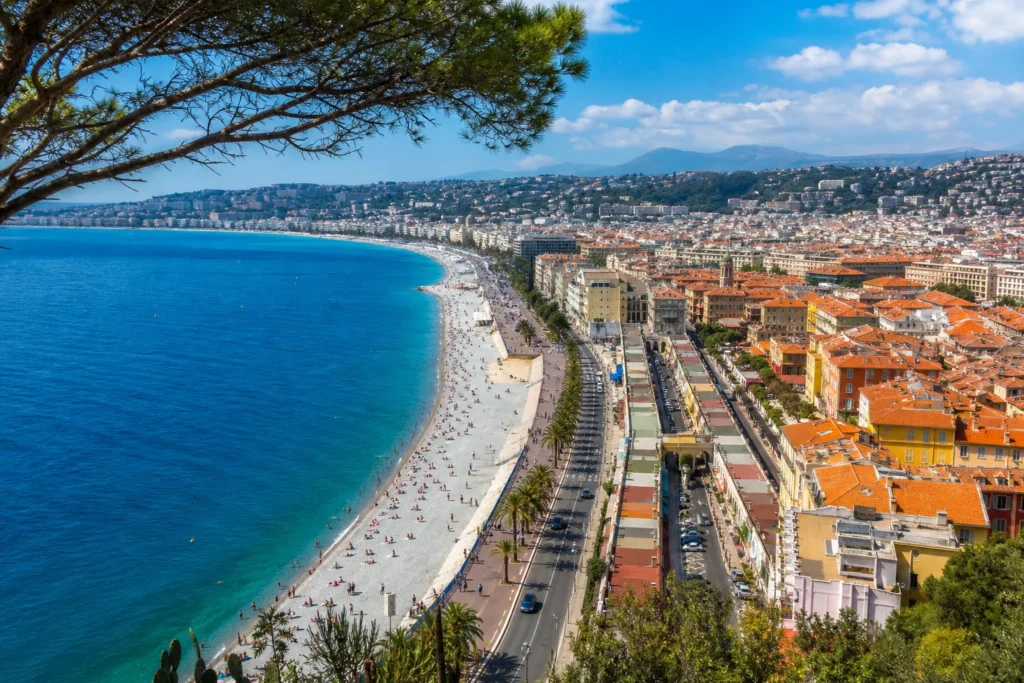
Start where the city meets the sea: long pebble beaches and the palm-lined Promenade des Anglais frame a compact, walkable centre that mixes markets, museums, and hilltop green space.
Vieux Nice’s narrow lanes and the Cours Saleya market concentrate Provençal food and daily life, while Colline du Château and Cimiez offer panoramic views and Roman or Belle Époque layers. Museums from Musée Matisse to the archaeological site at Cimiez round out a short list of concentrated, easily reached attractions.
Why Visit Nice
Visitors come for the clear Mediterranean light, accessible cultural density, and the city’s easy blend of relaxed seaside life and urban discovery. Walkable clusters keep major draws—Promenade des Anglais and beaches, Vieux Nice and Cours Saleya, Colline du Château viewpoints, and museums—within short distances.
Parc Phoenix adds varied gardens and family-friendly green space, while the Russian Cathedral provides striking architectural contrast and historical depth.
Top Things to Do in Nice, France
Nice’s principal experiences concentrate along the seafront, in the Old Town, on nearby hills, and in a handful of specialist museums and parks. Below are the city’s most visitable places and how they fit together for a short stay.
Promenade des Anglais
The Promenade des Anglais is Nice’s long seaside boulevard along the Baie des Anges, a wide, flat route framed by a palm-lined green strip and pebble beaches.
Walking or cycling here reveals grand Belle Époque hotels and monumental facades—the Negresco and the Palais de la Méditerranée are visual anchors—and frequent public art pieces that shape the city’s civic identity.
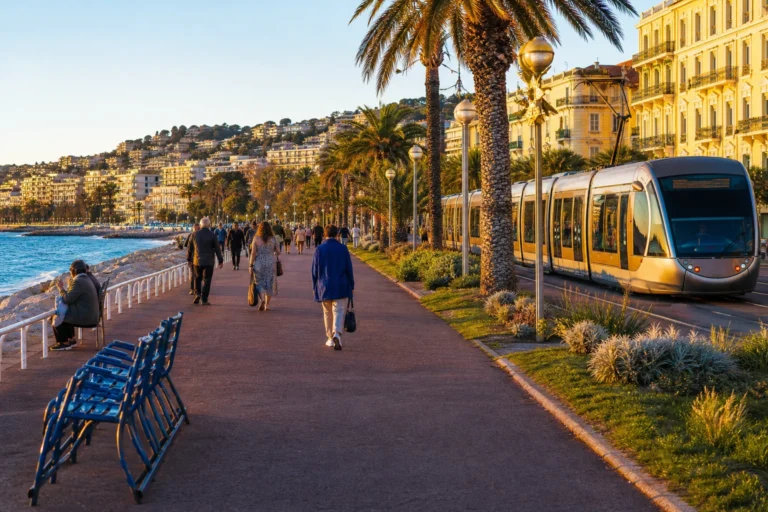
Its origins date to early nineteenth-century winter visitors from Britain; over two centuries the road expanded into a roughly seven-kilometre spine that shaped Nice’s tourist development and figures in the city’s winter‑resort heritage. Practical features for visitors include broad cycle and pedestrian lanes, rows of iconic blue chairs, and sunrise or sunset viewpoints.
Vieux Nice (Old Town)
Vieux Nice is a compact maze of narrow alleys, pastel-painted façades, baroque churches and lively squares where centuries-old shops, cafés and artisan stalls cluster. The district’s Italianate rhythms and dense urban grain concentrate markets and local food culture; Place Rossetti and nearby streets host terraces and people-watching that feel characteristically Niçois.
Architectural layers range from medieval lanes to seventeenth- and eighteenth-century Baroque churches, notably the Cathédrale Sainte-Réparate. A practical approach pairs market time in the Cours Saleya with a climb toward Colline du Château to gain panoramic perspective on the sea and town.
Check official tourism pages for guided-tour options or special access details.
Cours Saleya (flower and food market)
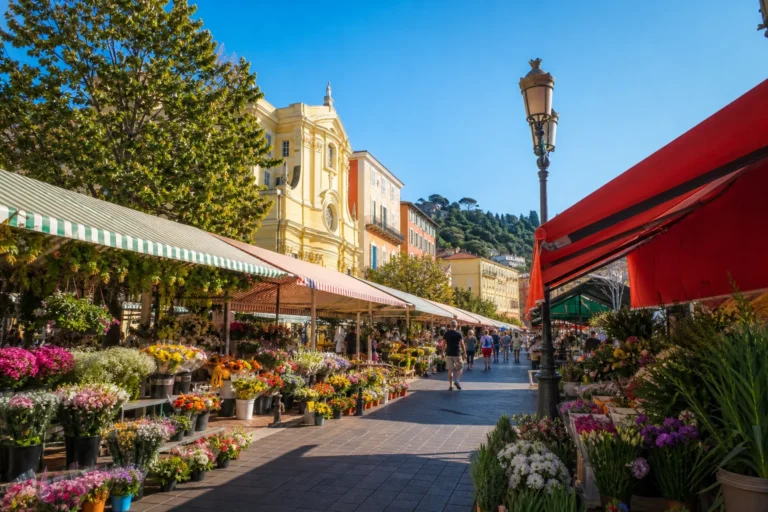
Cours Saleya sits at the heart of the Old Town as Nice’s principal market spine. The market is best known for its long-standing flower trade and fresh regional foodstuffs—cut flowers, fruit, cheeses, charcuterie, olives and Provençal specialties—that showcase local produce and seasonality.
Walking the rows reveals a mix of daily life and tourism: terraces invite pauses for tasting, while vendors preserve traditional trades. The market rewards slow movement and sampling—try socca and other local snacks on site—and occasional specialist markets or antiques displays appear on some days.
Verify special events or temporary changes on official tourism channels before planning.
Colline du Château (Castle Hill)
Colline du Château is the green, archaeological high point above Nice and the Old Town, now functioning as a public park and panoramic lookout. From belvederes you gain wide views across the Baie des Anges, pebble beaches and the harbour, clarifying Nice’s coastal orientation and growth.
Access is by stairs, lift or paths into lawns, shaded promenades and viewpoint terraces.
Archaeological fragments and later nineteenth‑century landscaping—an artificial waterfall and planted promenades—anchor the hill’s layered history. Playgrounds and lawns make it popular for picnics and family visits.
Because access routes and conservation work sometimes change, consult the city’s official pages for the latest visitor details.
Promenade du Paillon (Esplanade Niki de Saint Phalle)
Promenade du Paillon is Nice’s central linear park—a cool green ribbon that follows the covered bed of the Paillon river. Visitors find shaded paths, lawns, a long reflective water mirror and interactive fountain jets that cool the air and invite children to play.
The layout links urban vistas toward the sea with domestic leisure space for residents and tourists.
Completed in major redesign phases from the 2010s, the promenade unifies planted surfaces and leisure lawns, adding playgrounds, timber terraces and sculptural pieces. A restored monumental work by Niki de Saint Phalle marks the Esplanade near the MAMAC museum.
The promenade often hosts temporary events; check municipal or tourism pages for current access and closures.
Official Promenade du Paillon (Esplanade Niki de Saint Phalle) website →
Musée Matisse
Musée Matisse occupies a Genoese villa on the Cimiez hill, surrounded by olive trees, and houses a world-class collection largely devoted to Henri Matisse. The displays include paintings, sculptures, drawings and prints that trace Matisse’s long, experimental career and his engagement with Mediterranean light.
The museum’s core collection stems from the artist’s mid-twentieth-century gifts and later curatorial expansions that respect the villa and garden setting. Highlights include major paintings, sculptures and graphic sequences that illuminate technique and process.
Musée Matisse pairs naturally with nearby Cimiez ruins and monastery gardens; check the museum’s official site for guided tours and access details before visiting.
Musée d'Archéologie de Nice – Cimiez (Arènes de Cimiez)
The Musée d’Archéologie de Nice – Cimiez combines an on-site museum with an open-air archaeological park on the footprint of ancient Cemenelum. Visitors can walk paved lanes among thermal baths, an amphitheatre and early-Christian structures, then move indoors to study Bronze Age through Early Middle Ages finds—inscriptions, ceramics, small bronzes and building fragments.
The outdoor ruins and museum displays together convey daily life, public spectacle and urban planning in Roman southern Gaul. A useful visiting sequence is to start outdoors and end with the museum’s vitrines and reconstructions.
Verify guided-visit options, accessibility arrangements and any conservation work on the museum’s official resources before you go.
Parc Phoenix
Parc Phoenix is a seven-hectare botanical and exhibition park at Nice’s western edge beside the Promenade des Anglais. The site is organized into roughly twenty themed gardens and habitats and centers on a large pyramidal greenhouse that presents subtropical and tropical plants alongside small animal displays and staged landscapes.
Designed as an educational and family-friendly greenway, the park features sensory trails, interpretive panels, a small farm area and playgrounds. Paved paths and gentle grades support stroller and wheelchair access, and the greenhouse offers sheltered interest on hot or rainy days.
Check the park’s official channels for current programs and visitor guidance.
Cathédrale Orthodoxe Russe Saint-Nicolas
The Cathédrale Orthodoxe Russe Saint-Nicolas, built between 1903 and 1912, commemorates Nice’s Russian winter community and is modelled on late sixteenth-century Muscovite churches. Its red-brick and white-stone exterior, blue-and-gilded onion domes and rich mosaics catch the light, while interiors contain an iconostasis, carved woodwork and mural painting from Russian workshops.
The cathedral remains an active house of worship and a protected monument; visitors should dress respectfully and expect restricted photography or access during liturgies. Guided visits or heritage displays may be offered outside worship times—verify visiting conditions on official channels before planning.
Best Time to Visit Nice
Summer highlights the beaches and promenades, but late spring and early autumn are often the best windows for milder temperatures, fewer crowds, and full access to markets and museums. Spring brings floral interest; autumn can extend pleasant sea weather.
Plan mixes of daytime seaside time and late-afternoon city wandering to capture both light and local dining rhythms.
SPECIAL EVENTS IN Nice
Le Carnaval de Nice (Nice Carnival)
Le Carnaval de Nice is Nice’s flagship winter festival, known for giant themed floats, illuminated night parades (corsos), and the iconic Bataille de Fleurs. The city’s historic centre and seafront come alive with street performances, colourful papier-mâché sculptures and family-friendly programming. Travelers value it for outstanding photo opportunities, immersive local culture, and a festive atmosphere that showcases Provençal hospitality and regional gastronomy. The event draws international visitors and transforms Nice into one of Europe’s most celebrated winter carnival destinations.
- Dates
- February 9, 2027 - February 28, 2027
- Venue
- Place Masséna (principal parade site; festivities also take place across the city and seafront)
Festival du Livre de Nice
The Festival du Livre de Nice is an annual public literary festival produced with the City of Nice and local cultural partners. It brings authors, debates, readings, signings, family programming and book awards to outdoor city spaces, attracting hundreds of writers and publishers. Travelers will find free or low-cost events, opportunities to meet French and international authors, pop-up bookstands and a lively seaside atmosphere—making it a convenient cultural highlight for spring visits to Nice and for book lovers exploring regional literature and events.
- Dates
- May 28, 2027 - May 30, 2027
Getting Around Nice
Nice is compact and highly walkable: the Promenade des Anglais, the historical centre, and many attractions lie within easy walking distance. A dense tram and bus network links the train station, airport, and outlying neighbourhoods; bike lanes and shared electric bikes support short trips.
Taxis and ride-hailing fill gaps for luggage or late hours, and regional trains serve coastal towns from Nice‑Ville.
Location
Map of Nice, France
The interactive map loads only when you choose to view it.
Plan Your Visit to Nice
Base yourself near the Promenade des Anglais, Place Masséna or Vieux‑Nice to reach top sites on foot or by short tram rides. Use Lignes d’Azur trams and buses for longer hops and expect short uphill walks for Colline du Château or park paths in Parc Phoenix.
Comfortable shoes and water are helpful.
Book museum visits (Musée Matisse, Cimiez archaeology) in advance if you need guided tours or accessibility assistance.
Local Tips for Nice
Early morning and late afternoon are the best windows for promenading and exploring Cours Saleya before crowds peak; markets and cafés feel most local then. Vieux‑Nice lanes are narrow—travel light and watch for deliveries and scooters.
For photos and quieter views, visit Colline du Château viewpoints and plan a picnic on the lawns. Dress respectfully at the Russian Cathedral and use official tram and tourist-office maps to check event or traffic changes.
Live conditions
Current Weather

Updated 2026-09-22 02:15
- Feels like
- 22°C / 72°F
- Today’s high / low
- 25°C / 78°F · 21°C / 69°F
- Humidity
- 59%
- Wind
- ↖ 5 km/h
- Precipitation
- 0 mm
- Chance of rain
- 5%
- Local time
- 2026-09-22 02:16
Safety
Nice is generally safe for visitors but take standard urban precautions: keep valuables out of sight and manage bags in crowded places such as Cours Saleya, trams, and the seafront. Be mindful of distraction techniques used by thieves.
Summer sun and heat are serious risks—carry water, use sunscreen, and avoid strenuous climbs at midday. Swim only in supervised or flagged areas and follow lifeguards’ guidance.