
Travel Guide
Plan your visit around Old Faithful Geyser, Grand Prismatic Spring, and more of Yellowstone National Park, Wyoming.
Discover the best things to do in Yellowstone National Park, Wyoming, from signature sights to memorable local experiences.
Vast wildlife valleys, and dramatic river-cut scenery. Boardwalks and viewpoints make features like Old Faithful and Grand Prismatic accessible, while Lamar and Hayden valleys concentrate bison, elk, wolves, and bears.
Much of the park is remote, so plan routes and timing carefully.
Why Visit Yellowstone National Park
Visitors come to Yellowstone for its singular combination of geothermal spectacle, large‑scale ecosystems, and classic western landscapes. See predictable geyser eruptions at Old Faithful, photograph the vivid microbial colors of Grand Prismatic Spring, and walk the travertine terraces at Mammoth Hot Springs.
Dramatic vistas at the Grand Canyon of the Yellowstone and scenic drives through Hayden and Lamar valleys offer reliable wildlife viewing and landscape photography. Trails, river corridors, and interpretive centers let travelers explore geology, native plants, and park history, making Yellowstone a place that rewards repeat visits across seasons.

Top Things to Do in Yellowstone National Park, Wyoming
Yellowstone’s headline attractions center on hydrothermal basins, canyon viewpoints, and broad wildlife valleys. Below are the park experiences travelers most commonly plan around, each offering short boardwalk loops or scenic pullouts that make visits practical even on a tight schedule.
Old Faithful Geyser (Upper Geyser Basin)
Old Faithful is Yellowstone’s best‑known eruptive hot spring and a signature visitor experience. Visitors gather on a broad viewing area and short boardwalks to watch fountains of near‑boiling water and steam.
The vent sits in the Upper Geyser Basin, which hosts the greatest concentration of geysers anywhere on Earth and includes the historic Old Faithful Inn nearby.
Eruptions typically last between about one and a half and five minutes and can throw water well over 100 feet into the air. The Park Service publishes predicted times and maintains webcams to help plan visits.
Stay on the amphitheater and boardwalks, and use the Old Faithful Visitor Education Center to learn about geyser plumbing and safety.
Grand Prismatic Spring (Midway Geyser Basin)
Grand Prismatic Spring is Yellowstone’s largest hot spring and Midway Geyser Basin’s most photographed feature. From the low boardwalk the pool’s deep blue center and vivid colored rings are dramatic, while a short uphill overlook on the Fairy Falls Trail (about 0.6 mile spur) gives the best view of the full concentric palette.
The colors arise from temperature‑controlled microbial communities and optical effects in the clear water.
Wind and steam can change visibility rapidly, so the overlook is ideal for photography. The spring drains across pale sinter flats into the Firehole River; remain on boardwalks to protect fragile bacterial mats and avoid scalding water.
Official Grand Prismatic Spring (Midway Geyser Basin) website →
Grand Canyon of the Yellowstone (Artist Point & Lower Falls)
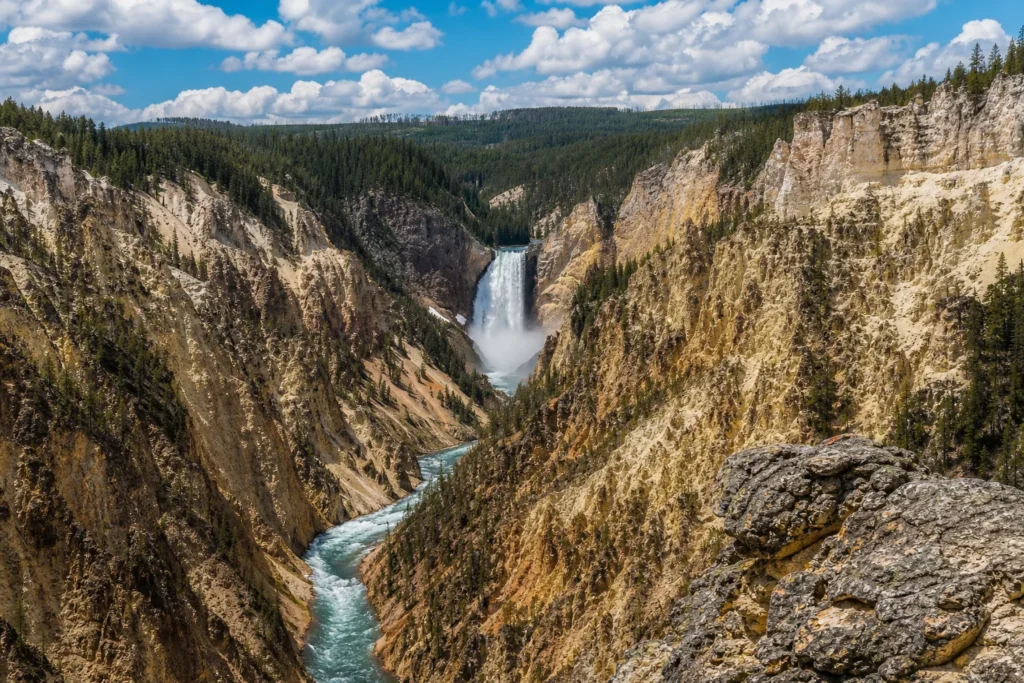
The Grand Canyon of the Yellowstone is a dramatic river‑cut gorge whose colorful rhyolite walls frame the 308‑foot Lower Falls. Artist Point on the canyon’s south rim gives the classic composition many visitors seek, looking across sweeping walls toward the river’s sharp turn below the falls.
Trails and overlooks provide a range of vantage points from high panoramas to closer rim views that reveal canyon detail and river turbulence.
The canyon records volcanic, hydrothermal, and river‑erosion processes that produced vivid mineral staining and sculpted cliffs. Stay on signed trails, bring layers for changing weather, and consult park guidance before exploring steep viewpoints.
Official Grand Canyon of the Yellowstone (Artist Point & Lower Falls) website →
Mammoth Hot Springs Terraces
Mammoth Hot Springs is an actively forming travertine complex where carbonate‑rich hot water builds stair‑stepped terraces. Warm groundwater dissolves limestone at depth, then precipitates calcium carbonate at the surface to form Upper and Lower Terraces.
Boardwalks thread pools, small cascades, and porous crusts that host algae and mineral films tinting the travertine orange, brown, and green.
The terraces change continually—channels open and pools drain—so the appearance can shift between seasons. Mammoth’s setting includes historic Fort Yellowstone and nearby lodgepole and fir forests, offering a mix of cultural and geothermal interest.
Remain on boardwalks to protect fragile deposits and ensure safety.
Norris Geyser Basin
Norris Geyser Basin is Yellowstone’s hottest, oldest, and most changeable thermal area. Boardwalks carry visitors through Porcelain and Back Basin to view vents, springs, fumaroles, and pale silica soils where steam and hissing ground create an otherworldly setting.
Geology and deep fractures concentrate unusually hot, sometimes acidic fluids, and surfaces often exceed local boiling temperatures.
Norris is notable for rapid change—thermal channels shift and pools alter color—and for rare phenomena such as acid geysers and the intermittently active Steamboat Geyser, which can erupt to great heights when active. Expect short walking loops of 30–90 minutes and follow posted safety guidance.
Lamar Valley wildlife viewing
Lamar Valley is a broad, river‑cut grassland on Yellowstone’s northern range where the Lamar River and open meadows create excellent habitat for large herds and predators. Visitors commonly see bison and elk and may encounter pronghorn, coyotes, foxes, and many raptors.
The valley is especially known for wolves and bears; wolves were reintroduced to Yellowstone in 1995–1996 and remain a highlight for wildlife watchers.
For best viewing arrive near dawn or dusk, use binoculars or a telephoto lens from a safe distance, and expect vehicle “animal jams.” Maintain required distances—at least 100 yards from bears and wolves and at least 25 yards from bison and elk—and check park alerts before visiting.
West Thumb Geyser Basin & Yellowstone Lake shoreline
West Thumb Geyser Basin lies on the southwest shore of Yellowstone Lake and offers a compact shoreline thermal landscape accessible by a short boardwalk loop. Visitors see Abyss Pool’s intense blue, shallow sinter aprons, and clusters of vents and mud pots that sit at the junction between lake water and hot groundwater.
Some cones are influenced by lake levels and seasonal inundation.
West Thumb is a caldera within the park’s larger volcanic system, and hydrothermal plumbing extends beneath the lake. The loop is brief but popular; stay on designated paths to protect fragile microbial mats and for personal safety, and check current shoreline conditions before visiting.
Official West Thumb Geyser Basin & Yellowstone Lake shoreline website →
Hayden Valley wildlife and scenic drives
Hayden Valley is a broad meadow between Canyon Village and the lake, with the Grand Loop Road along its western edge and signed pullouts offering wide views across wetlands, meadows, and the Yellowstone River.
The valley’s open profile concentrates wildlife, making it a premier scenic‑drive destination where large bison herds, elk, pronghorn, and waterbirds are frequently seen.
Black and grizzly bears use valley edges in spring and early summer, and wolves sometimes pass through following ungulate herds. Use designated pullouts, keep binoculars or a telephoto lens ready, maintain safe viewing distances, and expect potential wildlife jams on the road.
Check park guidance for road and wildlife alerts before you drive.
Best Time to Visit Yellowstone National Park
Yellowstone’s seasons offer distinct experiences. Summer (June–August) provides the fullest road access, lodge services, and long daylight for hiking and thermal-basin visiting, but it is also the busiest.
Spring (late April–May) and early summer bring newborn wildlife and fewer crowds, though weather and some higher-elevation roads can remain unpredictable. Fall (September–October) cools, elk rut activity increases, and visitation eases; many services begin seasonal closure.
Winter transforms the park into a snowbound landscape accessible by guided snowcoach and snowmobile services on select routes for a quiet, wildlife-focused visit.
Getting Around Yellowstone National Park
Travel within Yellowstone relies primarily on private vehicles, guided shuttles, and seasonal specialty services; plan for long drives between attractions and limited cell coverage. The Grand Loop Road connects major hubs (Mammoth, Norris, Canyon, Lake, Old Faithful, West Thumb) and includes pullouts and short boardwalk loops at thermal areas.
Entrances link to gateway towns—Gardiner, West Yellowstone, Cody, and Jackson—for lodging and supplies. Check official park road‑status information before travel since seasonal openings, closures, and construction shape realistic routes.

Location
Map of Yellowstone National Park, Wyoming, United States
The interactive map loads only when you choose to view it.
Plan Your Visit to Yellowstone National Park
Plan Yellowstone as a vehicle‑first, time‑buffered trip: sites are widely spaced and road travel between major attractions often takes hours. Use the five park entrances to frame your route and allow extra time for wildlife jams and slow traffic.
Cell service is intermittent, so download offline maps and print key waypoints.
Reserve frontcountry campgrounds and park lodges well in advance and request backcountry permits where required. Bring bear‑resistant food storage for overnight stays and layered clothing for sudden high‑altitude weather changes.
Local Tips for Yellowstone National Park
Beat crowds by visiting popular features early morning or late afternoon; mid‑day is busiest at Old Faithful, Grand Prismatic, and canyon overlooks. Always stay on boardwalks and marked trails near thermal areas to protect fragile ground and avoid scalding injuries.
For wildlife viewing, watch from inside your vehicle or from designated pullouts and use binoculars or a telephoto lens. If you plan backcountry travel, study bear management areas, carry approved hard‑sided canisters, and check visitor center or ranger‑station notices for localized closures before hiking.
Live conditions
Current Weather

Updated 2026-09-21 08:30
- Feels like
- 36°F / 2°C
- Today’s high / low
- 60°F / 16°C · 37°F / 3°C
- Humidity
- 79%
- Wind
- ↘ 2 mph
- Precipitation
- 0 in
- Chance of rain
- 4%
- Local time
- 2026-09-21 08:39
Safety in Yellowstone
Yellowstone is active geothermal and large‑wildlife country. Maintain recommended distances: at least 100 yards from bears, wolves, and cougars, and at least 25 yards from bison, elk, and other large animals.
Stay on boardwalks around hot springs and geysers—ground can be thin and dangerously hot. All overnight backcountry travel requires a permit and Interagency Grizzly Bear Committee‑approved hard canisters; follow park guidance on food storage, pack out trash, and carry bear spray where advised.
Check current road conditions and closures before you go.