
Travel Guide
Plan your visit around Freedom Trail, Fenway Park, and more of Boston, Massachusetts.
Discover the best things to do in Boston, Massachusetts, from signature sights to memorable local experiences.
This compact, walkable coastal city layers colonial streets, 19th‑century neighborhoods, and a modern university-and-museum scene into short walks, subway rides, or quick ferries.
From the Freedom Trail and Fenway Park to the MFA and waterfront attractions, Boston’s varied neighborhoods make it easy to pack history, arts, and lively dining into a single day or a longer stay.
Why Visit Boston
Visit Boston for a tightly packed mix of American history, arts, and neighborhood life. The Freedom Trail connects founding‑era sites and museums that illuminate the Revolutionary era.
Fenway Park offers an iconic sporting and social experience. And the Museum of Fine Arts and Isabella Stewart Gardner Museum provide complementary collections and distinctive settings.
Waterfront attractions and the Charlestown Navy Yard add maritime heritage, while nearby Harvard Square and the region’s universities contribute an energetic intellectual and culinary scene. Boston’s compact scale and public parks deliver many experiences within short distances.
Top Things to Do in Boston, Massachusetts
Below are Boston’s essential visitor experiences, grouped by walkable neighborhoods and waterfront destinations. Each entry summarizes what to expect and practical context for planning a visit.
Freedom Trail
The Freedom Trail is a continuous 2.5‑mile walking route that threads through downtown Boston, marked by a red brick or painted line. It links sixteen nationally significant sites—public spaces, churches, meetinghouses, burial grounds, and museums—where key events of the American Revolution unfolded.
Typical visitors begin at Boston Common and follow the line north through the State House, Faneuil Hall, the North End, and into Charlestown near Bunker Hill and the Charlestown Navy Yard.
The visit mixes self‑guided discovery with structured interpretation: National Park Service rangers, the Freedom Trail Foundation, and independent guides offer guided walks, costumed programs, and an official audio tour. Plan a full day to pause at interiors and check each site’s seasonal hours before you go.
Fenway Park
Fenway Park, opened in 1912, is Major League Baseball’s oldest ballpark still in regular use and is set in the Fenway–Kenmore neighborhood. Its compact, intimate bowl and idiosyncratic field—tight foul lines, a shallow right field, and the oversized left‑field wall known as the Green Monster—create distinctive sightlines and memorable game dynamics.
The park blends early‑20th‑century masonry with modern amenities, and features like the hand‑operated scoreboard, Pesky’s Pole, and the outfield Triangle reflect its layered history.
Beyond game days, Fenway offers behind‑the‑scenes tours and museum exhibits that explain design choices, memorable plays, and the park’s community role. Check official Fenway or Red Sox resources for current tour availability and event details.
Museum of Fine Arts (MFA)
The Museum of Fine Arts (MFA) presents a sweeping global collection arranged across specialized wings that emphasize American, Asian, European, and modern art. The museum’s holdings range from ancient objects to contemporary installations, enabling focused highlights tours or deeper thematic visits.
Galleries are organized with maps and color‑coding to help visitors navigate lengthy routes, and signature spaces frame works with deliberate sightlines for quieter, concentrated viewing.
Because the MFA rotates special exhibitions and loans, give yourself several hours for a meaningful visit, check timed‑entry or ticket policies in advance, and use guided tours or audio guides to tailor the experience to your interests and mobility needs.
Isabella Stewart Gardner Museum
The Isabella Stewart Gardner Museum is a personal, house‑museum arranged around a Venetian‑style courtyard. Isabella Gardner’s original installation logic—careful room sequences and curated sightlines—creates an intimate, salon‑like atmosphere where paintings, sculpture, decorative arts, and horticulture converse across spaces.
Visitors begin in the open central courtyard and move through compact rooms that preserve the founder’s hang and eclectic taste.
A Renzo Piano wing expanded programming and exhibition space while respecting the Palace’s intimacy. The museum uses timed entry, permits non‑flash personal photography with restrictions, and recommends advance tickets for peak times to make the most of the original collection and the museum’s layered narratives.
Boston Common & Public Garden
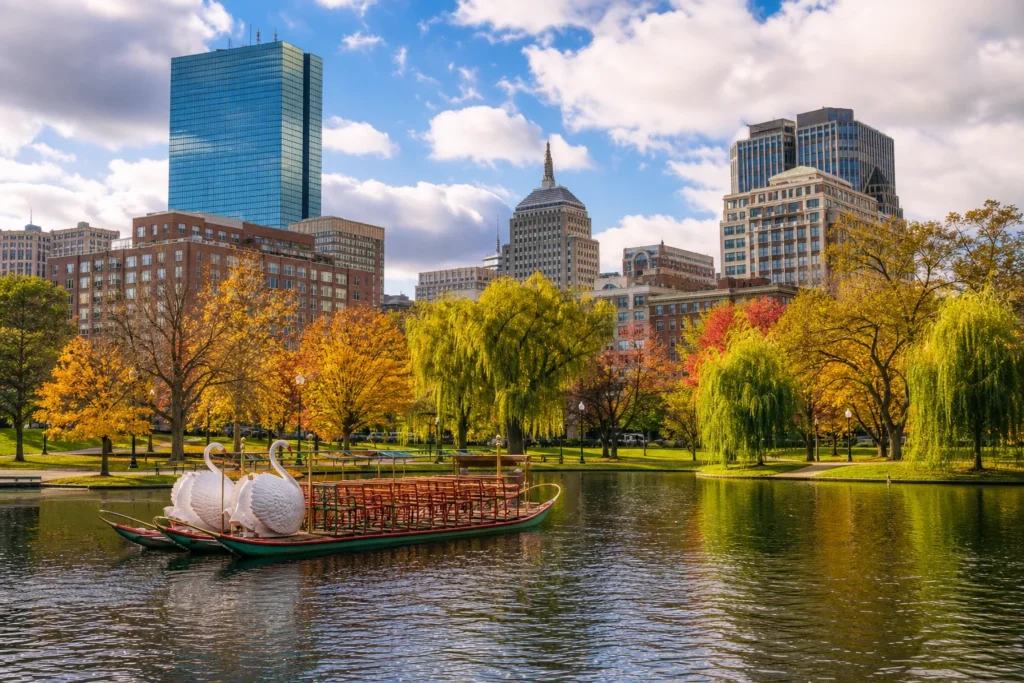
Boston Common and the adjacent Public Garden form a contiguous pair of historic parks at downtown’s core. Boston Common, dating to 1634, is America’s oldest public park; the Public Garden, established in 1837, is the nation’s first public botanical garden.
Together they offer broad lawns, tree‑lined promenades, a landscaped lagoon, monuments, and family attractions such as the Frog Pond and the long‑running swan boats.
The spaces contrast in design—the Common’s civic open lawn and memorials versus the Garden’s intimate paths, Victorian ironwork, and the “Make Way for Ducklings” sculpture—yet they function as civic stages for rallies, parades, and quieter strolling. The parks anchor the Freedom Trail and connect easily to Beacon Hill and Back Bay.
Faneuil Hall Marketplace (Quincy Market)
Faneuil Hall Marketplace and Quincy Market form a dense historic‑commercial complex in downtown Boston. Faneuil Hall (1742) functioned as a market and meeting hall, with its Great Hall hosting political debate and assembly.
Quincy Market’s 1820s granite colonnade and barrel‑roofed market building were designed for practical wholesale and retail trade and now house a mix of food vendors, shops, and restaurants gathered around a lively plaza.
Today the site blends historic interpretation—park rangers and panels explain civic history—with contemporary commerce and street performance. The complex remains legible as a 19th‑century market even as modern tenants and events animate the space; consult official marketplace resources for current services and programming.
New England Aquarium
The New England Aquarium anchors Boston’s Central Wharf with marine science and public programming. The four‑story Giant Ocean Tank—a cylindrical reef habitat—dominates the atrium and is viewed from a spiraling gallery where tropical reef species, juvenile sea turtles, and diver demonstrations set the pace for the visit.
Compact surrounding galleries interpret local and global seas, and the Penguin Colony and Marine Mammal Center bring close views of penguins and seals.
Hands‑on exhibits include a supervised shark and ray touch tank, and the Simons Theatre offers film programs about regional places like Stellwagen Bank. Because some programs and screenings change seasonally and the aquarium can feel busy, check the official site for showtimes and availability before you go.
USS Constitution and Charlestown Navy Yard
USS Constitution—"Old Ironsides"—is a three‑masted wooden frigate launched in 1797 and preserved at the Charlestown Navy Yard, part of Boston National Historical Park. The frigate’s heavy oak hull and periodic restorations illustrate historic wooden shipbuilding and its famed service in the War of 1812.
The compact Navy Yard shows industrial shipyard features—Dry Dock 1, historic storehouses, and nearby WWII destroyer USS Cassin Young—while interpreters explain naval history and shipboard life.
The adjacent USS Constitution Museum uses hands‑on displays to prepare visitors for the ship experience, but boarding the vessel requires climbing steep companionways and uneven decks, which limits accessibility; check National Park Service resources for current boarding policies and restoration work.
Official USS Constitution and Charlestown Navy Yard website →
Harvard University / Harvard Square
Harvard Square and Harvard University’s Yard form a compact mix of collegiate architecture and a bustling neighborhood hub in Cambridge. The Yard’s brick quadrangles and memorials are interpreted by official student‑led historical tours and a Visit Harvard mobile app.
Nearby, quiet cloisters and research libraries stand alongside cafés, independent bookstores, and small performance venues that reflect daily campus life.
Many academic buildings are not open to casual entry, so guided tours and museum visits clarify what is accessible. Because multiple small museums and collections cluster nearby, choose one or two highlights to avoid overloading a short visit; check the Visitor Desk or official Harvard guidance for tour times and campus access notes.
Boston Tea Party Ships & Museum
The Boston Tea Party Ships & Museum is a living‑history attraction on Congress Street that interprets the 1773 protest using replica 18th‑century vessels, costumed interpreters, and a multi‑sensory theater.
Visitors can board full‑scale replicas such as the brig Beaver and the ship Eleanor to experience aspects of shipboard life and the tea‑dumping protest while exhibits, hands‑on displays, and reenactments explain tea’s global trade and colonial politics.
The museum also displays the Robinson Tea Chest—an artifact linked to the event—and frames the reenactments within evidence‑based interpretation. Programs and ship‑boarding practices vary seasonally, so pair this stop with nearby Freedom Trail sites for fuller historical context and check the museum’s calendar before visiting.
Best Time to Visit Boston
Boston’s seasons shape the experience. Late spring through early fall (late May.
October) offers the most comfortable weather, active outdoor programming, and full museum and harbor services. October’s foliage is a local highlight.
Shoulder months such as May and September–early October balance pleasant weather with fewer crowds. Late winter and early spring are quieter and may lower travel costs but bring colder temperatures and shorter daylight.
Check attraction schedules and special exhibitions when planning shoulder- or off‑season visits.
SPECIAL EVENTS IN Boston
Boston Film Festival
The Boston Film Festival is a long-running, industry-recognized film festival in Boston that programs feature films, documentaries, shorts and animation alongside post-screening Q&As, panels and red-carpet events. It attracts a mix of emerging and established filmmakers and often includes premieres and specialty presentations, making it appealing to cinephiles and industry visitors. Travelers attend for exclusive screenings, filmmaker access, and the chance to combine cultural programming with Boston’s walkable neighborhoods, historic sites, and lively fall festival atmosphere.
- Dates
- September 17, 2026 - September 21, 2026
- Venue
- Paramount Theatre
Boston Book Festival
The Boston Book Festival is an annual, free literary street festival in downtown Boston that brings authors, publishers, booksellers, and readers together for author talks, panel discussions, a large outdoor book fair, music, and family programming. Held in a central public square, it’s a compact way for travelers to sample New England’s literary scene, meet local bookstores and writers, catch readings and book signings, and enjoy short cultural experiences within walking distance of transit, hotels, and other city attractions.
- Dates
- October 17, 2026
- Venue
- Copley Square
Boston Marathon (B.A.A. Boston Marathon presented by Bank of America)
The Boston Marathon is the world’s oldest annual marathon and a cornerstone of New England spring traditions. Organized by the Boston Athletic Association, it draws elite international competitors and tens of thousands of public entrants and spectators. Travelers come for the electric race-day atmosphere, neighborhood viewing traditions, and the chance to combine race weekend with Boston’s cultural attractions. The event also supports charity fundraising and volunteer opportunities, making it a major civic festival that transforms city streets and transit for a single high-profile day each year.
- Dates
- April 19, 2027
- Venue
- Boylston Street finish area
PAX East
PAX East is an annual consumer gaming festival in Boston that celebrates video games, tabletop titles, indie developers, esports, and gaming culture. Travelers attend for hands-on expo demos, developer panels, tournaments, live concerts, and community-driven activities like cosplay and meetups. The show attracts both fans and industry professionals looking for first looks at new releases, networking, and unique fan experiences across genres. Its central convention location and nearby hotels, dining, and transit options make it easy to combine the event with exploring Boston.
- Dates
- April 22, 2027 - April 25, 2027
- Venue
- Thomas M. Menino Convention & Exhibition Center
Boston Calling Music Festival
Boston Calling is a large, multi-stage outdoor music festival held in Boston that mixes major national and international headliners with regional acts, local food vendors, visual art installations and on-site experiences. Travelers attend for headline performances, day-party energy and easy access to city attractions and transit—making it an appealing combination of destination music event and urban weekend getaway. The festival’s footprint and programming attract attendees looking for a compact, city-based festival experience rather than a remote camping event.
- Dates
- June 4, 2027 - June 6, 2027
- Venue
- Harvard Athletic Complex
Getting Around Boston
Getting around Boston is straightforward: the MBTA subway and bus network links downtown, major neighborhoods, universities, and Logan Airport via the Silver Line, with commuter rail and ferries extending regional access. The central core is highly walkable, and many attractions sit within easy walking distance.
Bike lanes, bike‑share, taxis, and ride‑hail services provide short‑distance options. For trips beyond the center—Cambridge, Beacon Hill, Fenway, Charlestown—use the subway or allow extra time for taxis during peak traffic and event periods.
Location
Map of Boston, Massachusetts, United States
The interactive map loads only when you choose to view it.
Plan Your Visit to Boston
Plan itineraries by neighborhood to minimize repeat travel: the Freedom Trail and Faneuil Hall/Quincy Market cluster in the historic core. The MFA and Fenway sit on Huntington Avenue.
The waterfront hosts the New England Aquarium and Charlestown Navy Yard. And Harvard Square centers Cambridge visits.
Use MBTA subway and commuter rail for longer trips and expect stairs, some transfers, and occasional service changes. Reserve museum tickets, timed entries, or Fenway Park tours in advance for peak-season travel and weekend evenings.
Local Tips for Boston
Boston neighborhoods each show a distinct character: walk the Freedom Trail for concentrated colonial sites, then explore the North End’s bakeries and the waterfront near the aquarium. For Fenway events, arrive early and prefer transit or rideshare to avoid game-day closures and scarce parking.
Combine MFA or Gardner Museum visits with a stroll in the Public Garden or along Commonwealth Avenue. In Cambridge around Harvard Square expect pedestrian congestion and many small cafés; bring layered clothing—the riverfront can be breezier than downtown.
Live conditions
Current Weather

Updated 2026-09-20 10:00
- Feels like
- 55°F / 13°C
- Today’s high / low
- 61°F / 16°C · 52°F / 11°C
- Humidity
- 68%
- Wind
- ↓ 5 mph
- Precipitation
- 0 in
- Chance of rain
- 84%
- Local time
- 2026-09-20 10:08
Safety
Boston is generally safe for visitors but behaves like a busy urban center—use common-sense precautions. Stay aware in crowded tourist hubs (Faneuil Hall, the Freedom Trail, transit stations) where pickpockets and opportunistic theft are more likely; keep valuables secured and use front-facing bags.
Near Fenway during games and along crowded sidewalks, watch for heavy foot traffic and temporary road closures. When riding MBTA late at night, prefer busier stations and well-lit platforms.
Check City of Boston, MBTA service alerts, and official museum or park sites for real‑time advisories.