
Travel Guide
Plan your visit around National Mall, National Museum of American History, and more of Washington, District of Columbia.
Things to do in Washington, D.C. Concentrate on the compact, highly walkable National Mall—the city’s ceremonial axis of museums, memorials, and federal buildings. Within a short pedestrian radius are Smithsonian museums, the National Gallery of Art, and landmark memorials such as the Lincoln and Jefferson Memorials, while the Capitol and White House provide civic context.
The city pairs dense museum offerings with urban parks and the Smithsonian’s National Zoo for a mix of history, art, and family-oriented nature experiences.
Why Visit Washington
Visitors come for concentrated access to nationally significant collections and monuments. Smithsonian museums like the National Museum of American History, National Air and Space Museum, and National Museum of African American History and Culture offer world-class, free public collections.
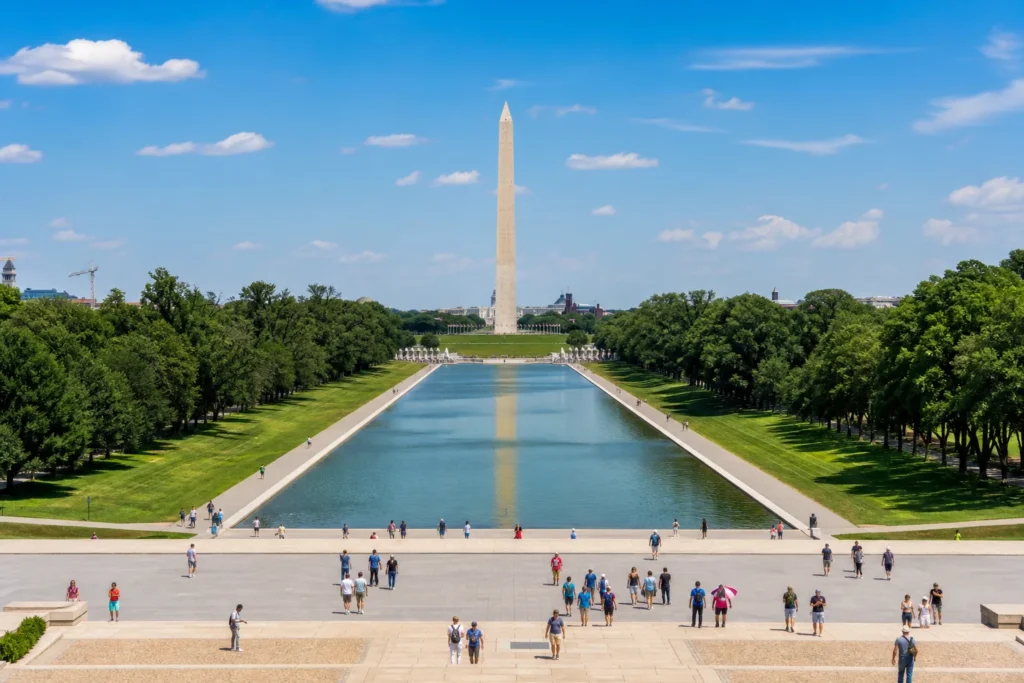
The Mall’s memorials. Including the Lincoln and Jefferson Memorials.
Provide civic context and dramatic vistas, while the National Gallery of Art adds fine‑art depth and the National Zoo supplies family-friendly conservation programming. Together these sites make Washington ideal for history, art, and policy-minded travelers.
Top Things to Do in Washington, District of Columbia
The National Mall and its adjacent museums and memorials form a compact itinerary where you can link major collections and civic sites on foot. Below are the essential places and institutions to plan into a Mall-area visit.
National Mall
The National Mall is Washington’s defining civic green: a broad parkland linking the U.S. Capitol to the Potomac and concentrating memorials, plazas, and Smithsonian museums. Visitors encounter wide lawns, axial promenades, and framed vistas that make the Washington Monument and Lincoln Memorial focal points.
The Mall functions as park, museum campus, and ceremonial stage—hosting demonstrations, inaugurations, festivals, and everyday recreation depending on scheduled events.
Practical visiting favors walking, cycling, or short circulator rides; the Park Service provides maps, ranger-led programs, and wayfinding. Verify event closures or construction on official park pages before you travel.
National Museum of American History (Smithsonian)
The National Museum of American History collects, preserves, and interprets objects that tell the United States’ political, social, and cultural story. Located on Constitution Avenue NW, the museum displays nationally iconic artifacts alongside everyday objects—textiles, technology, political memorabilia, and entertainment items—that illuminate American life and change over time.
Galleries combine object-rich displays, film and media elements, and interpretive panels. The museum runs public programs and family activities and supports scholarly research; check the museum’s official pages for timed displays or conservation-related access changes before visiting.
Official National Museum of American History (Smithsonian) website →
National Air and Space Museum (Smithsonian)
The National Air and Space Museum interprets human flight and space exploration through a public collection of aircraft and spacecraft. On the Mall, galleries juxtapose large, iconic artifacts—such as early airplanes and Apollo-era craft—with conservation displays and narrative media that explain technological development and human stories in aviation and spaceflight.
The museum is paired with the Steven F. Udvar‑Hazy Center near Dulles for very large aircraft and visible restoration work.
Entry to the Mall building is free but may use timed-entry arrangements; check the museum’s site for current policies and consider the Udvar‑Hazy Center for large-object displays.
Official National Air and Space Museum (Smithsonian) website →
National Museum of African American History and Culture (Smithsonian)
The National Museum of African American History and Culture is the nation’s only museum devoted exclusively to African American life, history, and culture.
Sited on the National Mall with a layered bronze façade, the museum uses objects, oral histories, and performance to trace long arcs of experience—from forced migration and slavery through civil rights to cultural expression in music, fashion, and sport.
Galleries balance historical depth and cultural breadth, pairing fragile artifacts with photographs, film, and first‑person testimony. The museum operates public programs and scholarship; it requires free timed-entry passes for general admission, so reserve ahead and consult official visitor pages for accessibility and policy details.
Official National Museum of African American History and Culture (Smithsonian) website →
United States Capitol / Capitol Visitor Center
The Capitol Visitor Center (CVC) is the formal public entry to the U.S. Capitol complex, located mainly underground on the building’s east side. Emancipation Hall, the CVC’s central space, rises beneath a skylight and displays items such as statues from the National Statuary Hall Collection and a model of the Capitol Dome.
The Center offers an orientation film, exhibitions on how Congress works, and hands-on learning in the Democracy Lab.
All guided Capitol tours begin at the Visitor Center and typically include the Crypt, Rotunda, and National Statuary Hall. Expect security screening and check the CVC’s official site for tour reservations and same-day pass availability.
Official United States Capitol / Capitol Visitor Center website →
The White House / White House Visitor Center
The White House Visitor Center, a short walk from the White House, interprets the president’s residence through exhibits, a large-scale model, and media that explain architecture, restoration, and the lives of first families.
Operated by the National Park Service with the White House Historical Association, the Center presents tactile elements and rotating displays suitable for family visitors.
Because interior White House tours are arranged through congressional or diplomatic channels, the Visitor Center is a practical first stop for maps, guidance on tour requests, ranger-led programming, and up-to-date visitor information. Check the Center’s official pages before arriving.
Official The White House / White House Visitor Center website →
Lincoln Memorial
The Lincoln Memorial is a monumental neoclassical temple at the west end of the National Mall. Visitors climb marble steps to enter a colonnaded chamber dominated by a seated figure of Abraham Lincoln; interior inscriptions include the Gettysburg Address and Second Inaugural Address.
The memorial’s axial placement provides frontal views down the Reflecting Pool toward the Washington Monument and Capitol, making it both a contemplative site and a formal terminus for the Mall’s central axis.
The memorial is publicly accessible without admission, and its scale and history also mark it as a civil‑rights landmark.
National Gallery of Art
The National Gallery of Art is a museum campus on the Mall composed of paired buildings, a Sculpture Garden, and research facilities.
The West Building focuses on European and American art up to the 19th century and features a Rotunda modeled on the Pantheon, while the East Building presents 20th‑century and contemporary art in a modern geometric plan. The Sculpture Garden brings large outdoor works into seasonal public view.
The Gallery’s collections span painting, sculpture, prints, and decorative arts; admission to the permanent collection is free. Use docent tours or audio resources for orientation and check official pages for temporary exhibitions and visitor services.
Smithsonian’s National Zoo
The Smithsonian’s National Zoo is a 163‑acre urban zoological park in Rock Creek Park and part of the Smithsonian Institution. The Zoo pairs public exhibits with the Smithsonian Conservation Biology Institute’s research programs, emphasizing species, ecosystems, and active science.
Popular routes include the Asia Trail (home to the panda program), Amazonia, and the American Trail, alongside modernized habitats like Elephant Trails and the historic Bird House.
The Zoo focuses on conservation, field programs, and public education. Admission is free; exhibits sometimes close for renovation, so confirm availability on the Zoo’s official site before visiting.
Jefferson Memorial (Tidal Basin)
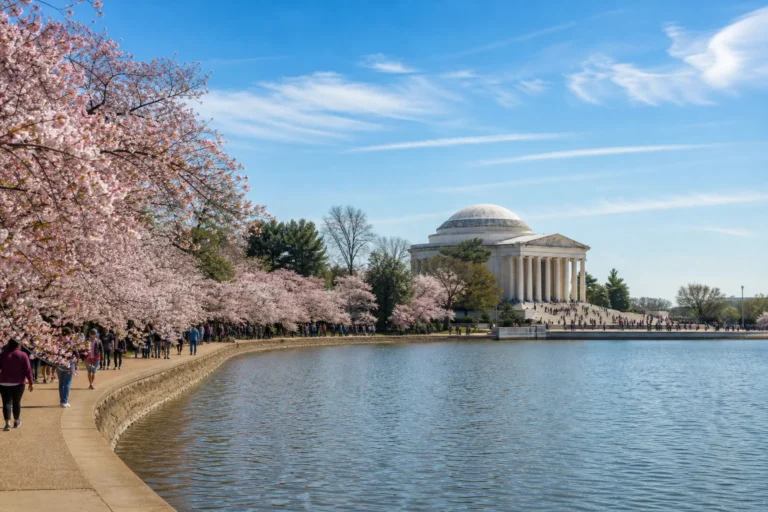
The Jefferson Memorial is a domed, classically inspired temple on the south shore of the Tidal Basin, honoring Thomas Jefferson with a bronze statue and inscriptions drawn from his writings.
Designed by John Russell Pope, the memorial aligns visually with the White House and Washington Monument to form a formal axis across the city’s monumental core.
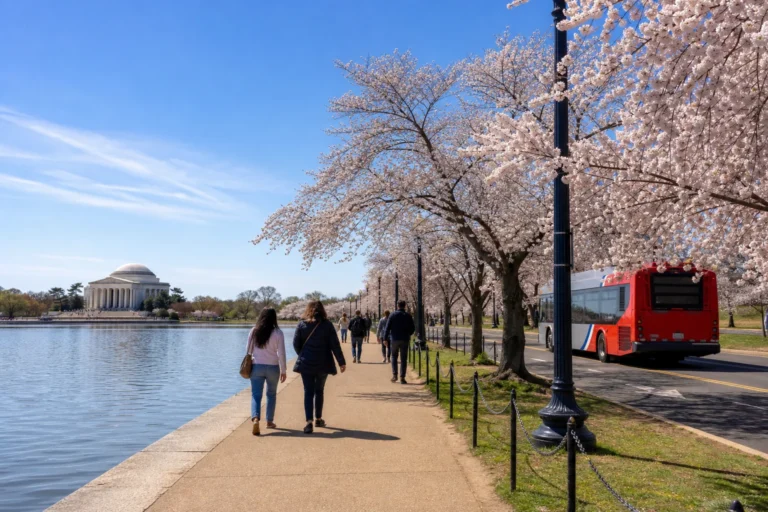
The waterfront setting and surrounding cherry trees shape the site’s seasonal character, especially in spring. Approach on foot from the Tidal Basin promenade, read the inscribed passages, and enjoy wide panoramas across the water.
The site is administered by the National Park Service.
Best Time to Visit Washington
Washington is visitable year-round, but seasons shape crowds and atmosphere. Spring draws peak visitation for the Tidal Basin cherry blossoms.
Summer brings the largest crowds and frequent cultural programs. Autumn offers milder weather and fewer tourists.
Winter is least crowded and easier for booking indoor museum time.
For shorter lines at major Smithsonian museums and the Capitol complex, aim for weekdays outside school holidays and reserve timed-entry passes or tours in advance for busy periods.
SPECIAL EVENTS IN Washington
National Memorial Day Concert
The National Memorial Day Concert is a nationally televised ceremony honoring U.S. Military service and those who made the ultimate sacrifice. Presented with the National Symphony Orchestra, military bands, celebrity hosts and dramatic readings, the program is filmed on the West Lawn of the U.S. Capitol and broadcast widely on public television. Travelers may plan to attend or view the free outdoor performance as a moving civic observance and photo opportunity near the National Mall; it’s also a high-profile local cultural event.
- Dates
- May 30, 2027
- Venue
- West Lawn of the U.S. Capitol
Getting Around Washington
The core attractions are concentrated and very walkable; plan walking loops on and around the National Mall to connect multiple museums and memorials. Metro rail and Metrobus serve the Mall and nearby neighborhoods, with short transit or walking distances to the Capitol Visitor Center, major Smithsonian museums, and the National Gallery.
Bike-share and e-scooter services cover short hops, and taxis or ride-hail work for early or late transfers or destinations beyond central D.C. A car is generally unnecessary for Mall-area sightseeing.
Location
Map of Washington, District of Columbia, United States
The interactive map loads only when you choose to view it.
Plan Your Visit to Washington
The National Mall and museum clusters are easiest visited on foot or by short Metro rides. Organize museum-heavy days by location (Smithsonian museums and the National Gallery along the Mall.
Air and Space and American History nearby).
Use a SmarTrip card for Metro and most buses, and consider the DC Circulator or dockless bikes for short trips. Many Smithsonian museums have free admission, but some popular sites require free timed-entry passes—reserve those in advance.
Allow extra time for security screening at the Capitol and White House areas.
Local Tips for Washington
Start early on the National Mall to avoid crowds and midday heat, and combine adjacent attractions where practical (for example, National Gallery with National Portrait Gallery or Lincoln Memorial with a Tidal Basin walk). Check each institution’s official visitor pages for ticketing, entry points, and bag policies before you go.
Wear comfortable shoes for varying surfaces, and if you plan to see cherry blossoms expect high visitor density during peak bloom. Consider off-peak times or guided routes.
Carry a refillable water bottle—refill stations are increasingly common.
Live conditions
Current Weather

Updated 2026-09-21 10:30
- Feels like
- 70°F / 21°C
- Today’s high / low
- 75°F / 24°C · 63°F / 17°C
- Humidity
- 65%
- Wind
- ↗ 7 mph
- Precipitation
- 0 in
- Chance of rain
- 52%
- Local time
- 2026-09-21 10:36
Safety and security
The Mall and major sites are generally safe but draw large crowds and demonstrations; follow guidance from National Park Service rangers, Capitol and National Park Police, or U.S. Capitol Police near government buildings. Expect routine security screening at museums, the Capitol Visitor Center, and White House viewing areas; prohibited-item lists apply.
Petty theft can occur in crowded areas—use a secure daypack or keep valuables discreet. In emergencies call 911; visitor-center staff and non-emergency police contacts can assist with lost property or crowd questions.