
Travel Guide
Plan your visit around Savannah Historic District, Forsyth Park, and more of Savannah, Georgia.
Discover the best things to do in Savannah, Georgia, from signature sights to memorable local experiences.
Georgia, start with the city’s compact, walkable Historic District where oak‑shaded squares, antebellum architecture, and museum clusters invite slow exploration.
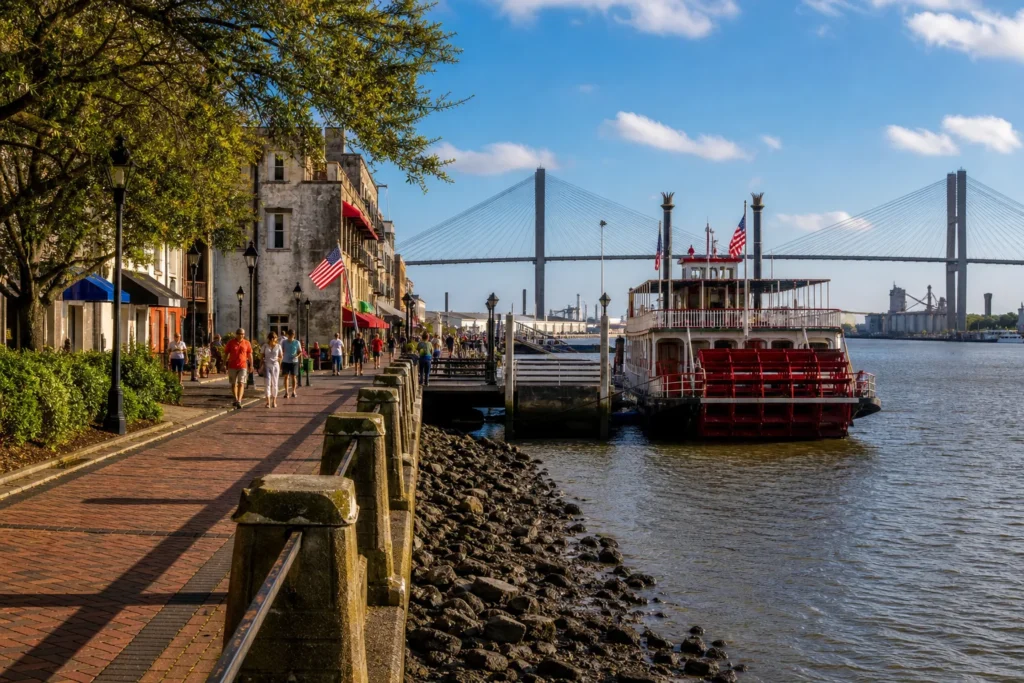
The cobblestone River Street waterfront and 30‑acre Forsyth Park anchor contrasting outdoor experiences, while Telfair Museums, the SCAD Museum of Art, and house tours provide concentrated cultural time.
Nearby Fort Pulaski, Wormsloe, and Bonaventure Cemetery extend visits into military, plantation, and maritime landscapes, making Savannah well suited to multi‑day stays focused on walking, photography, and history.
Why Visit Savannah
Savannah’s appeal rests on a distinctive Southern urban plan, well‑preserved historic architecture, and an active arts scene. The Historic District’s intimate public squares and varied domestic styles pair with museums—Telfair and SCAD among them—and a lively waterfront at River Street.
Nearby sites such as Fort Pulaski, Wormsloe, and Bonaventure Cemetery diversify the itinerary with coastal history, dramatic live‑oak avenues, and evocative funerary sculpture. The city’s compact center rewards slow walking, food‑forward days, and cultural discovery over several visits.
Top Things to Do in Savannah, Georgia
These highlights focus on walking the Historic District, waterfront promenades, major museums, and nearby state and national sites. Mix a few into a multi‑day plan depending on your interests.
Savannah Historic District (Historic Landmark District)
Savannah’s Historic Landmark District preserves James Oglethorpe’s 1733 grid of streets punctuated by more than twenty public squares. The district’s mix of colonial, Federal, and Victorian buildings shows continuous occupation and adaptive reuse across centuries, and its layout remains a living example of early urban planning.
Visitors move through narrow, shaded streets past historic homes, civic buildings, and moss‑draped live oaks. The riverfront, City Market, and museum clusters add commercial and cultural layers.
Practical visiting centers on walking and short tours; verify museum programs, guided‑tour availability, and special events on official sites before planning to avoid closures or schedule conflicts.
Official Savannah Historic District (Historic Landmark District) website →
Forsyth Park
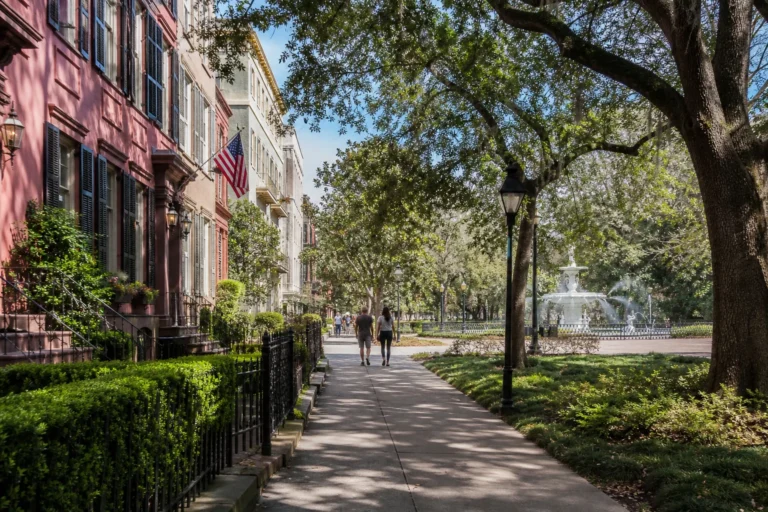
Forsyth Park is Savannah’s principal nineteenth‑century public green, expanded to roughly thirty acres and centered on its iconic cast‑iron fountain installed in 1858. Broad alleys, live oaks, framed vistas, and open lawns create a setting for photography, picnics, and everyday local life.
The park hosts concerts, markets, festivals, and informal recreation; features include a bandshell, playgrounds, and historic monuments. Allow time to walk the main promenade and explore adjacent neighborhoods and cafés.
Check official city or park pages for renovation notices or temporary closures before visiting.
River Street (Savannah River waterfront)
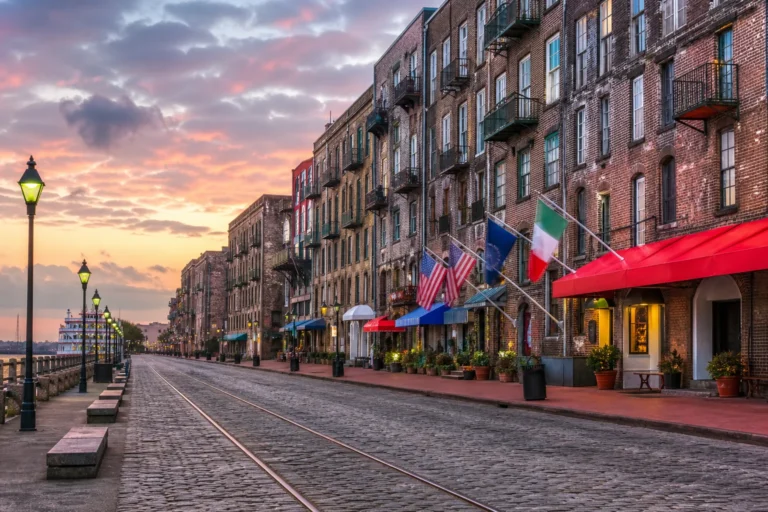
River Street runs along the south bank of the Savannah River with nineteenth‑century brick warehouses above a cobblestoned lower street, reflecting the area’s past as a working cotton port. Ramps, stairs, and the layered passageways of Factors Walk link the river level to Bay Street above.
The pedestrian esplanade offers river views, benches, ship‑watching, shops, galleries, and restaurants housed in adaptive‑reuse buildings. Uneven paving and steep ramps require comfortable shoes; allow extra time to explore side passages, historic plaques, and waterfront viewpoints, and verify tour or museum details on official sites before you go.
Bonaventure Cemetery
Bonaventure Cemetery sits on a wooded bluff above a tidal arm of the Wilmington River and is known for mature live oaks, hanging Spanish moss, and Victorian funerary sculpture. The landscape includes notable monuments, small family plots, and layers of social history dating to the nineteenth century.
Guided walks and maps from local historical organizations highlight famous graves and landscape features; the well‑known “Bird Girl” sculpture has been moved to a museum. Visitors should behave quietly, stay on established paths to protect plantings and monuments, and consult official cemetery or historical‑society resources for maps and tour schedules.
Telfair Museums (Telfair Academy, Owens-Thomas House & Jepson Center)
Telfair Museums comprises three nearby sites—Telfair Academy, Owens‑Thomas House & Slave Quarters, and the Jepson Center—that form a compact museum campus in Savannah’s historic core. The institution traces its origins to Mary Telfair’s nineteenth‑century bequest and is among the region’s oldest public museum entities.
Exhibits range from neoclassical period rooms and decorative arts to contemporary galleries. The Owens‑Thomas House interprets English Regency domestic life and includes interpreted slave quarters, while the Jepson Center hosts rotating modern and contemporary exhibitions.
Many galleries are self‑guided; the Owens‑Thomas House commonly uses guided tours—check the museum’s official site for program details.
Official Telfair Museums (Telfair Academy, Owens-Thomas House & Jepson Center) website →
Wormsloe State Historic Site
Wormsloe State Historic Site preserves a coastal plantation landscape on the Isle of Hope, best known for its dramatic live‑oak avenue that frames the old approach. The property contains tabby ruins, shell middens, and trails through maritime forest and saltmarsh that illustrate early colonial settlement and coastal ecology.
A visitor center provides interpretive exhibits about colonial life and the site’s habitats; trails lead to remnants of colonial foundations and shoreline viewpoints. Expect uneven footing and shady, sometimes wet paths—bring water, sun protection, and sturdy shoes, and consult Georgia State Parks for seasonal access or ranger‑led programs before visiting.
SCAD Museum of Art
The SCAD Museum of Art occupies a rehabilitated mid‑19th‑century railroad complex adapted into a contemporary museum space that highlights rotating exhibitions and teaching‑based programs. The building’s layered architecture combines historic Savannah gray brick with a modern expansion and courtyard used for outdoor projects.
Galleries present large installations, immersive video, and focused historical holdings; the museum links professional practice with student work across disciplines. Allow time for temporary exhibitions and collection highlights, and verify accessibility, guided‑visit options, and special programs on the museum’s official information pages before you go.
Fort Pulaski National Monument
Fort Pulaski stands on Cockspur Island at the mouth of the Savannah River, with massive brick walls, a wet moat, and casemates illustrating nineteenth‑century masonry fortification. The fort is best known for its April 1862 siege when rifled artillery breached the walls, signaling a major shift in military engineering.
A visitor center and exhibits explain construction and Civil War action; visitors can walk the ramparts, view the breached wall, and follow trails to nearby batteries and marsh viewpoints. Expect outdoor exposure on historic surfaces and check the National Park Service for current visitor guidance before traveling.
Best Time to Visit Savannah
Spring (March–May) is the most popular time for flowering trees, mild temperatures, and festivals. Autumn (September–November) offers warm days, thinner crowds after Labor Day, and comfortable walking weather.
Summer brings heat, humidity, and higher demand; winter is milder and quieter, useful for lower‑cost travel and indoor museum visits. For outdoor photography and comfortable walking, aim for late March–May or mid‑October–November to balance weather, daylight, and crowd levels.
SPECIAL EVENTS IN Savannah
SCAD Savannah Film Festival
The SCAD Savannah Film Festival is an acclaimed, university-run eight-day celebration of cinema in Savannah that brings award-winning features, shorts, documentaries, and animated films alongside panels, workshops, and industry honorees. Travelers interested in film, networking, and cultural events will find exclusive premieres, opportunities to meet filmmakers, and screenings at historic downtown venues. The festival also offers a lively city atmosphere with guided programming for students and the public, making it a compelling reason to visit Savannah for cultural tourism and film-industry engagement.
- Dates
- October 24, 2026 - October 31, 2026
- Venue
- Multiple SCAD venues including Trustees Theater; Lucas Theatre for the Arts; SCAD Museum of Art; Press Café; Gutstein Gallery
Savannah Book Festival
The Savannah Book Festival is a four-day literary celebration in Savannah’s historic downtown that brings nationally recognized and local authors together for headliner talks, a free Festival Saturday of author presentations, book signings, and a school outreach program (SBF@Schools). Travelers enjoy a compact, walkable schedule across historic squares and theaters, opportunities to meet authors, and cultural programming that pairs well with sightseeing, dining, and nearby museums. The festival is family-friendly and highlights Savannah’s literary and civic life.
- Dates
- February 4, 2027 - February 7, 2027
- Venue
- Lucas Theatre (headliner events) and multiple historic downtown venues for Festival Saturday
Savannah Music Festival
Savannah Music Festival is a multi-genre, springtime cultural festival that brings nationally and internationally acclaimed artists to historic downtown Savannah. Programming spans classical, jazz, roots, world music and contemporary acts, plus education initiatives like the Jazz Academy and Musical Explorers. Travelers value its mix of high-quality concerts across intimate and landmark venues, year-round community programming, and the opportunity to pair performances with Savannah’s architecture, dining, and tourism offerings. The festival is a major seasonal draw for music fans and cultural visitors.
- Dates
- April 2, 2027 - April 17, 2027
Getting Around Savannah
Savannah’s Historic District is compact and best explored on foot, with a grid of public squares linking museums, parks, and the riverfront. Trolleys, shuttles, and a downtown transit network provide short hops and guided introductions; taxis, ride‑hail, and bike rentals fill gaps to outlying sites.
Fort Pulaski and Wormsloe require driving or organized tours from downtown. Allow extra time for narrow streets, pedestrian zones, and uneven cobblestones along the waterfront.
Location
Map of Savannah, Georgia, United States
The interactive map loads only when you choose to view it.
Plan Your Visit to Savannah
Plan most visits around the Savannah Historic District and nearby squares, where major museums, house tours, and restaurants cluster. Allow at least half a day for Forsyth Park and the Historic District loop, a few hours for Telfair Museums or the SCAD Museum of Art, and a separate half‑day for Wormsloe and Bonaventure Cemetery.
Fort Pulaski is best combined with a coastal drive. Confirm museum hours, guided‑tour availability, and park access on official sites before you go.
Local Tips for Savannah
Wear sturdy shoes for cobblestones and uneven sidewalks; expect short walking hills in some blocks. Arrive early on River Street for quieter views and better photos.
For Bonaventure, Wormsloe, and Fort Pulaski, bring insect and sun protection plus water—trails and drives there are largely natural surfaces. Book museum admissions or house‑tour reservations in advance when recommended, and check each institution’s visitor rules and bag policies before arrival.
Live conditions
Current Weather

Updated 2026-09-21 10:00
- Feels like
- 85°F / 30°C
- Today’s high / low
- 88°F / 31°C · 73°F / 23°C
- Humidity
- 82%
- Wind
- ↗ 4 mph
- Precipitation
- 0.02 in
- Chance of rain
- 60%
- Local time
- 2026-09-21 10:02
Safety
Savannah is generally safe for daytime sightseeing, but practice ordinary urban precautions: be aware of your surroundings and secure valuables. Watch your step on historic cobblestones, uneven sidewalks, and wet riverfront bricks to avoid trips.
At coastal and island sites, follow posted guidance about tides, wildlife, and trail conditions; use official operators for ferry or boat access. In emergencies, follow municipal or National Park Service contacts listed on site signage or official web pages.