
Travel Guide
Plan your visit around Red Fort, Qutub Minar, and more of Delhi, India.
Things to do in Delhi span Mughal-era monuments, Victorian government buildings, lively traditional bazaars and contemporary cultural sites. The city concentrates UNESCO and nationally protected sites like the Red Fort, Qutub Minar and Humayun’s Tomb alongside civic monuments, large museums, prominent temples and one of India’s busiest international airport gateways.

Why Visit Delhi
Visit Delhi to experience India’s historical sweep and contemporary energy in one compact urban area. The city brings together major Mughal and Delhi Sultanate monuments, thriving traditional bazaars (notably Chandni Chowk), national institutions and museums, and commemorative civic spaces such as India Gate and the National War Memorial.
Religious and architectural diversity. From Jama Masjid’s courtyard scale to the quiet gardens of the Lotus Temple and the modern spectacle of Akshardham.
Makes Delhi ideal for history, architecture, food and institutional‑culture itineraries.

Top Things to Do in Delhi, India
Delhi’s key attractions cluster into heritage circuits, market streets, grand civic boulevards and modern cultural campuses. Below are the city’s essential monuments, markets and museums to plan into a visit.
Red Fort (Lal Qila)
The Red Fort (Lal Qila) is Shah Jahan’s 17th‑century fortified palace and a defining symbol of Mughal Delhi. Constructed mainly of red sandstone, the complex forms an irregular octagon with high enclosing walls, imposing gateways and a ceremonial face toward the Yamuna.
Inside, formal gardens and a sequence of public and private buildings—including the Diwan‑i‑Am and Diwan‑i‑Khas—show how administrative, ceremonial and residential zones were organized.
The fort’s surviving decorative work includes pietra dura, carved marble and painted plaster; many structures have been restored by the Archaeological Survey of India. Its location beside Old Delhi makes it easy to pair a visit with the bazaars and lanes beyond its gates.
Qutub Minar
Qutub Minar is the dominant brick‑and‑stone minaret of the Qutb archaeological complex in Mehrauli, begun in the late 12th and early 13th centuries.
The tapering tower features alternating bands of carved inscription, decorative flutings and projecting balconies and stands within a landscaped courtyard that includes medieval monuments such as the Quwwat‑ul‑Islam Mosque and the iron pillar famed for its corrosion resistance.
Inscribed as a UNESCO World Heritage property and managed by the Archaeological Survey of India, the complex illustrates early Indo‑Islamic architecture and the layered reuse of material and sites across centuries. Visitors can walk defined paths to view the tower and adjacent ruins from multiple angles.
Humayun's Tomb
Humayun’s Tomb is a pioneering 16th‑century Mughal garden‑tomb set within a formal charbagh that helped define later imperial mausolea in South Asia. The raised terraced plinth, symmetrical water channels and axial pathways frame the white‑and‑red mausoleum, whose double dome, high arches and recessed bays show a Persianate synthesis of form and proportion.
The wider enclosure contains several smaller tombs and structures, creating a layered archaeological setting that explains the development of dynastic mausolea. Conservation work and interpretive panels are commonly present; allow time to read the site as both funerary landscape and architectural prototype.
India Gate
India Gate is a monumental Lutyens‑era arch on New Delhi’s central ceremonial axis, conceived as a war memorial and sited to link the monument with surrounding government buildings and the Rashtrapati Bhavan.
Cut from sandstone and carved with inscriptions, the arch functions as both a place of remembrance and a popular public open space surrounded by broad lawns and tree‑lined avenues.
Visitors experience India Gate from the base lawns or the approach boulevard; photographers and strollers often remain after sunset when the lighting alters the stone’s appearance. Special events and commemorative ceremonies occur on the avenue, so check official notices when planning a visit.
National War Memorial
The National War Memorial is a contemporary commemorative landscape near India Gate that honours Indian Armed Forces personnel who died in post‑Independence conflicts. The site is organized as concentric rings and processional paths leading to a central obelisk and an eternal flame, with bronze plaques and sculptural tableaux that narrate service and sacrifice.
The memorial’s rings—Amar Chakra, Veerta Chakra and Tyag Chakra—present thematic spaces for names, reliefs and sculptural works, shaping a solemn, readable circulation. It functions as both a public place of reflection and a site for state observances; interpretive panels and controlled access to certain zones are commonly in place.
Lotus Temple (Bahá’í House of Worship)
The Lotus Temple, formally the Bahá’í House of Worship in New Delhi, is a modern religious building shaped like a blooming lotus, composed of curving, petal‑like concrete shells arranged around a nine‑sided central hall.
Nine entrances open from landscaped gardens into a spare interior reserved for silent prayer and meditation rather than ritual furniture or clergy.
Light filters softly through the shell structure, creating a contemplative atmosphere; the surrounding gardens and information centre support reflection and visitor orientation. The House of Worship welcomes people of all backgrounds while maintaining guidelines for silence and respectful conduct.
Akshardham Temple (Swaminarayan Akshardham)
Swaminarayan Akshardham is a modern mandir complex noted for richly carved pink sandstone and white marble architecture, extensive sculpted reliefs and a large campus of exhibitions and gardens. The main mandir is raised on a plinth and emphasizes traditional stone construction and detailed iconography celebrating saints, avatars and cultural motifs.
The complex includes curated exhibitions with audiovisuals, landscaped water features and an evening water‑light show; it functions as both a devotional site and a cultural campus. Security screening and bag restrictions are common, and visitors should allow several hours to see the mandir, exhibitions and gardens at a relaxed pace.
Official Akshardham Temple (Swaminarayan Akshardham) website →
Jama Masjid
Jama Masjid is a large 17th‑century congregational mosque in Old Delhi, built under Shah Jahan and notable for its broad forecourt, long prayer hall with three domes, and two tall minarets combining red sandstone and white marble.
The expansive open courtyard was designed to hold large congregations and remains a defining civic space amid the dense surrounding streets.
Visitors move through a sequence of thresholds from busy streets into the mosque’s ordered open space; terraces and minarets offer views over the surrounding lanes and nearby Red Fort. Because it is a living religious site, visitors should observe modest dress and respectful behaviour and time visits outside main prayer hours when possible.
Chandni Chowk (Old Delhi market)
Chandni Chowk is Old Delhi’s historic commercial spine, laid out in the seventeenth century and now a dense network of specialized lanes where jewelers, grocers, cloth merchants and book sellers maintain long‑standing trades.
The market functions as a series of distinct bazaars—Dariba Kalan, Kinari Bazaar and Nai Sarak among them—each with its own trade focus and atmosphere.
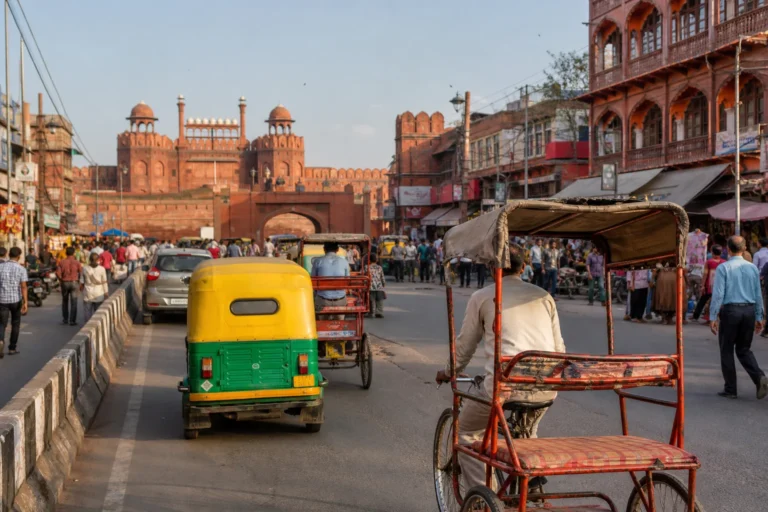
Sights include crowded storefronts, hawkers, manual trolleys and lively street food stalls; the market sits immediately outside the Red Fort and Jama Masjid, making it easy to combine monument visits with shopping and food exploration. Practical tips: travel light, wear comfortable shoes, and allow time for slow walking and bargaining.
National Museum, New Delhi
The National Museum on Janpath is India’s principal state museum, with collections spanning prehistoric times to the modern era. Galleries present sculpture, paintings, coins, textiles, manuscripts and archaeological finds that trace the subcontinent’s cultural and chronological development, highlighting miniature paintings, Buddhist and Hindu sculpture and numismatics.
Beyond exhibits, the museum functions as a research and educational centre with conservation labs, guided tours and rotating temporary exhibitions. Allocate several hours to see core galleries and special displays, and check the museum’s official information for current ticketing and gallery closures.
Best Time to Visit Delhi
Delhi has a strongly seasonal climate. Winters (late November–February) are mild and dry and the most comfortable for sightseeing; early spring and late autumn are also pleasant.
Summers (April–June) bring very high temperatures, while the monsoon (July–September) reduces heat but brings humidity and localized flooding. Major festivals fall in winter and autumn, so plan around national observances if you prefer smaller crowds or specific cultural programming.
Getting Around Delhi
Delhi’s transport network mixes a high‑capacity metro, extensive bus routes, suburban rail and road options (taxis, app rides, cycle rickshaws). The Delhi Metro links most tourist clusters and the airport; buses and suburban rail fill other corridors.
In Old Delhi and market areas, walking combined with short rickshaw or e‑cycle trips is most practical. Expect road congestion at peak hours—use the metro for predictable cross‑city transfers and allow extra time when travelling by road.
Location
Map of Delhi, India
The interactive map loads only when you choose to view it.
Plan Your Visit to Delhi
Delhi is served by Indira Gandhi International Airport and an extensive metro system. Use the Delhi Metro for the fastest, most predictable journeys and buy or top up an official metro card or app.
Major sights sit in separate clusters—plan neighbourhoods by transport node and allow time for traffic when transferring by road.
Carry a photocopy of your ID and small change for entry or offerings, and check official sites for current access arrangements and any conservation work.
Local Tips for Delhi
Markets like Chandni Chowk reward exploration. Wear comfortable shoes, expect narrow lanes, and keep a firm hold on bags.
Bargaining is normal in bazaars while government stalls often have fixed prices. Dress respectfully at religious sites (cover shoulders and knees; head coverings may be required in some mosques and gurdwaras).
Use official pre‑paid taxi booths at airports and major stations or app-based taxis, and favour busy, high‑turnover street‑food stalls while carrying hand sanitizer. Download metro and tourism apps and save offline maps for Old Delhi’s alleys.
Live conditions
Current Weather

Updated 2026-09-23 06:00
- Feels like
- 27°C / 81°F
- Today’s high / low
- 36°C / 97°F · 27°C / 81°F
- Humidity
- 46%
- Wind
- ↗ 7 km/h
- Precipitation
- 0 mm
- Chance of rain
- 1%
- Local time
- 2026-09-23 06:19
Safety in Delhi
Delhi is generally safe for tourists but petty theft and pickpocketing occur in crowded areas and on public transport—carry valuables in an inside pocket and consider a money belt. Women travellers should prefer registered taxis or the metro; helplines such as 1091 are available.
Avoid isolated streets after dark, use pre‑paid taxi booths at transport hubs, and be aware of seasonal air pollution and high summer heat. Keep travel and health insurance and note local emergency contacts and nearest medical facilities.