
Travel Guide
Plan your visit around Nara Park, Tōdai-ji Temple, and more of Nara, Japan.
Things to do in Nara range from strolling with free‑roaming deer in Nara Park to visiting Tōdai‑ji’s Daibutsuden and wandering Naramachi’s merchant streets. Nara’s compact historic core concentrates major temples, shrines, museums and gardens within easy walking distance, so you can combine spiritual sites, green space and neighborhood exploration in a single day.

Why Visit Nara
Visit Nara to experience Japan’s classical era in a human‑scale setting where major cultural sites are immediately accessible. See one of the world’s largest bronze Buddhas at Tōdai‑ji, stroll lantern‑dappled approaches at Kasuga Taisha, and watch deer graze beneath temple trees in Nara Park.
The Nara National Museum and gardens like Isuien concentrate Buddhist art and refined landscape design, while Naramachi’s merchant houses reveal domestic architecture and living craft traditions. Nara is ideal for travelers who want accessible cultural immersion without the scale of a big city.

Top Things to Do in Nara, Japan
Nara’s main sights sit close together around tree-lined Nara Park, making it easy to combine temples, shrines, museums and neighborhood streets on a single walking route.
Nara Park (and its free-roaming deer)
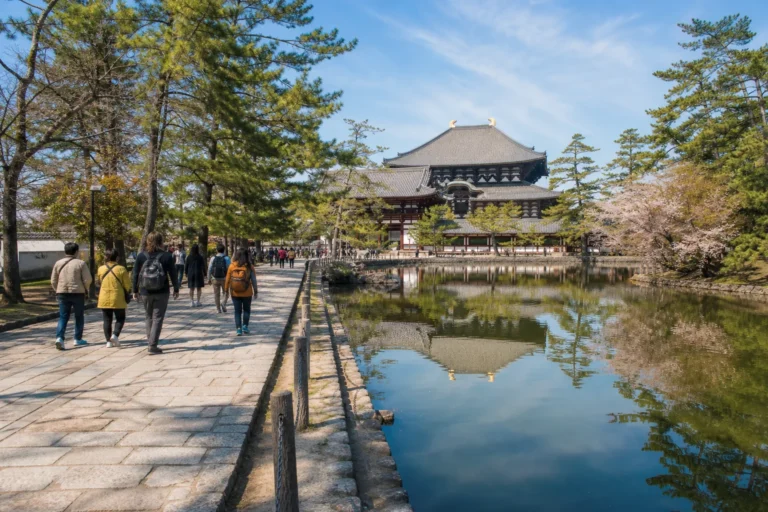
Nara Park is a broad, gently wooded public park at the heart of Nara that links major temples, shrines, museums and traditional streets. Its open lawns, ponds and tree‑lined avenues create a calm setting for walking and short explorations, with quieter pockets for picnics and seasonal views of cherry blossoms and autumn color.
The park is best known for its free‑roaming sika deer, long regarded in local Shinto belief as messengers of the gods. The deer are protected and accustomed to people; designated feeding crackers are sold at kiosks and local guidance explains safe ways to approach and feed them.
Tōdai-ji Temple (Great Buddha / Daibutsuden)
Tōdai‑ji is a monumental eighth‑century Buddhist complex whose Daibutsuden (Great Buddha Hall) houses a colossal seated Vairocana statue widely known as the Great Buddha.
Approaching through the Nandaimon (Great South Gate) with its guardian statues creates a dramatic transition into the precinct, where the scale of the hall and ritual objects evokes both devotion and historic craftsmanship.
The present Daibutsuden is a later reconstruction that preserves the Daibutsuyō timber tradition introduced from continental East Asia.
Tōdai‑ji is part of the Historic Monuments of Ancient Nara (a UNESCO World Heritage grouping) and pairs easily with nearby park walks, subsidiary halls and the temple museum—allow time to absorb the interior scale and the surrounding tree‑lined processional ways.
Kasuga Taisha Shrine
Kasuga Taisha sits within an ancient cedar‑shaded precinct at the eastern edge of Nara Park and is famous for its hundreds of stone lanterns and the covered corridors hung with bronze lanterns. Approaching through torii gates and tree‑lined paths leads visitors past these massed lanterns—many donated over centuries—which define the shrine’s distinctive atmosphere.
Architectural highlights include bright vermilion halls, white walls and hinoki‑cypress roofs set against primeval woodland. The shrine enshrines deities historically linked to protection of the old capital and maintains treasure and exhibition spaces that interpret ritual objects.
Regular festivals and lantern observances continue here; check official sources for current schedules and allow time to walk the approaches slowly and notice the variety of lantern inscriptions.
Kōfuku-ji Temple
Kōfuku‑ji is one of Nara’s principal Buddhist complexes, historically associated with the Fujiwara family and immediately recognizable for its tall five‑storied pagoda that shapes the city skyline. Founded in the eighth century, the temple preserves multiple nationally designated treasures—pagodas, halls and sculptures—that reflect centuries of religious practice and aristocratic patronage.
The five‑storied pagoda visible from Nara Park is the site’s most familiar element; its present form dates from later reconstructions. On‑site collections and exhibition spaces help visitors understand the temple’s art and ritual objects.
Kōfuku‑ji pairs naturally with nearby Nara Park walks; take time to view the pagoda from different approaches and use displays or guides to appreciate the site’s layered history.
Nara National Museum
The Nara National Museum concentrates on Buddhist art and cultural materials from Japan’s ancient capital, with galleries that emphasize carved statuary, painted scrolls, sutra manuscripts and ritual paraphernalia produced for regional temples.
A permanent Buddhist Sculpture Hall showcases nearly one hundred important figures organized to highlight stylistic change across centuries, and the museum’s holdings include multiple nationally designated objects.
Architecturally, the museum blends Meiji‑era masonry and later gallery additions to create spaces for close inspection and comparative viewing. The institution is active in conservation and research, often staging rotating special exhibitions that borrow works from temple treasuries—check current temporary displays and visitor guidance before you go.
Isuien Garden
Isuien Garden is a compact strolling garden that combines two historical layers: an Edo‑period front garden and a Meiji‑era back garden. The front garden creates an enclosed tea‑garden atmosphere, while the back garden uses borrowed scenery (shakkei) to incorporate Nara’s surrounding hills and the distant gate of Tōdai‑ji into its composition.
Walking the garden reveals composed views—stepping stones, mossed banks and a reflective pond—that change with the seasons. Stone lanterns, teahouses and a small museum of East Asian antiquities are integrated into the grounds, and volunteer guides or interpretive panels explain the garden’s layered history.
Isuien pairs easily with a route through central Nara and merits time for slow walking and photography.
Naramachi historic merchant district
Naramachi is Nara’s compact historic merchant quarter, concentrated south of Nara Park and formed from Edo–Meiji period machiya townhouses, narrow lanes and artisanal shopfronts. Many original structural features remain, so visitors can see long narrow façades that once combined shop, workshop and living space, plus inner courtyards and hidden gardens preserved in some houses.
Small museums and preserved machiya let you step inside period domestic spaces, while craft shops sell regional ceramics, traditional toys and local calligraphy. The district blends heritage with contemporary uses—cafes, boutique ryokan and galleries occupy restored buildings—so plan to explore on foot and consult local maps or visitor centres for walking routes and building histories.
Best Time to Visit Nara
Spring (late March–May) and autumn (October–November) are the most rewarding seasons to visit Nara. Cherry blossoms soften the park and shrine precincts from late March into early April, while autumn brings vivid maples and comfortable daytime temperatures ideal for walking.
These shoulder seasons avoid Japan’s peak summer heat and the coldest weeks of winter, making outdoor exploration of temple grounds and Naramachi more pleasant. Festival dates vary each year, so check official shrine and city sources for exact calendars before planning.
Getting Around Nara
Nara’s core attractions are compact and best explored on foot; Nara Park, Tōdai‑ji, Kasuga Taisha, Kōfuku‑ji and Naramachi cluster within a roughly 2–3 km area. Local loop buses and the Nara Kotsu network handle short hops to outlying temples.
Kintetsu and JR rail services link Nara with Osaka and Kyoto for one‑day trips. Bicycles are widely available for short distances, and taxis serve late‑night or accessibility needs.
Use official transit maps for route planning and service notices.
Location
Map of Nara, Japan
The interactive map loads only when you choose to view it.
Plan Your Visit to Nara
Allow flexible blocks of time rather than a strict timetable. Principal sites around Nara Park (Tōdai‑ji, Kasuga Taisha, Kōfuku‑ji, Nara National Museum and Isuien Garden) are within easy walking distance but each typically needs 30.
90 minutes depending on interest.
Buy special-exhibition tickets at museums on arrival and check official attraction pages for guided‑tour availability. Use Nara Kotsu bus passes or one‑day area passes if you prefer fewer walks between zones.
For a simple midday meeting point, choose one station (Kintetsu or JR) to simplify transfers.
Local Tips for Nara
Concentrate time around Nara Park and the clustered monuments, then wander Naramachi for shops and preserved machiya houses. Train access is easiest via Kintetsu‑Nara (closest to Naramachi) or JR Nara (a short walk or bus ride to the park).
Both networks accept national IC cards.
For short hops use the low‑fare Gurutto/Loop buses or rentable bicycles near the stations. Tourist information counters at Kintetsu and JR stations can provide route maps and luggage‑forwarding help.
Live conditions
Current Weather

Updated 2026-09-21 01:15
- Feels like
- 25°C / 77°F
- Today’s high / low
- 25°C / 77°F · 22°C / 71°F
- Humidity
- 81%
- Wind
- ↑ 10 km/h
- Precipitation
- 0.01 mm
- Chance of rain
- 48%
- Local time
- 2026-09-21 01:18
Safety
The free‑roaming deer in Nara Park are wild animals and should be treated with respect. Follow park guidance: do not chase, corner, or feed deer anything other than the specially sold deer crackers, and supervise children.
Deer can bite, butt with antlers, or become aggressive around food or during breeding season—give them space. Also obey on‑site rules at shrines and temples: drones, smoking, and certain photography are often prohibited in sensitive areas.
For longer trips outside the city, check local transport and weather advisories and consider travel insurance.