
Travel Guide
Plan your visit around Kenrokuen Garden, Kanazawa Castle, and more of Kanazawa, Japan.
If you’re looking for things to do in Kanazawa, this compact city combines Kenrokuen Garden, preserved samurai and geisha districts, contemporary museums, and a bustling fish market within a short radius.
Formerly the Maeda clan’s domain capital, Kanazawa is notable for well‑preserved Edo‑period streetscapes, a strong crafts tradition, and museums that link traditional artistry with modern design.

Why Visit Kanazawa
Visit Kanazawa to experience a concentrated combination of Japan’s classical garden culture, well‑preserved historical districts, and regional cuisine. Kenrokuen Garden is a textbook strolling garden; Higashi Chaya and Nagamachi reveal geisha and samurai townscapes respectively; Omicho Market showcases fresh seafood and local produce.
Contemporary museums and specialized craft workshops—gold leaf, Kaga yuzen textiles, and lacquer—add modern and artisanal layers to a walkable city itinerary.
Top Things to Do in Kanazawa, Japan
Kanazawa’s highlights are clustered within a short walk: classical gardens, a castle park, preserved chaya and samurai quarters, a lively market, and notable museums that span traditional crafts to contemporary art.
Kenrokuen Garden
Kenrokuen Garden is one of Japan’s Three Great Gardens and was developed by the Maeda lords as a daimyo strolling garden beside Kanazawa Castle. The landscape is composed for sequential appreciation: winding paths, ponds such as Kasumigaike, teahouses, artificial hills, and framed views that change with each step.
The garden’s name refers to six ideal attributes—spaciousness, seclusion, artifice, antiquity, water sources, and panoramic views.
Long-established features include the oldest pump‑free fountain in Japan, water supplied via the Tatsumi Canal, and winter yukitsuri rope supports on pine branches. Seasonal plantings—plum and cherry blossoms, irises, azaleas and autumn maples—structure visits across the year, and interpretation panels or an audio guide explain named elements like Horai Island.
Kanazawa Castle
Kanazawa Castle sits beside Kenrokuen and forms the historic core around which the city developed under the Maeda clan. While many original buildings were lost to fire over time, the grounds preserve extensive stone walls, reconstructed gates and turrets, repaired ramparts, and museum displays that interpret feudal governance and urban development.
The site balances fortification features with landscaped parkland used year‑round for viewing foliage and events.
Visitors commonly walk the moats and ramparts, examine reconstructed storehouses and tiled roofs, and see traditional construction methods such as wooden joinery and plastered walls. The Gyokuseninmaru Garden within the compound is a refined samurai‑era garden offering sheltered tea service in a quieter setting.
Higashi Chaya District
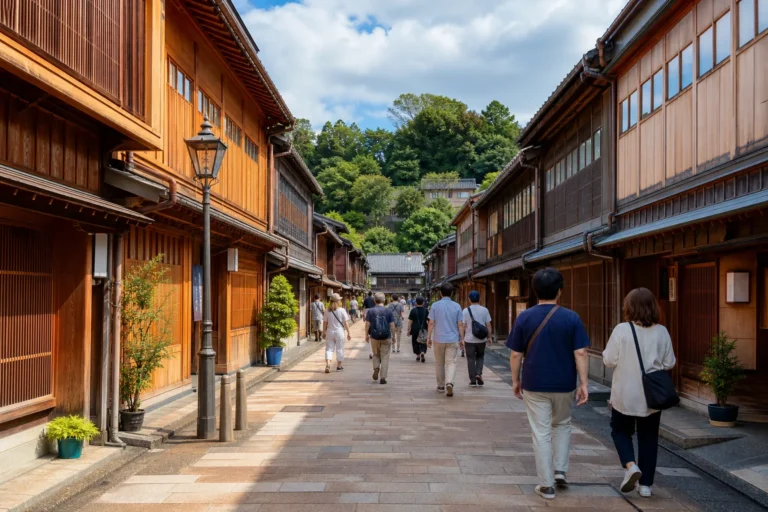
Higashi Chaya District preserves Kanazawa’s best‑known teahouse quarter, where two‑story wooden chaya facades and dark latticed windows form narrow, stone‑paved lanes dating to the Edo period. Many buildings are protected as Important Preservation Districts for Traditional Buildings, so the area retains authentic architectural features rather than modern replicas.
The streetscape evokes the atmosphere of historical entertainment culture.
Several former chaya operate as museums, teahouses, or restaurants open to the public, allowing peeks into lacquered interiors and spaces used for music and dance. Long‑established shops sell local crafts, gold‑leaf goods, and confections.
Some private experiences, such as geisha entertainment, require advance arrangements, and pedestrian surfaces include uneven stone and short steps—comfortable shoes are advised.
Nagamachi Samurai District
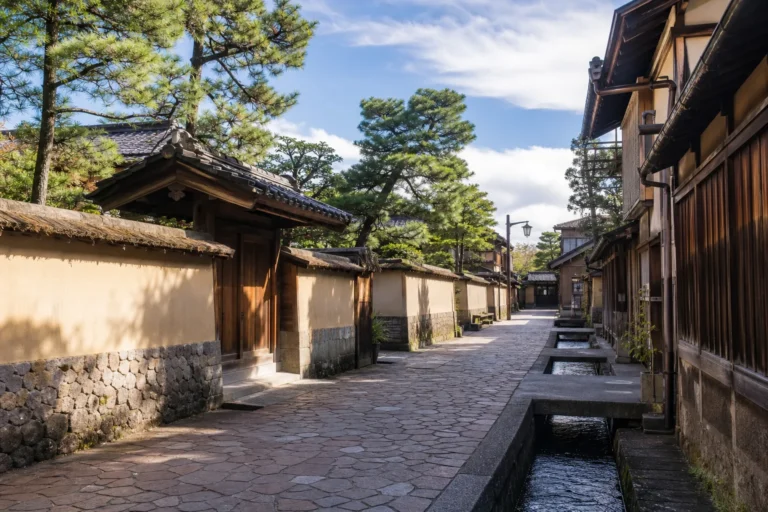
Nagamachi Samurai District preserves a residential quarter of middle‑ and upper‑ranking samurai from the Maeda domain. The defining features are low earthen walls (tsuchi‑kabe), narrow lanes, small canals, and gate‑fronted bukeyashiki samurai houses, producing a tangible sense of Edo‑period domestic architecture and urban planning.
The surviving streetscape emphasizes the town’s relationship to Kanazawa Castle.
Key stops include the Nomura‑ke (Nomura family residence) and similar restored houses that show tatami rooms, tokonoma alcoves, household fittings, and storage arrangements. Conserved waterworks and cisterns illustrate practical infrastructure.
The district is compact and best explored on foot; some streets are uneven and constrained, and exhibit access can change during conservation work.
21st Century Museum of Contemporary Art, Kanazawa
The 21st Century Museum of Contemporary Art is a public, light‑filled museum designed by SANAA (Kazuyo Sejima and Ryue Nishizawa) and opened in 2004. Its low circular plan and broad glass walls have no single front, inviting approaches from multiple directions and linking the building with surrounding parks.
The museum presents a mix of permanent installations and rotating exhibitions, including site‑specific and playful works that encourage physical engagement and social interaction.
Architectural features—daylighting, open sightlines, and thresholds between indoor galleries and exterior lawns—shape visits as much as the artworks. The museum includes quieter gallery rooms, a library, and learning spaces; specific exhibitions and access to particular installations change periodically, so check official listings before visiting.
Omicho Market
Omicho Market is Kanazawa’s long‑standing working food market, historically established to centralize fishmongers and greengrocers. Today roughly one hundred and seventy shops cluster under covered arcades and low‑rise buildings, selling fresh seafood, seasonal produce, prepared foods, pickles, sweets, kitchenware and local crafts.
The market remains both a retail hub for residents and a destination for visitors.
Vendors display catches from the Sea of Japan and produce from the Kaga plain; many stalls offer small tastes and standing counters serving seafood bowls and quick sushi. The market is busiest in the morning and at lunchtime—arrive early for the freshest selections—and expect narrow aisles and active working areas.
Bring small bills and plan to pause at counters rather than wander while eating.
D.T. Suzuki Museum
The D.T. Suzuki Museum commemorates Kanazawa‑born scholar Daisetz Teitaro Suzuki (1870–1966) and is designed by Yoshio Taniguchi to encourage reflection. The building is spare and quietly composed, with a small sequence of galleries and a central courtyard where light, water, and wood frame contemplative pauses.
Exhibits focus on Suzuki’s writings, translations, and his influence on modern Zen, using succinct texts, select original documents, and reserved displays.
The museum pairs short interpretive panels with seating niches for reading and quiet study, and a shallow reflecting pool encircles part of the building to capture seasonal light. The scale is intimate, so visits are typically brief and deliberately paced—allow time to sit and absorb the setting.
Myoryu-ji (Myoryu-ji "Ninja Temple")
Myoryu‑ji, commonly called the “Ninja Temple,” is a temple complex noted for defensive and deceptive architectural features incorporated during the Edo period. Built by the Maeda domain, the compound includes concealed stairs, hidden rooms, false floors and narrow observation points intended to confuse intruders while maintaining a temple identity.
The interior passages deliberately change direction and include landings and spaces that disorient first‑time visitors.
Visits are by guided tour only and generally require advance reservation; tours typically last around forty minutes and explain construction tricks and their historical rationale. English‑speaking guides are often available by prior arrangement, and photography or access to some areas may be restricted due to active rituals and preservation needs.
Best Time to Visit Kanazawa
Kanazawa rewards year‑round, with distinct seasonal character. Spring (March–May) brings cherry blossoms and mild weather; autumn (October–November) offers cool days and vivid foliage around Kenrokuen.
Winter (December. February) frequently covers the city in snow and is prized by photographers, while summer includes a hot, humid spell and a rainy season (mid‑June to mid‑July).
For milder weather and balanced crowds, late spring or mid‑autumn are ideal.
Getting Around Kanazawa
Kanazawa’s compact central district is best explored on foot; Kenrokuen, Kanazawa Castle, Higashi Chaya and Omicho Market lie within comfortable walking distance of one another. A frequent loop bus connects major sights for short hops and is useful for first-time visitors.
Regional trains including the Hokuriku Shinkansen connect Kanazawa Station to Tokyo and Kyoto. Local buses serve neighborhoods and museum corridors; short bicycle rentals and taxis provide flexible last‑mile options.
Check official city transit resources for current route maps and seasonal advisories.
Location
Map of Kanazawa, Ishikawa, Japan
The interactive map loads only when you choose to view it.
Plan Your Visit to Kanazawa
Plan arrival via the Hokuriku Shinkansen or regional limited-express trains to Kanazawa Station; Komatsu Airport links by bus. Base yourself near Kanazawa Station, Korinbo, or Hakomachi for easy access to the castle/Kenrokuen cluster.
Allow a full morning for Kenrokuen and the adjacent castle park, half to three-quarters of a day for Higashi Chaya and Nagamachi, and 1. 2 hours for the 21st Century Museum.
Use local bus maps or the city’s digital transit portal to combine stops and check individual sites for current opening and access details.
Local Tips for Kanazawa
Kanazawa’s compact central area makes walking the best way to link Kenrokuen Garden, Kanazawa Castle, Higashi Chaya, Nagamachi and the 21st Century Museum. Most highlights lie within 20.
30 minutes on foot of Kanazawa Station. Use the city’s loop buses for longer hops and consult the Norimasshi/Kanazawa digital transit portal for day passes.
Arrive early at Omicho Market for the freshest seafood and smaller crowds. Carry cash for small vendors, bring a light umbrella (summer rains/typhoon season), wear comfortable shoes for stone streets, and book guided visits in advance for sites that limit numbers such as Myoryu‑ji.
Live conditions
Current Weather

Updated 2026-09-23 10:15
- Feels like
- 25°C / 76°F
- Today’s high / low
- 25°C / 77°F · 17°C / 62°F
- Humidity
- 69%
- Wind
- ↑ 6 km/h
- Precipitation
- 0 mm
- Chance of rain
- 26%
- Local time
- 2026-09-23 10:32
Safety
Ishikawa Prefecture has relatively low crime, but exercise normal urban caution: secure belongings in busy markets and on buses, and be aware of bicycles on narrow streets. Kanazawa is in a seismically active country—familiarize yourself with basic earthquake and evacuation procedures and local shelter locations.
Respect site restrictions at cultural properties (some buildings prohibit backpacks, large bags, or flash photography) and follow staff directions during guided tours such as Myoryu‑ji. In severe weather or typhoon season, check official transport notices for reduced services or temporary closures.