
Travel Guide
Find top sights, local places, maps, weather, and simple trip tips for Florence, Italy.
Looking for Things to Do in Florence, Italy? Use this guide to compare top sights, local tips, maps, weather, and nearby places.
Planning things to do in Florence begins with the compact, walkable historic centre clustered along the Arno between Ponte Vecchio and Piazza del Duomo.
Florence is renowned as the cradle of the Renaissance: the Duomo complex, Uffizi, Accademia, Palazzo Vecchio, Palazzo Pitti and Boboli Gardens form a dense cultural circuit, while medieval streets, artisan workshops and lively markets reward slow wandering as much as focused museum visits.
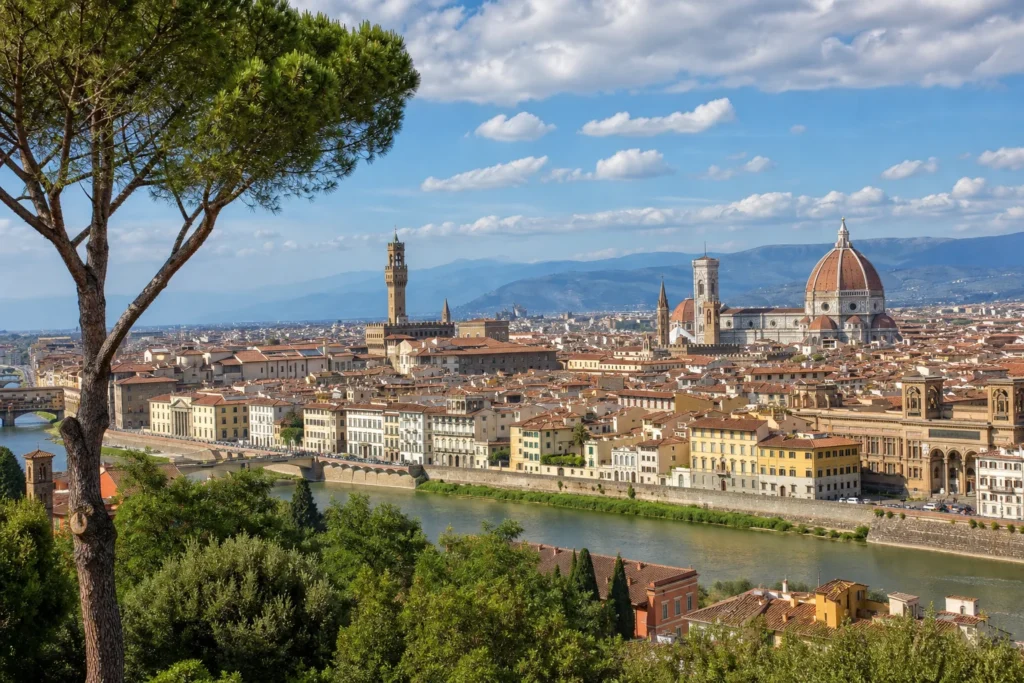
Why Visit Florence
Florence offers direct access to Renaissance masterpieces, landmark architecture and living civic history. Major galleries like the Uffizi and Accademia present seminal painting and sculpture.
The Cathedral of Santa Maria del Fiore and the Baptistery shape the skyline. And civic spaces such as Piazza della Signoria and historic palaces tell Florence’s political and Medici-era story.
Beyond museums, artisan studios, bakeries and markets provide everyday encounters with Tuscan food and craft traditions, making the city an immersive mix of art, history and urban life.
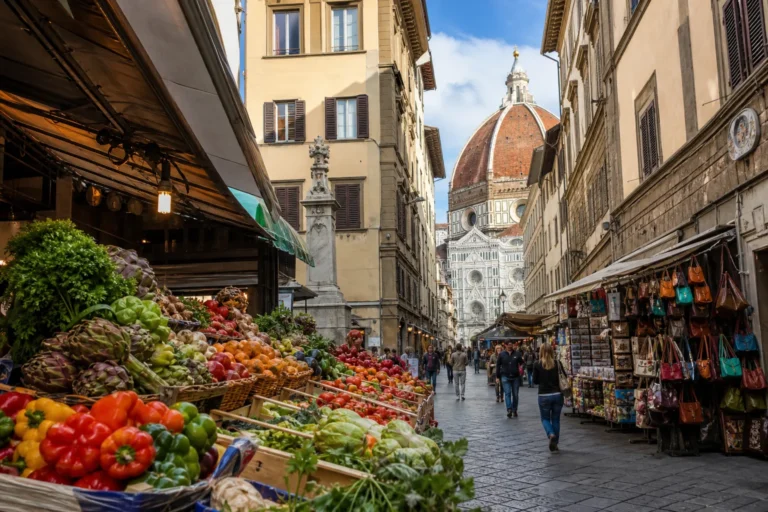
Top Things to Do in Florence, Italy
The following highlights cluster around the Duomo, the Arno and the Oltrarno quarter. Each entry focuses on what to look for and how the site fits into Florence’s civic and artistic story.
Cathedral of Santa Maria del Fiore (Florence Duomo)
The Cathedral of Santa Maria del Fiore dominates Piazza del Duomo with its polychrome marble exterior and the octagonal drum that supports Brunelleschi’s dome. Begun in 1296 to Arnolfo di Cambio’s plan, the cathedral functions as both a sacred space and a civic symbol for Florence.
Brunelleschi’s dome is an engineering milestone built without full wooden centring; its inner surface contains a monumental Last Judgment fresco cycle by Giorgio Vasari and Federico Zuccari. Inside, the three‑nave sequence, raised presbytery and side chapels reflect a Gothic plan adapted to Renaissance needs.
Practical visits use the Opera del Duomo ticketing system and originals are conserved in the nearby museum; check official information for access and climb rules.
Official Cathedral of Santa Maria del Fiore (Florence Duomo) website →
Baptistery of San Giovanni
The Baptistery of San Giovanni faces the Duomo and is one of Florence’s oldest monuments, noted for its octagonal plan and bronze‑clad doors. Its gilded mosaic dome preserves a medieval pictorial program centered on a cosmic Last Judgment, with Genesis and Joseph cycles executed by workshops influenced by Byzantine models.
Three pairs of bronze doors once served as main ceremonial entrances; the celebrated east pair by Lorenzo Ghiberti (the “Gates of Paradise”) are now preserved in the Opera del Duomo museum while replicas remain in place.
Visiting the baptistery provides a compact encounter with medieval mosaic technique and Florence’s civic and religious identity; consult Opera del Duomo for conservation updates and access arrangements.
Galleria degli Uffizi (Uffizi Gallery)
The Uffizi occupies the long Vasari building beside Piazza della Signoria and guides visitors through connected rooms arranged along a gallery sequence. Originally designed as Medici administrative offices, the building encourages a route that reads art across centuries rather than as isolated works.
The collection concentrates on Italian and European painting from the late medieval to early modern periods, with landmark works by Botticelli, Leonardo, Michelangelo, Titian and Caravaggio. Windowed galleries offer repeated framed views of the Arno and Ponte Vecchio, situating the paintings within Florence’s civic geography.
Book in advance and check the Uffizi’s official site for closures, accessibility services and current displays.
Galleria dell'Accademia (Accademia Gallery)
The Galleria dell’Accademia is best known as the indoor home of Michelangelo’s David, presented to preserve the sculpture from weather and crowding. The museum also holds Michelangelo’s unfinished Prisoners and the largest group of his sculptures, which reveal his carving process and studio practice.
The Accademia’s institutional history traces to an eighteenth‑century reorganization to house artworks transferred from churches and convents; David was moved from Piazza della Signoria in the nineteenth century for protection.
Galleries are compact and intended for concentrated encounters; reserve timed‑entry tickets, and consult the museum for accessibility, audio guides and temporary changes due to conservation or loans.
Official Galleria dell'Accademia (Accademia Gallery) website →
Palazzo Vecchio
Palazzo Vecchio overlooks Piazza della Signoria with a crenellated tower and fortress‑like silhouette that still reads as civic authority. The building functions as both a town hall and a civic museum, integrating public square, monumental rooms, private apartments and subterranean remains.
The museum route centers on the Salone dei Cinquecento, a vast painted hall with monumental fresco cycles and sculptural groups, while smaller state rooms and the Sala dei Duecento reveal shifting political programs. The palace preserves Medici apartments and the Studiolo of Francesco I; excavations beneath the palace have revealed Roman theatre remains.
Check municipal museum information for restorations and guided‑route options.
Palazzo Pitti
Palazzo Pitti sits on the south bank just beyond the Ponte Vecchio and served as the grand ducal residence of the Medici. Its broad façade faces the Boboli Gardens, forming a combined art‑and‑garden destination that illustrates princely display and evolving taste.
The piano nobile houses the Galleria Palatina and former royal apartments with courtly portraiture and decorative programs; specialized museums within the palace include the Gallery of Modern Art and the Fashion and Costume Museum. For combined tickets, seasonal routes and conservation notices consult the official Pitti and Uffizi information before visiting.
Boboli Gardens
The Boboli Gardens lie behind Palazzo Pitti as an expansive sculpted park of terraces, axial avenues and formal parterres. Begun for the Medici in the sixteenth century, the gardens function as an open‑air museum filled with ancient and Renaissance sculpture, monumental fountains and decorated grottoes.
Key features include the Viottolone cypress axis terminating at the Vasca dell’Isola, the Amphitheatre cut from a quarry, the Grotta del Buontalenti and the Fountain of Neptune. Paths climb and descend across a steep hillside, offering panoramic views of Florence and the Arno; sensible shoes and stamina improve the visit.
Consult the museum authority for access points and conservation notices.
Ponte Vecchio
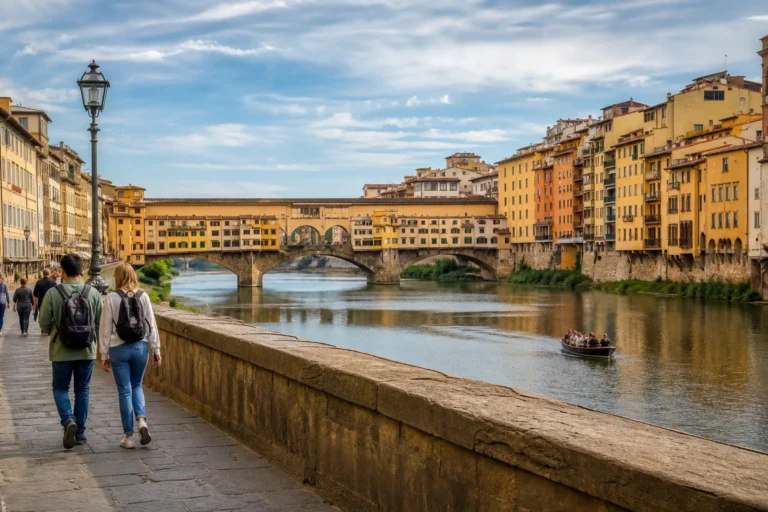
Ponte Vecchio crosses the Arno as a continuous line of shops on a mid‑fourteenth‑century stone bridge built after earlier wooden bridges were lost to flood. Its three segmental arches support a medieval market street where shopfronts lean over the roadway, creating an enclosed, atmospheric river crossing.
Historically the bridge hosted butchers and fishmongers until a Medici decree reserved its shops for goldsmiths and jewellers; above the shops runs the Vasari Corridor, a raised passage connecting Palazzo Vecchio with Palazzo Pitti. Crossing offers close views of the Arno and framed riverbank vistas—expect dense pedestrian traffic and many shopfronts at peak times.
Basilica of Santa Croce
The Basilica of Santa Croce stands on Piazza Santa Croce as Florence’s principal Franciscan church and an informal civic pantheon. Built from the late thirteenth century to a design attributed to Arnolfo di Cambio, the church combines a processional Gothic nave with rich chapels and funerary monuments.
Visitors encounter fresco cycles by Giotto and workshop, Donatello’s carved crucifix, and celebrated tombs for Michelangelo, Galileo, Machiavelli and others. The complex includes cloisters, small museums and Brunelleschi’s Pazzi Chapel within the cloister ensemble.
Allow time for measured looking at tomb sculpture, chapel programs and the relationship between civic memory and Franciscan devotion; check Opera di Santa Croce for access and conservation updates.
Best Time to Visit Florence
Spring (April–early June) and autumn (September–October) strike the best balance of milder weather and more manageable crowds. Weekdays, early mornings or late afternoons are best for museum visits; reserve timed-entry tickets for major galleries.
Winters are quieter with lower rates, though outdoor attractions may be less pleasant in cold, damp weather. Expect peak crowds in summer and plan accordingly.
Getting Around Florence
The historic centre is compact and most major sites sit within a 20–30 minute walk of one another, so walking is the primary way to explore. The Zona a Traffico Limitato (ZTL) restricts private vehicles in the core; use public transit, taxis, or on‑demand rides for outlying destinations.
Firenze Santa Maria Novella is the main rail hub for regional and high‑speed services. Cycling and e-bikes are popular for short trips, but narrow streets and pedestrian areas require care.
Location
Map of Florence, Italy
The interactive map loads only when you choose to view it.
Plan Your Visit to Florence
Arrive by train to Firenze Santa Maria Novella for fastest access to the centre and reserve timed-entry tickets for the Uffizi and Accademia well in advance to avoid long queues. Use the official FeelFlorence portal and the Firenze Welcome Center for verified itineraries, guided tours and on‑site assistance.
Expect cobbled streets and limited vehicle access in the historic Zona A; plan luggage and mobility accordingly and choose accommodation with clear transit options.
Local Tips for Florence
Follow the EnjoyRespectFirenze campaign: don’t climb monuments, avoid sitting on church steps, and obey signage inside churches and museums. Visit major museums early or late in the day during peak season, and explore the Oltrarno quarter for artisan workshops and quieter cafés.
Download the FeelFlorence app for maps, itineraries and museum notices. Carry a reusable water bottle to use public drinking fountains and dress modestly when entering religious sites (shoulders and knees covered).
Live conditions
Current Weather

Updated 2026-08-25 11:30
- Feels like
- 28°C / 82°F
- Today’s high / low
- 30°C / 86°F · 20°C / 67°F
- Humidity
- 64%
- Wind
- ↙ 5 km/h
- Precipitation
- 0.04 mm
- Chance of rain
- 67%
- Local time
- 2026-08-25 11:44
Places to Visit Near Florence
Firenze Santa Maria Novella is the city’s main train station and transit hub, offering the fastest rail access to the historic centre.
The Duomo and Baptistery form the cathedral complex around Piazza del Duomo, a primary starting point for many visits.
This civic square and palace mark Florence’s political heart and sit beside the Uffizi Gallery.
The Uffizi anchors the riverside museum sequence with views toward the Arno and Ponte Vecchio.
Home of Michelangelo’s David, the Accademia is a short walk from the Duomo complex.
Crossing the Arno leads to Palazzo Pitti and the Boboli Gardens on the Oltrarno bank—an important art-and-garden destination.
Santa Croce contains major funerary monuments and important fresco cycles near Piazza Santa Croce.
The Firenze Welcome Center and FeelFlorence portal provide visitor services, guided‑tour listings and day‑trip suggestions.
Safety in Florence
Florence is generally safe for tourists but apply common urban precautions. Pickpocketing and bag snatching occur in crowded areas such as stations, museums, markets (San Lorenzo) and on public transit; keep valuables secure and use front‑worn bags.
Follow municipal guidance from the Comune di Firenze on respectful behaviour to avoid fines. In hot months, expect heat-related discomfort—stay hydrated and favor shaded routes.
For emergencies use national emergency numbers and contact the Firenze Welcome Center for non‑urgent assistance.