
Travel Guide
Find top sights, local places, maps, weather, and simple trip tips for Cairo, Egypt.
Looking for Things to Do in Cairo, Egypt? Use this guide to compare top sights, local tips, maps, weather, and nearby places.
If you’re searching for things to do in Cairo, you’ll find a layered metropolis where Pharaonic monuments, medieval Islamic architecture, Coptic churches, and modern boulevards coexist along the Nile.
Core attractions concentrate in clear districts: the Giza Plateau and its pyramids. Downtown Tahrir and the Egyptian Museum.
The dense streets of Islamic and Coptic Cairo around Al‑Muizz Street and the Hanging Church. And lively bazaars such as Khan el‑Khalili.
Nile felucca trips, riverfront promenades, and urban parks provide softer contrasts to the monuments.
Cairo functions as Egypt’s political, cultural, and transport hub. Use this guide to prioritize neighborhoods, plan transit between distant sites, and choose the experiences that match your schedule and interests.
Why Visit Cairo
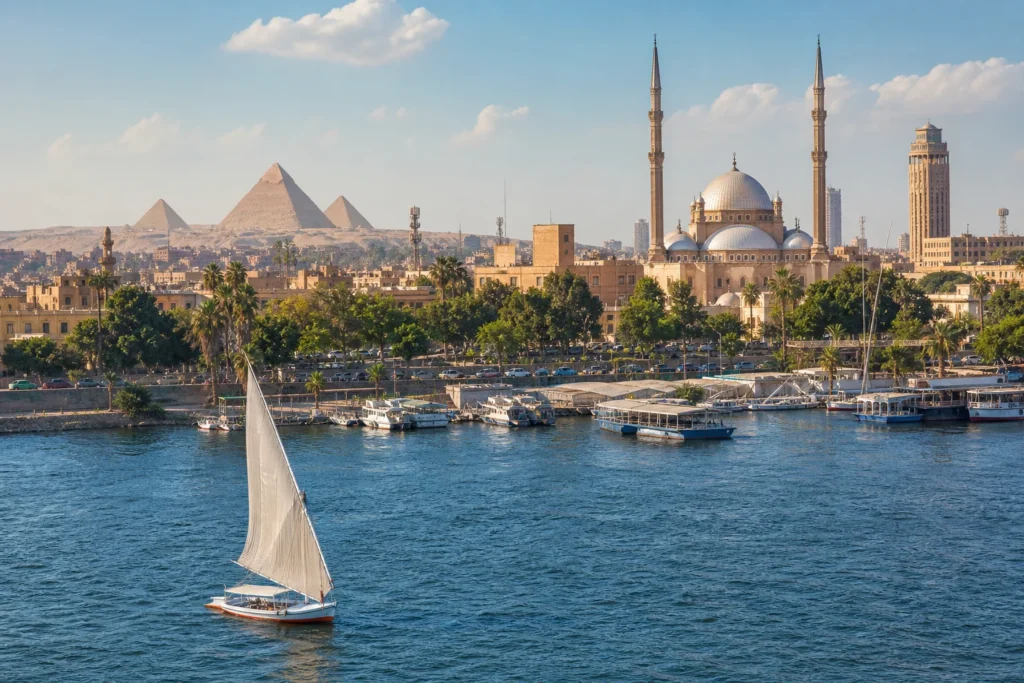
Visitors come to Cairo to experience world-class archaeology, intimate historic neighborhoods, and living urban culture in a single trip.
The Giza Pyramid Complex and the Sphinx provide the city’s signature ancient spectacle. The Egyptian Museum preserves dense pharaonic collections.
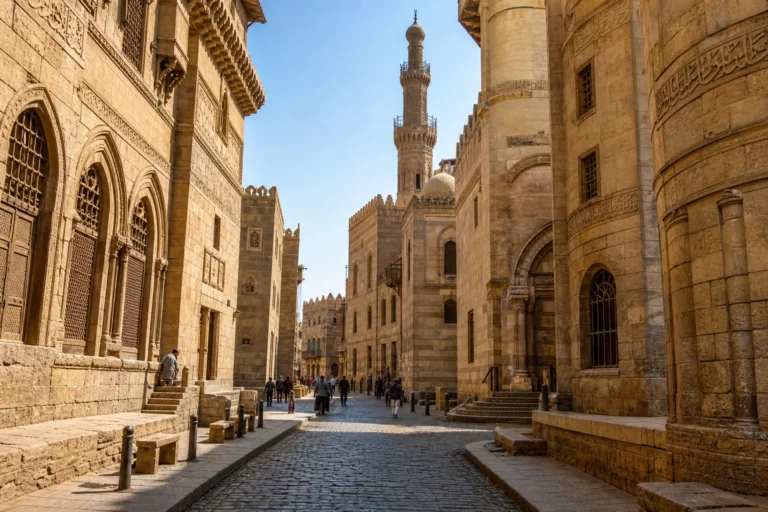
Islamic Cairo offers medieval mosques and madrasas along Al‑Muizz Street. Coptic Cairo holds early-Christian churches.
And Khan el‑Khalili remains the city’s best-known bazaar.
Nile feluccas, rooftop viewpoints, and Al‑Azhar Park add experiential contrasts to the monumental sites.
Top Things to Do in Cairo, Egypt
Cairo’s major sights cluster by neighborhood, so plan visits around the Giza Plateau, downtown Tahrir, Historic Islamic and Coptic Cairo, and the Nile waterfront. Below are the city’s signature attractions and experiences, with practical context to help you combine them efficiently.
Giza Pyramid Complex (Great Pyramid of Khufu and the Sphinx)
The Giza Pyramid Complex sits on the limestone Giza Plateau immediately west of central Cairo and forms the iconic skyline of ancient Egypt.
The ensemble centers on the Great Pyramid of Khufu with two companion pyramids and the Great Sphinx, and the plateau includes quarry scars, mastabas, and workers’ tombs that together convey funerary architecture and ancient engineering.
On the ground you’ll walk broad causeways and long sightlines between monuments. Interior access to the Great Pyramid’s chambers is controlled and sometimes restricted, so verify conditions in advance.
The plateau’s western rim and perimeter roads provide the classic panoramic views of the three main pyramids in alignment.
Official Giza Pyramid Complex (Great Pyramid of Khufu and the Sphinx) website →
The Egyptian Museum (Tahrir)
The Egyptian Museum in Tahrir Square is an early twentieth‑century neoclassical building designed to house finds from excavations across Egypt. Its galleries present a dense chronological sweep of pharaonic material culture, including monumental Old and Middle Kingdom sculpture, the Narmer Palette, and richly equipped burials such as the tombs of Yuya and Thuya.
The museum’s downtown location makes it easy to pair with central Cairo walks, but expect compact rooms and older display settings alongside active conservation work. Major transfers of objects to new institutions mean some famous items may be relocated, so check what’s on display before you go.
Khan el-Khalili bazaar
Khan el‑Khalili is Cairo’s best‑known historic marketplace: a braided network of alleys, covered arcades, and small courtyards lined with shops, copper and brass ateliers, textile sellers, perfumers, and cafés.
The bazaar’s identity formed in the Mamluk era around a caravanserai and later evolved into the dense suq seen today, with Ottoman and nineteenth‑century remodelling visible in facades and gates.
Visits move between main alleys and quieter side passages where artisans work. Bargaining is customary and many shops expect negotiation.
Confirm current pedestrian routes and recommended safety advice before you go.
Historic/Coptic Cairo (including the Hanging Church and Church of St. Sergius)
Historic or Coptic Cairo is a compact cluster of early Christian and late Roman monuments around the old Babylon fortress, including the Hanging Church and the Church of St. Sergius.
The Hanging Church perches above Roman fort remains and preserves carved wooden screens and painted icons; it has long been a seat of the Coptic patriarchate.
The Church of St. Sergius incorporates an underground cave traditionally associated with the Holy Family’s flight into Egypt. The area also includes the Coptic Museum and archaeological traces of Fustat; interior access and conservation work can affect visits, so check ahead.
Official Historic/Coptic Cairo (including the Hanging Church and Church of St. Sergius) website →
The Citadel of Saladin and the Muhammad Ali (Alabaster) Mosque
The Citadel of Saladin crowns Mokattam Hill and has dominated Cairo’s skyline since the late twelfth century. Founded by Salah al‑Din beginning in 1176, the fortified complex contains massive stone walls, rounded towers, terraces, and multiple phases of Ayyubid, Mamluk, and nineteenth‑century construction, and it offers commanding viewpoints over Historic Cairo and the Nile plain.
The Muhammad Ali Mosque (Alabaster Mosque) sits near the citadel’s highest point. Built in the mid‑1800s in an Ottoman idiom, it is notable for a large central dome, semi‑domes, twin slender minarets, and alabaster panels.
The citadel is largely outdoor and uphill—allow time for walking and dress respectfully for mosque interiors.
Official The Citadel of Saladin and the Muhammad Ali (Alabaster) Mosque website →
Al-Azhar Mosque and Al-Azhar University
Al‑Azhar began as a Fatimid foundation around 970–972 CE and evolved into one of the world’s longest‑running centres of Islamic learning. The mosque complex combines a large courtyard, colonnaded prayer halls, and several minarets that reflect later Mamluk and Ottoman additions, with carved stonework and inscriptions documenting more than a millennium of use.
Al‑Azhar University grew from mosque‑based study circles into a modern institution whose historic precinct still functions as an active mosque and teaching centre. Prayer schedules, separate gender areas, and conservation work can affect visitor access, so verify rules before visiting.
Al-Muizz Street and Islamic Cairo historic district
Al‑Muizz Street forms the central spine of Cairo’s Islamic district and dates to the tenth century. Running between Bab al‑Futuh and Bab Zuwayla, it concentrates mosques, madrasas, sabils, hammams, and palatial complexes—an open‑air museum of Fatimid foundations and Mamluk architectural flowering.
Walking Al‑Muizz reveals restored facades, hidden courtyards, and monuments such as the Qalawun complex and Al‑Aqmar Mosque. Pedestrianization and conservation projects have improved access, but interior routes and openings vary, so confirm which monuments admit visitors or hire a local guide for context.
Official Al-Muizz Street and Islamic Cairo historic district website →
Al-Azhar Park
Al‑Azhar Park is a large landscaped green space above Historic Cairo created from a rehabilitated rubble mound under the Aga Khan Trust for Culture.
The roughly thirty hectares of gardens feature axial layouts, water features, terraces, promenades, planted beds, cafés, playgrounds, and an amphitheatre, all framed by panoramic views of the Citadel and the old city skyline.
The park’s creation linked archaeological excavation and monument restoration with social and conservation initiatives in Darb al‑Ahmar. Paths combine stone paving and lawns—wear comfortable shoes—and check event programming and facilities before visiting.
Nile River experiences (felucca and evening Nile cruises)
The Nile in Cairo offers two contrasting visitor experiences: quiet felucca sails and larger evening dinner cruises. A felucca is a small wind‑driven wooden sailboat that slips along the water at sunset, offering calm, immediate river views and a close sense of daily riverside life.
Book a licensed boat and confirm safety and passenger limits for private or short group trips.
Evening dinner cruises run on larger multi‑deck barges with buffet dining and staged entertainment; quality varies across operators, so check reviews and reputations. For solitude choose a private felucca at dusk; for spectacle pick a reputable dinner boat.
Official Nile River experiences (felucca and evening Nile cruises) website →
Best Time to Visit Cairo
Cairo has a desert climate: long, hot summers and short, mild winters. The most comfortable months for sightseeing run from late October through March, when daytime temperatures are warm but not extreme and evenings are cooler.
Shoulder months (April and late September–October) offer lower prices and fewer crowds but hotter days. In summer (June–August), plan for early‑morning and late‑afternoon sightseeing, indoor museum time, and careful sun and hydration precautions.
Special events
Upcoming Events
Cairo International Film Festival (CIFF)
The Cairo International Film Festival (CIFF) is Egypt’s leading international film festival and a major cultural draw for travelers interested in world and Arab cinema. Established in 1976 and FIAPF-accredited, CIFF presents international competitions, retrospectives, industry programs, and panels that bring filmmakers, critics, and cinephiles together. Visitors attend premieres, red-carpet openings, and masterclasses, and can explore Cairo’s cultural sites while the festival runs. CIFF is a key timing consideration for arts-focused trips to Cairo each autumn.
- Dates
- November 11, 2026 - November 20, 2026
Getting Around Cairo
Cairo’s transport mix includes a growing metro, extensive bus and microbus routes, taxis and ride-hail services, and river boats. The metro is often the fastest way to cross congested central corridors; taxis and app-based rides are convenient for door-to-door travel but allow extra time in peak traffic.
Many historic-district streets are walkable for short trips, and guided walking routes help navigate crowded lanes. For Giza and outlying archaeological sites, organized transfers, taxis, or private drivers simplify logistics.
Location
Map of Cairo, Egypt
The interactive map loads only when you choose to view it.
Plan Your Visit to Cairo
Cairo is a very large, congested metropolis; allow extra travel time between districts and attractions. Most international visitors arrive at Cairo International Airport and transfer by official airport taxi, ride-hail, or pre-arranged transfer.
Public transit (Cairo Metro and intercity rail) helps bypass surface traffic; familiarize yourself with main lines and interchange stations. Carry small Egyptian pounds for street vendors, taxis, and tips; ATMs and card acceptance are common in central hotels and major museums.
Buy travel insurance that covers medical evacuation and trip disruption.
Local Tips for Cairo
Dress respectfully for religious and historic sites—cover shoulders and knees for mosques and churches; women may be asked to cover hair in some mosques. Bargaining is expected in bazaars; start about 30–50% below the asking price and stay polite.
Use official or well-reviewed tour guides at major sites to avoid common scams and get reliable context. Keep a printed or screenshot copy of your hotel address in Arabic to show taxi drivers.
Stay hydrated in summer, and schedule outdoor visits for cooler morning or late‑afternoon hours.
Live conditions
Current Weather

Updated 2026-08-25 06:30
- Feels like
- 28°C / 82°F
- Today’s high / low
- 39°C / 103°F · 27°C / 81°F
- Humidity
- 52%
- Wind
- ↑ 10 km/h
- Precipitation
- 0 mm
- Chance of rain
- 0%
- Local time
- 2026-08-25 06:42
Places to Visit Near Cairo
Giza Pyramid Complex (Great Pyramid of Khufu, Sphinx) sits on the plateau west of central Cairo and pairs naturally with nearby mastabas and small museums.
The Egyptian Museum and Tahrir Square are in downtown near Nile Corniche hotels and combine well with central Cairo walks.
Coptic Cairo (Hanging Church, Church of St. Sergius) lies south of downtown and pairs well with the Citadel and Muhammad Ali Mosque.
Al‑Muizz Street and Islamic Cairo connect to Khan el‑Khalili bazaar, allowing a full day of monuments and market streets.
Felucca departures concentrate near downtown bridges and Zamalek island for short sunset sails or evening cruises.
Safety
Cairo is generally safe for tourists in well‑traveled districts, but follow official travel advice and remain alert in crowded areas where pickpocketing and petty theft can occur. Photographing military, police, or government facilities is prohibited—obey signage and staff instructions.
Use registered taxis, ride‑hail apps, or hotel-arranged transport at night and avoid isolated streets after dark. Report incidents to local Tourist Police and keep digital backups of passports and embassy contacts before arrival.