
Travel Guide
Find top sights, local places, maps, weather, and simple trip tips for Marrakech, Morocco.
Looking for Things to Do in Marrakech, Morocco? Use this guide to compare top sights, local tips, maps, weather, and nearby places.
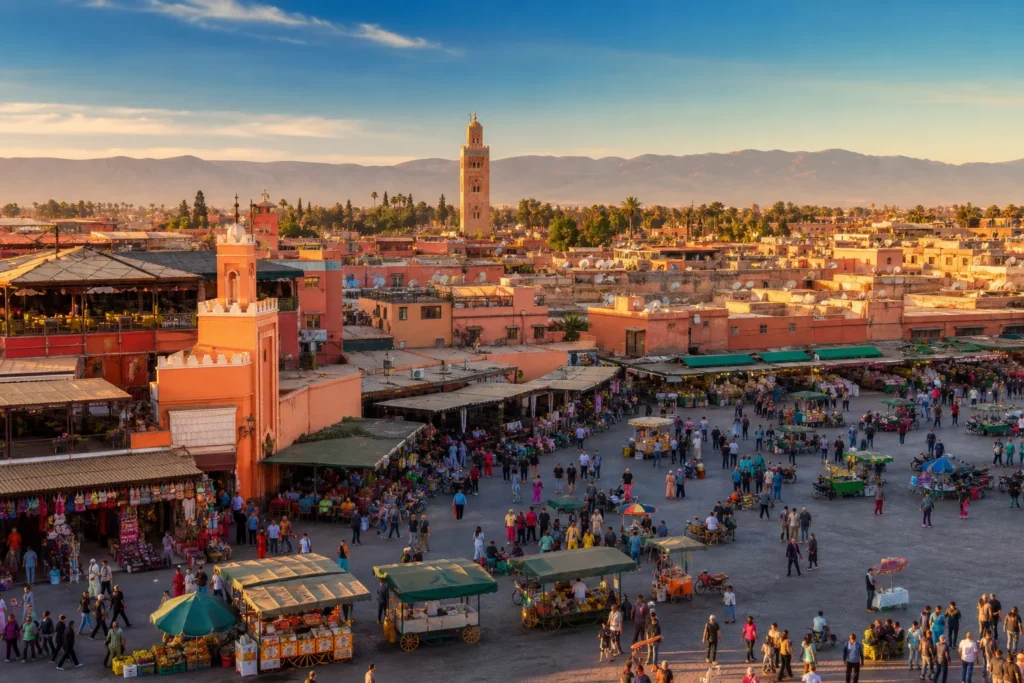
If you’re searching for things to do in Marrakech, start in the UNESCO‑inscribed medina where Jemaa el‑Fna anchors a living marketplace of storytellers, musicians and nightly food stalls.
The city’s compact historic core concentrates major monuments. The Koutoubia minaret, Bahia Palace, Saadian Tombs and Ben Youssef Madrasa.
Alongside leafy cultural sites such as Jardin Majorelle and the Yves Saint Laurent Museum.
Marrakech also serves as a practical gateway for Atlas Mountain trips and desert circuits, so it works equally well as a focused cultural stop or a base for wider regional excursions.
Why Visit Marrakech
Visitors come for Marrakech’s concentrated sensory mix: the public theatre of Jemaa el‑Fna, the maze of artisan souks, and richly decorated historic sites that reflect Islamic, Amazigh and Andalusian influences.
The medina’s intimate riads and bustling markets contrast with curated cultural institutions and gardens nearby, offering both immersive street life and tranquil museum or botanical visits. Its location near the High Atlas also makes Marrakech a convenient departure point for mountain and desert excursions.
Top Things to Do in Marrakech, Morocco
Begin with Jemaa el‑Fna and then drift through the medina’s specialized souk streets to palaces, tombs and historic madrasas. Pair busy market exploration with quieter visits to Jardin Majorelle and the Musée Yves Saint Laurent to see how the city’s visual culture spans centuries.
Jemaa el-Fna (main square)
Jemaa el‑Fna sits at the historic threshold of Marrakech’s medina and functions as the city’s social heartbeat. The triangular square has been a public meeting place since the eleventh century and was proclaimed a Masterpiece of the Oral and Intangible Heritage of Humanity by UNESCO in 2001.
Its character shifts through the day: mornings feature water sellers, henna artists and traders preparing their stalls; afternoons bring storytellers, musicians and performers; after sunset the square becomes a bustling night market of food stalls and strong spices.
Visitors experience the square from street level and from rooftop terraces that offer panoramic views toward the Koutoubia and the maze of souks.
Medina of Marrakech (historic old city and souks)
The Medina of Marrakech is the walled historic core founded around 1070–72 and inscribed by UNESCO in 1985 for its exceptional concentration of monuments.
Beyond landmarks such as the Koutoubia minaret, Saadian Tombs and Bahia Palace, the medina is an active urban fabric of narrow lanes, covered souks, fondouks and artisan quarters where trades cluster by specialization—metalwork, leather, textiles, spices and household crafts.
A visit is intensely sensory: mosaic tiles, cedar woodwork, the smell of spices and the sound of craftsmen. Because the streets form a tight maze, use a local guide or a map anchored to major sites, wear comfortable shoes and be ready to bargain politely in the markets.
Official Medina of Marrakech (historic old city and souks) website →
Koutoubia Mosque and minaret
The Koutoubia is Marrakech’s largest mosque and a defining city landmark built during the Almohad period in the twelfth century. Its tall square minaret—roughly seventy‑seven metres high—uses carved geometric motifs and ceramic bands and served as an architectural model across the western Islamic world.
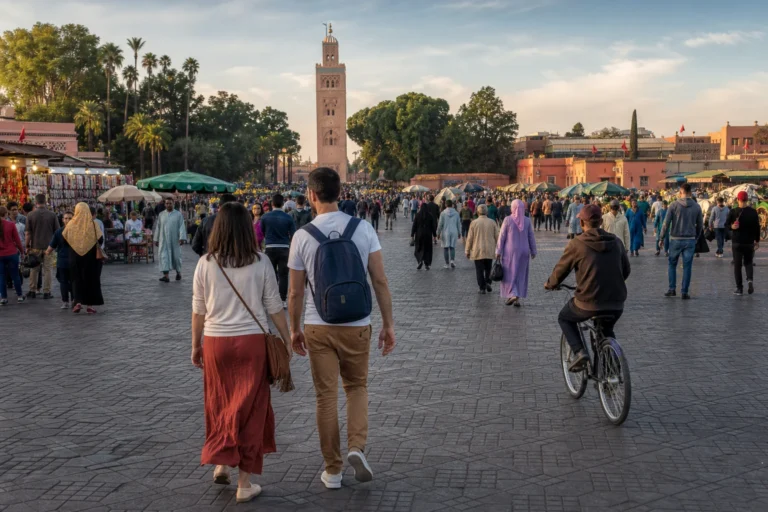
The tower’s visibility from many points inside the medina makes it a persistent orienting landmark for visitors and residents alike.
Non‑Muslim visitors should admire the mosque from the surrounding gardens and public walkways, as the prayer hall is an active religious space. The open gardens provide framed views of the minaret and are ideal for photography and understanding the mosque’s relationship to the medina’s street pattern.
Jardin Majorelle
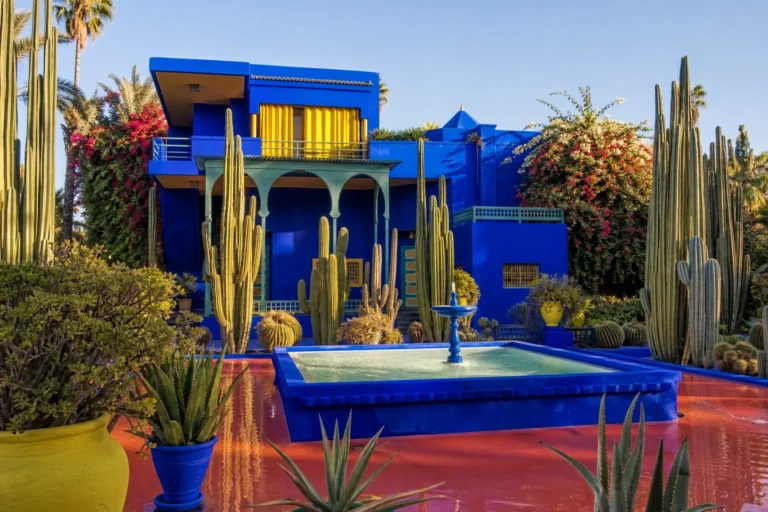
Jardin Majorelle is an artist’s garden and botanical sanctuary created by Jacques Majorelle in the early twentieth century and later restored by Yves Saint Laurent and Pierre Bergé. The garden is famed for its bold cobalt ‘Majorelle blue’ buildings, exotic palms, cacti and sinuous shaded pathways that link pools and sculpted beds.
Visitors move through a sequence of micro‑environments rather than a single panoramic vista, discovering quiet corners, birdlife and varied planting schemes.
The property also includes curated displays and a small museum of Berber arts; because paths are narrow and the site is conservation‑managed, timed entry and queuing can occur—verify ticketing details before you go.
Yves Saint Laurent Museum (Marrakech)
The Musée Yves Saint Laurent in Marrakech frames the couturier’s long dialogue with Morocco through a calm, museum‑style route that treats garments as cultural objects as well as fashion masterpieces.
The building, conceived by Studio KO, uses local materials and internal light‑controlled volumes to protect fragile textiles while echoing North African architectural organization around inner courtyards. The permanent display typically presents roughly fifty haute couture pieces at a time, with regular rotations to preserve fabrics.
Temporary shows, photography and projects by Moroccan artists extend interpretation beyond fashion. The museum is managed by the Fondation Jardin Majorelle and includes a research library, auditorium, bookshop and café‑restaurant; check official information for timed entry and special programmes.
Bahia Palace
The Bahia Palace is a late nineteenth‑century urban palace that illustrates Moroccan residential architecture at large scale. Built from the 1860s and expanded under Ahmed (Ba Hmad) from the 1890s, the complex weaves courtyards, intimate riads and richly ornamented salons into a coherent palace plan that evokes household life and social ambition.
Architectural highlights include extensive zellij tilework, carved cedar ceilings, painted zouak panels, fine stucco carving and stained glass.
Marble courtyards with fountains and planted citrus pockets structure the plan and help visitors read the palace’s social order. The site is managed as an active conservation monument; verify current access and any restoration notices before visiting.
Saadian Tombs
The Saadian Tombs form a compact royal necropolis beside the Kasbah Mosque and reward slow, quiet viewing. Built and enhanced during the late sixteenth century under Sultan Ahmad al‑Mansur, the ensemble includes the Chamber of the Twelve Columns, ornate private mausoleums and clustered family tombs, all richly decorated with carved stucco, zellige and inlaid stone.
The complex was later walled and effectively hidden until its rediscovery in the early twentieth century, giving it layered archaeological resonance.
Gardens and small reflecting pools frame many tomb groups, creating a calm contrast to the medina’s bustle. The site is small but often busy—combine it with nearby monuments and confirm ticketing before you go.
Ben Youssef Madrasa
Ben Youssef Madrasa is one of Marrakech’s finest examples of Moroccan religious architecture and a former Qur’anic college whose major rebuilding dates to the sixteenth century under Sultan Abdullah al‑Ghalib.
Visitors enter through a modest doorway and discover an inward‑focused courtyard ringed by carved cedar, stucco and zellij tilework, with stacked student dormitories and galleries arranged around a central water basin. The repetitive rhythm of rooms and decorative surfaces reflects the building’s educational function and domestic scale.
Restoration efforts have focused on preserving decorative surfaces and structural fabric. Because the madrasa lies deep within the medina, combine the visit with nearby souks and monuments and check official access notices before planning.
Best Time to Visit Marrakech
The most comfortable months for walking the medina and visiting outdoor sites are spring (March. May) and autumn (September.
November), when days are warm without extreme heat and evenings are pleasant. Summer brings intense heat that can make midday sightseeing taxing; winter is mild but cool at night and in nearby valleys.
For botanical highlights and softer light on monuments, aim for early morning or late afternoon visits.
Getting Around Marrakech
The historic core is compact and best explored on foot: many lanes are pedestrian‑scaled and vehicle access is limited inside the medina. Petit taxis handle short trips; negotiate fares for journeys beyond central districts or use metered taxis in the Ville Nouvelle.
For airport transfers or Atlas excursions, pre‑book shuttles, private cars or reputable tour operators. Allow extra time when crossing between the medina, Jemaa el‑Fna and the Ville Nouvelle because crowds and uneven paving slow movement.
Location
Map of Marrakech, Morocco
The interactive map loads only when you choose to view it.
Plan Your Visit to Marrakech
Marrakech’s UNESCO‑listed Medina, Jemaa el‑Fna and the souks concentrate the major sights, while the Ville Nouvelle (Gueliz/Hivernage) hosts modern hotels, galleries and transport links. Plan peak attractions (Jardin Majorelle, YSL Museum, Koutoubia area, Bahia Palace, Ben Youssef, Saadian Tombs) as separate half‑day visits to avoid rushing.
Carry small cash (Moroccan dirham) for markets and tips, and keep a copy of your riad or hotel address in Arabic to show drivers.
Local Tips for Marrakech
Wear comfortable closed shoes and light layers: many historic sites have uneven floors and shaded courtyards. Respect mosque rules—Koutoubia’s interior is reserved for Muslims, so admire it from the gardens and nearby viewpoints.
Use printed or offline maps for the medina and expect intermittent mobile signal in crowded alleys. Book Jardin Majorelle and Musée Yves Saint Laurent tickets in advance during high season, and when dining at Jemaa el‑Fna choose busy, visibly fresh stalls.
Live conditions
Current Weather

Updated 2026-08-25 04:15
- Feels like
- 20°C / 68°F
- Today’s high / low
- 34°C / 93°F · 19°C / 66°F
- Humidity
- 69%
- Wind
- ↑ 7 km/h
- Precipitation
- 0 mm
- Chance of rain
- 2%
- Local time
- 2026-08-25 04:27
Places to Visit Near Marrakech
Central landmarks and useful nearby places — — The city’s principal public square and starting point for exploring the souks and evening food stalls. — The tall twelfth‑century minaret that serves as an orienting landmark visible across the medina and from many rooftops. — The walled core with specialized artisan streets, tanners’ quarters and centuries‑old urban patterns. — A compact botanical garden and adjacent museum near Avenue YSL, often paired on the same visit. — Major historic monuments illustrating late‑medieval and nineteenth‑century royal architecture. — The historic Qur’anic college adjacent to the northern medina and easy to include with nearby souks.
Safety
Marrakech is widely visited but requires basic urban caution. Petty theft and pickpocketing occur in crowded places such as Jemaa el‑Fna and busy souks; keep valuables secure, use a money belt and watch bags during bargaining.
Be alert for traffic and informal scooters in narrow streets and cross with care. In summer, expect strong sun—carry water and sun protection and avoid prolonged midday exertion.
For short trips within the city, prefer official small‑metered taxis or agree fares in advance for longer rides.