
Travel Guide
Plan your visit around Explore Oia Village and Castle, Walk Fira’s Caldera Cliffside, and more of Santorini, Greece.
The best things to do in Santorini combine dramatic volcanic scenery with historic villages, important archaeology, and local island life. Walk the caldera from Fira toward Oia, explore the prehistoric settlement at Akrotiri, visit Ancient Thera, and look beyond the famous viewpoints to Pyrgos, Emporio, Red Beach, vineyards, and the volcanic islands offshore.
Why Visit Santorini
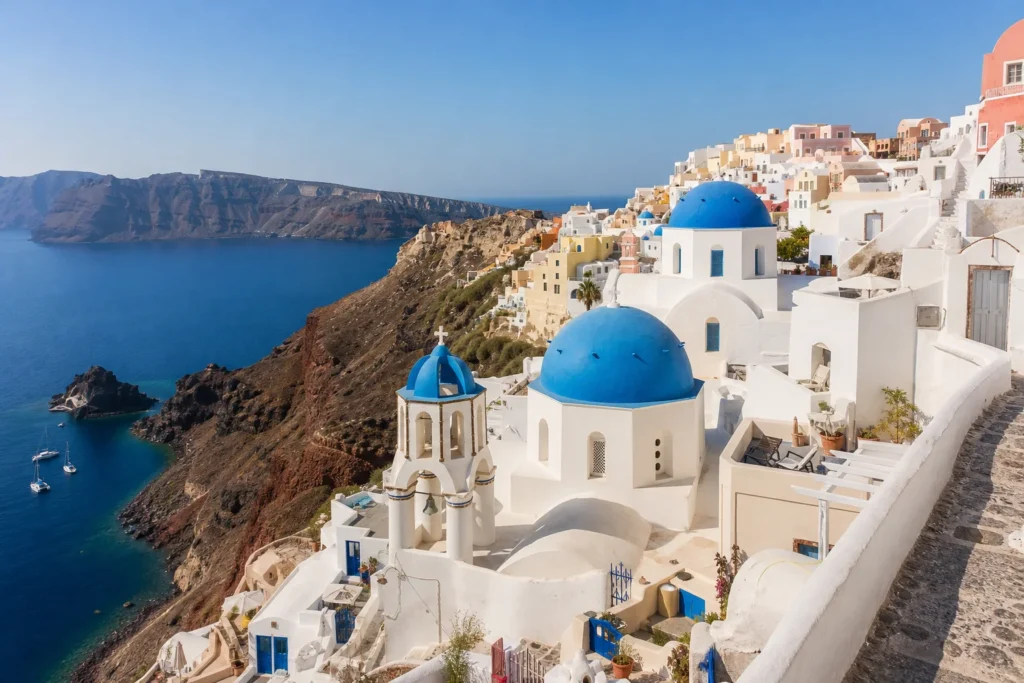
Santorini brings together a rare combination of volcanic geology, spectacular caldera scenery, historic settlements, and internationally important archaeology. Its whitewashed buildings, cave houses, blue-domed churches, winding lanes, and cliffs above the Aegean create a distinctive landscape shaped by the immense caldera formed during a prehistoric eruption.
Fira is the island’s commercial, administrative, and transport center, while Oia is known for its preserved architecture and caldera outlooks. Inland villages such as Pyrgos, Emporio, Megalochori, and Akrotiri offer a quieter perspective through castle quarters, vineyards, churches, and traditional homes.
The island’s character extends from archaeological sites and volcanic beaches to maritime landscapes, local wine traditions, and nearby volcanic islands.
Top Things to Do in Santorini, Greece
Santorini’s highlights are spread across the island, so combine caldera walks and villages with archaeological sites, beaches, and a boat excursion. These experiences connect the island’s scenery, history, and traditional settlements.
Explore Oia Village and Castle
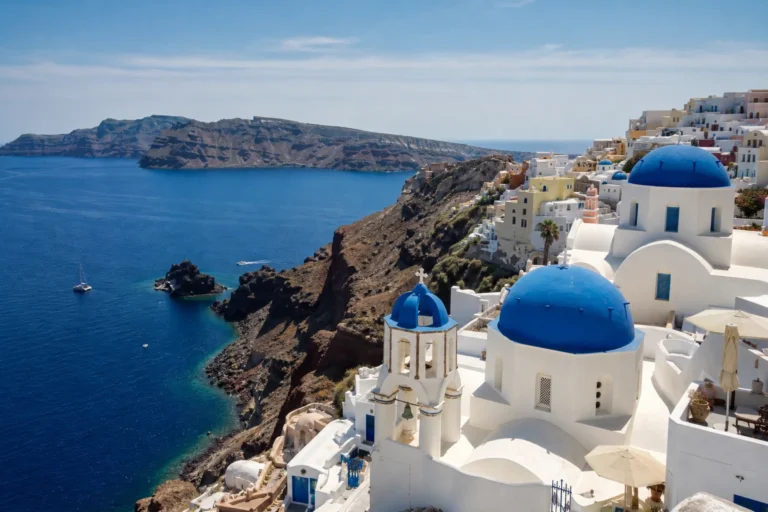
Oia occupies Santorini’s northwestern caldera edge, about ten kilometres from Fira. Its preserved settlement combines whitewashed cave houses, colorful facades, blue-domed churches, and former sea captains’ mansions, with architecture shaped by volcanic geology and Santorini’s maritime past.
Follow the pedestrian lanes through stairways, terraces, galleries, shops, and cafés, and look beyond the famous domes to the traditional houses. The Santorini Maritime Museum adds context on local shipping and navigation history.
At the western end, Oia Castle’s remaining walls provide broad views across the caldera, volcanic islands, and Aegean, especially at sunset. Ammoudi and Armeni reveal the village’s historic seaside character.
Walk Fira’s Caldera Cliffside
Fira is Santorini’s capital, positioned along the eastern rim of the volcanic caldera. A cliffside walk offers views across the deep blue basin toward Nea Kameni, Palea Kameni, Thirasia, and the layered volcanic cliffs.
The scenery changes as the route passes viewpoints, chapels, terraces, and densely built neighborhoods.
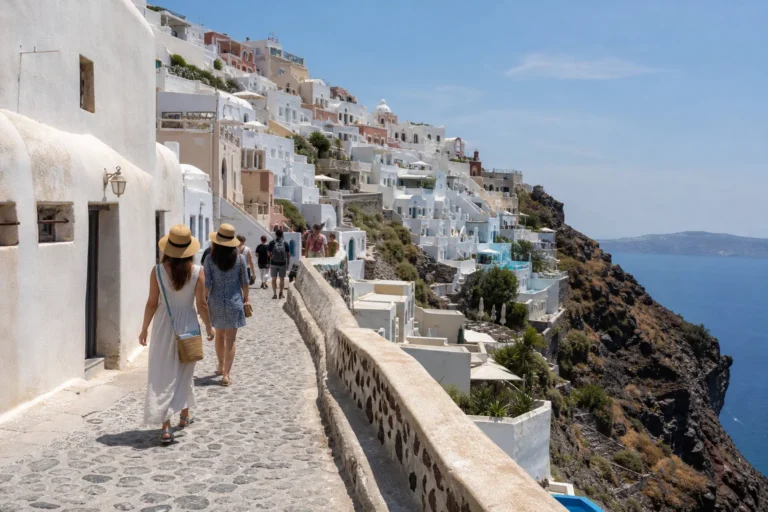
Start in central Fira and follow the pedestrian route north toward Firostefani and Imerovigli; the longer trail eventually reaches Oia. Fira’s Museum of Prehistoric Thera, Archaeological Museum, churches, Megaro Gyzi Cultural Center, cave houses, restaurants, and cafés provide useful pauses.
Farther sections become narrower, steeper, and more uneven, so carry water and use sturdy footwear.
Visit the Akrotiri Archaeological Site
At Santorini’s southern end, the Akrotiri Archaeological Site preserves a prehistoric city beneath a modern bioclimatic shelter. The visible settlement mainly dates from the Late Bronze Age, around 1650–1500 BC, while earlier layers show habitation from the Middle Neolithic period.
A raised visitor route leads through excavated streets, buildings, and rooms. More than thirty buildings have been identified within the protected area, and the remains reveal a wealthy harbour town with maritime connections to Minoan Crete, the Aegean, Cyprus, the eastern Mediterranean, Egypt, and Syria.
Large houses, drainage systems, household objects, and painted decoration show a sophisticated society buried by volcanic pumice and ash. Pair the visit with the Museum of Prehistoric Thera in Fira.
Explore the Archaeological Site of Ancient Thera
The Archaeological Site of Ancient Thera occupies Mesa Vouno, the steep mountain forming Santorini’s southeastern cape. Founded, according to archaeological evidence, in the eighth century BC, the city remained inhabited at least until the ninth century AD.
Its elevated position offered natural defenses, control over the southeastern Aegean, and access to water and fertile land.
The excavated city follows the ridge, with a principal road connecting residential areas, public buildings, shops, houses, drainage works, cisterns, and a theatre. The Royal Stoa, administrative center, and sanctuaries dedicated to several deities reveal its urban and religious life.
Roman and early Christian phases include public baths and basilicas. Expect exposed mountain terrain, uneven paths, and strong sun or wind.
Official Explore the Archaeological Site of Ancient Thera website →
Cruise the Santorini Caldera and Volcanic Islands
A cruise across the Santorini Caldera shows the island’s volcanic structure from the sea. The caldera formed after a major prehistoric eruption, when much of the original island collapsed beneath the Aegean.
Its steep inner cliffs expose layers of lava, ash, pumice, and older volcanic deposits.
Excursions commonly include Nea Kameni, where marked paths lead across dark and reddish lava toward volcanic features and fumaroles. Palia Kameni is known for warm, sulfur-rich waters where boats may pause for swimming.
Longer cruises can continue to Thirasia, with its small ports, cave houses, and hillside settlements. Routes, landing conditions, swimming stops, and access arrangements depend on weather and should be checked with the operator or official sources.
Visit Red Beach
Red Beach lies near Akrotiri on Santorini’s southern coast, beside one of the island’s important archaeological areas. Steep red and ochre volcanic cliffs frame the small cove, while dark pebbles and reddish shore material contrast with the blue Aegean.
Iron-rich volcanic rock gives the cliffs their distinctive color.
The approach above the beach offers a clear view of the layered rock, narrow shoreline, and sea routes used by excursion boats. Land access involves a rough, uneven path, and conditions can change because of erosion, loose stones, wind, and possible rockfall.
Red Beach is especially suited to scenery, photography, and a short swim, and pairs naturally with Akrotiri or a boat trip toward White Beach. Check current access conditions before travelling.
Explore Pyrgos Village and Castle
Pyrgos stands on a hillside near the center of Santorini, below Mount Profitis Ilias. As one of the island’s best-preserved traditional settlements, it offers wide views across vineyards, villages, the Aegean, and parts of the volcanic landscape.
Narrow lanes lead from the lower village toward Kasteli, the medieval fortified core.
Whitewashed homes, arched passages, courtyards, churches, and neoclassical buildings form a compact settlement whose outer walls create a defensive enclosure. Pyrgos Kasteli probably developed in the late fifteenth century and was a residential and administrative center.
Look for churches including the Presentation of the Virgin Mary, Agios Georgios, Agios Iakovos, and Agia Triada, which houses the Collection of Icons and Ecclesiastical Relics.
Explore Emporio Village and Castle
Emporio is Santorini’s largest village, on the southern side of the island near the foot of Mount Profitis Ilias. Its name reflects the settlement’s historic role as a commercial center, while its dense lanes preserve a strong medieval atmosphere away from the busiest caldera viewpoints.
Emporio Kasteli is regarded as Santorini’s best-preserved medieval fortress. Enter through its narrow passage to find stairways, vaulted lanes, overhead bridges, and closely built houses arranged for defense.
The Church of Panagia Mesani stands inside the Kasteli, while the Goulas is a substantial defensive tower outside it. Nearby Gavrilis windmills connect the village with Santorini’s agricultural landscape.
Best Time to Visit Santorini
Late April to early June and September to October generally offer the most balanced conditions for exploring Santorini. These periods suit caldera walks, archaeological sites, village visits, and boat excursions while avoiding the most intense summer heat and busiest peak-season atmosphere.
July and August bring hotter conditions and the strongest demand, though they may suit travelers prioritizing classic beach and sailing experiences. Spring can feel greener, while early autumn often combines warm sea conditions with a more settled rhythm.
Winter is quieter and atmospheric, but some visitor services, excursions, and seasonal businesses operate on reduced schedules. For comfortable sightseeing, plan strenuous walks and exposed archaeological visits outside the hottest part of the day.
SPECIAL EVENTS IN Santorini
Kykladitisses: Untold Stories of Women in the Cyclades
This landmark pan-Cycladic exhibition explores the lives, identities, work, beliefs, and social roles of women across the islands from early prehistory through the 19th century. Organized by the Museum of Cycladic Art and the Ephorate of Antiquities of the Cyclades, it brings together approximately 180 archaeological and historical objects from museums, collections, churches, and institutions throughout the Cyclades. Highlights include monumental sculpture, frescoes, jewellery, inscriptions, manuscripts, and rare artefacts rarely displayed together, offering travelers a distinctive and wide-ranging perspective on Cycladic heritage.
- Dates
- June 21, 2025 - December 31, 2026
- Venue
- Archaeological Museum of Thera
INDUSTRIANA: The Industrial Heritage of Santorini and Therasia
INDUSTRIANA presents the lesser-known artisanal, pre-industrial, and industrial heritage of Santorini and Therasia through archival documents, historical objects, machinery, recordings, and oral histories. Developed through a dedicated research program, the exhibition explores how production, labor, and local enterprise shaped the islands’ economic, social, and cultural identity. Travelers interested in island history, architecture, technology, and authentic local culture can gain a deeper perspective beyond Santorini’s famous scenery, while the museum setting offers an especially meaningful connection to the island’s working past.
- Dates
- July 11, 2026 - October 31, 2026
- Venue
- Tomato Industrial Museum “D. Nomikos”, Vlychada
Getting Around Santorini
Santorini is compact but hilly, with settlements and attractions spread across a narrow island. Public buses connect Fira with major villages, beaches, the port area, and other popular visitor zones, making Fira the practical transport hub.
Walking is the best way to experience Oia, Fira, Pyrgos, Emporio, and other historic villages, although lanes can be steep, uneven, and crowded. Taxis are limited relative to demand, so pre-arranging transfers can help with ferry connections or early departures.
Rental cars, scooters, and ATVs provide flexibility for archaeological sites, beaches, and inland villages, but require care on narrow, winding roads. Boat excursions reach the caldera and volcanic islands; routes and access conditions vary by operator and season.
Location
Map of Santorini, Greece
The interactive map loads only when you choose to view it.
Plan Your Visit to Santorini
Santorini is a compact but highly visited volcanic island, so plan around geography rather than assuming short distances are quick. Fira is the main inland transport hub and a useful base for reaching villages, archaeological sites, beaches, and port areas.
Oia, Fira, Pyrgos, Emporio, Akrotiri, Ancient Thera, and Red Beach are spread across the island and are best grouped by area.
Expect steep lanes, stairs, uneven paving, limited shade, and exposed terrain at caldera viewpoints and archaeological sites. Wear supportive footwear, carry water, and allow extra time for traffic, parking, transfers, and crowded pedestrian areas.
Confirm transport connections and attraction access locally before setting out.
Local Tips for Santorini
Use Fira as the practical orientation point when combining several places, but do not assume every connection is direct or frequent. Exploring Oia, Pyrgos, and Emporio is easiest on foot within each settlement, whose historic cores include narrow lanes, steps, and uneven stone surfaces.
Akrotiri and Ancient Thera require more deliberate planning because they are outside the main caldera settlements. Ancient Thera is high on Mesa Vouno and involves exposed, elevated terrain.
For caldera cruises, volcanic-island visits, and Red Beach excursions, check the departure point, transfer arrangements, sea conditions, and any access restrictions in advance. Official archaeological information is provided by Greece’s Ministry of Culture and the Cyclades Ephorate.
Live conditions
Current Weather

Updated 2026-09-21 23:45
- Feels like
- 22°C / 72°F
- Today’s high / low
- 24°C / 75°F · 23°C / 73°F
- Humidity
- 70%
- Wind
- ↖ 23 km/h
- Precipitation
- 0 mm
- Chance of rain
- 8%
- Local time
- 2026-09-21 23:48
Safety in Santorini
Take heat, strong sun, wind, and dehydration seriously, particularly on exposed caldera paths, at Ancient Thera, around castle viewpoints, and on boat excursions. Stay on marked or clearly established paths, keep away from cliff edges, and supervise children closely where lanes or viewpoints lack protective barriers.
Archaeological areas can contain rough ground, steps, and ruins; do not climb walls or enter restricted sections. Red Beach and volcanic-island stops may have changing access conditions because of coastal, geological, or marine hazards, so follow local signs and staff instructions rather than relying on old advice.
In an emergency, use Greece’s emergency number 112.