
Travel Guide
Plan your visit around Old Town of Corfu, Old Fortress, and more of Corfu, Greece.
Discover the best things to do in Corfu, Greece, from signature sights to memorable local experiences.
Expect a compact island city where Venetian fortifications, neoclassical arcades and seaside vistas sit within easy reach of one another.
Corfu’s UNESCO Old Town is the core: historical layers. Byzantine, Venetian, French and British.
Shape a walkable urban fabric that pairs naturally with palaces, monasteries and coastal viewpoints at Kanoni, Paleokastritsa and nearby islets.

Why Visit Corfu
Visitors come for Corfu’s rare blend of a walkable UNESCO-listed Old Town and dramatic Ionian coastline. The town’s Venetian walls, Liston arcade and Spianada square sit alongside palaces, monasteries and museums that chart Venetian, French and British layers.
Coastal viewpoints at Kanoni, the photogenic Pontikonisi islet and the Vlacherna chapel make easy short excursions, while Achilleion and Mon Repos reveal aristocratic and archaeological chapters. Paleokastritsa provides headland views and boat trips to coves, and the island’s cafés and tavernas introduce Corfiot cuisine and local life year-round.

Top Things to Do in Corfu, Greece
Corfu pairs a compact, walkable UNESCO Old Town with coastal viewpoints, palaces and monasteries. Below are the island’s essential sites and experiences to plan into a short visit or longer stay.
Old Town of Corfu (UNESCO World Heritage Site)
The Old Town of Corfu is a living historic centre where Venetian, French and British layers interweave across narrow lanes, tall townhouses and public squares. Key features include Venetian fortifications and loggias, the arcade-fronted Liston and the wide, lawned Spianada, whose cricket pitch and rotunda reflect British-era civic tastes.
The area reads as an urban palimpsest: carved lintels, shuttered windows and lion motifs reward close observation, while cafés and shops sustain everyday life alongside heritage.
Practical visiting notes: the Old Town is compact but hilly in places and best explored on foot. Many museums and churches lie within short distances, yet opening hours and temporary exhibitions change—check official sources before planning specific indoor visits.
Old Fortress (Palaio Frourio)
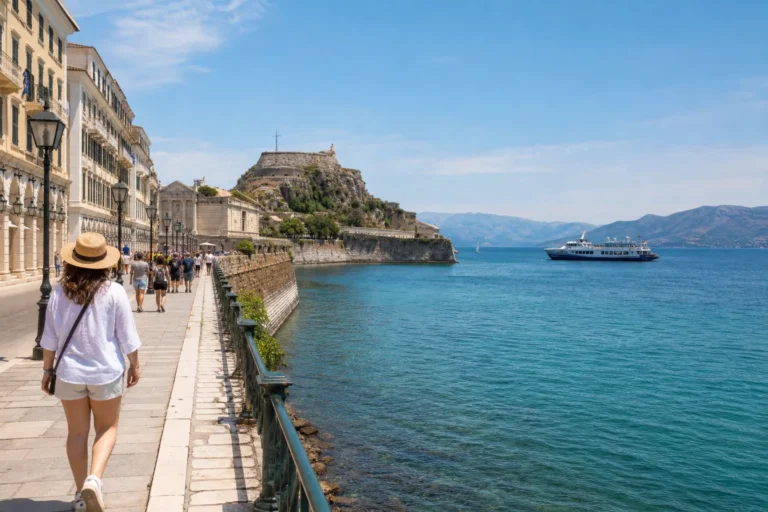
The Old Fortress (Palaio Frourio) occupies a rocky peninsula and showcases how defensive architecture adapted to Corfu’s maritime setting. Enlarged by the Venetians from medieval foundations, the complex includes bastions, curtain walls and vaulted passages.
Walking the ramparts offers commanding views over the harbour and town, while internal courtyards and covered galleries reveal successive construction phases and later additions such as a British-era Doric chapel.
Allow time for slow exploration: uneven stone surfaces and exposed steps require sturdy footwear. The fortress’s outlooks change with light, making sunrise or late-afternoon visits especially rewarding for photography and quiet observation.
Check official channels for access to interior exhibitions or temporary uses before visiting.
Achilleion Palace
Achilleion Palace, built in the 1890s for Empress Elisabeth of Austria ("Sissi"), is a neoclassical estate themed around the hero Achilles. The palace combines Pompeian-inspired planning, Italianate detailing and late‑Victorian tastes; its gardens stage sculptures, formal terraces and axial walks that frame wide views toward Corfu’s coastline.
Statues of Achilles and mythological ornamentation give the site a theatrical, curated character that blends architecture, sculpture and landscape design.
The palace later passed to Kaiser Wilhelm II and has layered historical uses. Reaching Achilleion requires a short uphill drive from Gastouri and involves paved garden paths and steps—comfortable footwear is recommended.
Verify access to interior rooms and temporary exhibitions on the official site before going.
Paleokastritsa Monastery
The Monastery of the Virgin at Paleokastritsa sits on a rocky headland above turquoise coves, combining Orthodox devotional life with dramatic coastal scenery. The compact complex includes chapels, cloisters and a small museum showing icons and manuscripts that reflect the monastery’s long continuity.
From the hilltop terraces visitors enjoy commanding views over the bays and sea caves that define Paleokastritsa’s landscape.
Practical tips: approach paths include steps and uneven paving, and the site remains active for worship—modest dress and quiet behaviour are expected inside chapels. Confirm museum access and visitor rules with official sources before planning a visit.
Pontikonisi (Mouse Island)
Pontikonisi, or Mouse Island, is a petite, tree‑covered islet off the Kanoni headland crowned by the small Byzantine Church of Pantokrator. From the Kanoni viewpoint the islet’s dark cypress silhouette, white chapel steps and shoreline setting form one of Corfu’s most reproduced images.
The composition—trees, chapel and sea—has deep cultural resonance and frequent photographic appeal.
Visits normally take place from shore viewpoints or by short boat trips; there is no fixed road access. If you plan to land expect steep steps, very limited walking space and no visitor facilities.
Be aware of aircraft noise from the nearby runway at Kanoni and verify boat availability and any access restrictions before arranging a landing.
Vlacherna Monastery (Kanoni)
Vlacherna Monastery sits on a low islet joined to Kanoni by a narrow causeway, presenting a whitewashed chapel ensemble that reflects quietly on still days. The interior contains a carved wooden iconostasis and traditional hagiography typical of Orthodox liturgical spaces.
From the causeway, the monastery frames views toward Pontikonisi and across the Halikiopoulos lagoon, making it a popular short excursion and photographic spot.
The site remains an active place of worship, so modest dress and respectful behaviour are expected. Access involves uneven paving and limited space on the islet; check local or municipal sources for any visitor rules or boat-trip options before you go.
Liston and Spianada Square
Liston and the Spianada form Corfu Town’s social heart: an elegant arcaded promenade faces one of the island’s largest open greens. Laid out during the French administration to echo Parisian colonnades, the Liston’s ground-floor arches host cafés and restaurants while the Spianada’s broad lawn, planted promenades and a small cricket pitch reflect British civic influence.
The contrast between the arcade’s stone facades and the green esplanade creates strong photographic compositions.
Visitors typically sit at a café under the arches for people-watching, cross the square to see the rotunda and stroll toward the Old Fortress. The space can be crowded on festival days and cruise ship arrivals—check municipal sources for any special events or temporary arrangements.
Mon Repos Palace and Park
Mon Repos is a late 19th-century neoclassical villa set in landscaped grounds on Corfu’s northeastern shore, known for garden walks, archaeological remains and royal connections. The estate combines formal terraces and shaded promenades with pockets of native Mediterranean planting, producing repeated seaside viewpoints that illustrate how landscape design frames coastal perception.
Archaeological finds in the park and small museum rooms add historical depth beyond the villa’s architecture.
A rewarding visit mixes terrace viewpoints with quieter shaded tracks to discover small ruins, memorials and water features. Paths include gentle slopes, gravel tracks and some steps; confirm access to interior rooms and guided-tour offerings with the estate’s official museum before visiting.
Archaeological Museum of Corfu
The Archaeological Museum of Corfu traces the island’s human story from prehistoric settlements through Late Antiquity, concentrating on material from Corfu town (ancient Korkyra) and nearby sites. A central highlight is the large stone pediment from the Doric temple of Artemis at Palaiopolis, including an archaic running‑Gorgon composition.
The galleries also display funerary monuments, terracottas, sculpture and inscribed stone that illuminate religious and maritime roles across centuries.
The museum’s chronological layout encourages a one‑to‑two‑hour visit depending on interest. Small interpretive labels and reconstructions aid non‑specialists; confirm guided‑tour offerings and temporary exhibitions with the museum’s official sources before you go.
Best Time to Visit Corfu
Late spring through early autumn is the best time to visit Corfu. May–June and September–early October combine warm sea temperatures, active cultural life and fewer peak-season crowds than July–August.
Spring (April–May) offers lush landscapes and lower prices, though the sea is cooler. Winter is mild and suitable for off-season museum and Old Town visits, but some tourist services and boat routes are reduced.
Plan around festival dates and ferry timetables.
Getting Around Corfu
Corfu town is compact and best explored on foot, with many key sites pedestrian-friendly. Local buses link Corfu Town with beaches and villages; scheduled boats, regional ferries and private excursions serve coastal highlights such as Paleokastritsa, Pontikonisi and Kanoni.
Renting a car or scooter gives flexibility for Achilleion, Mon Repos and remote beaches, but expect narrow roads and summer traffic. Taxis operate from the port and airport—book transfers in advance during peak arrival times and check ferry/boat timetables before setting out.
Location
Map of Corfu, Greece
The interactive map loads only when you choose to view it.
Plan Your Visit to Corfu
Arrive via Corfu International Airport (Ioannis Kapodistrias) or by ferry to Corfu Town’s port. The Old Town, Liston/Spianada and nearby attractions are within short taxi or walking distance of the harbor.
Cluster your itinerary: explore the Old Town, Old Fortress and Liston on foot. Drive or take a bus to Achilleion and Mon Repos.
Allow longer transfers for Paleokastritsa and northern beaches.
Book guided tours and transport in high season, carry an offline map, and visit the UNESCO Old Town and major palaces early or late to avoid crowds.
Local Tips for Corfu
Corfu Town (Kerkyra) is compact—best explored on foot through narrow lanes and the Liston/Spianada area. Use the main bus network from the port and bus station for longer island trips.
Taxis and licensed transfers exist but can be scarce at peak arrival times so pre-book when possible.
Rent a scooter or small car for remote beaches, but expect narrow, steep roads. For classic photos bring a camera to Kanoni/Vlacherna and Pontikonisi, and wear comfortable shoes for cobbles and fortress steps.
Live conditions
Current Weather

Updated 2026-09-21 17:30
- Feels like
- 27°C / 80°F
- Today’s high / low
- 26°C / 79°F · 24°C / 75°F
- Humidity
- 69%
- Wind
- ↖ 16 km/h
- Precipitation
- 0 mm
- Chance of rain
- 10%
- Local time
- 2026-09-21 17:33
Safety in Corfu
Corfu is generally safe for visitors. Take common-sense urban precautions: keep valuables secure in crowded streets and watch for pickpockets in busy Old Town areas.
Wear sturdy shoes for uneven cobbles, steps and fortress ramps. When swimming from rocky coves, check local sea conditions and advice; some small beaches have strong currents or no lifeguards.
Use licensed taxis or pre-booked transfers at night and carry contact details for local emergency services and your accommodation.