
Travel Guide
Plan your visit around Charles Darwin Research Station, El Chato Giant Tortoise Reserve, and more of Galapagos Islands, Ecuador.
Discover the best things to do in Galapagos Islands, Ecuador, from signature sights to memorable local experiences.
Start with guided shore excursions, snorkeling and short hikes that connect wildlife viewing with the archipelago’s volcanic story and conservation work.
Human settlements on Santa Cruz, San Cristóbal, Isabela and Floreana serve as gateways for day visits, live‑aboard cruises and research stations, while 97% of land is protected as Galápagos National Park to safeguard endemic species and fragile habitats.

Why Visit Galapagos Islands
Visitors come to see living examples of evolution, volcanic landscapes and exceptionally approachable wildlife: giant tortoises in highland reserves, nesting sea birds at Darwin Bay (Genovesa), the Pinnacle Rock viewpoint at Bartolomé, and marine encounters at Kicker Rock. Cultural touchpoints include Post Office Bay (Floreana) and interpretation centers that explain conservation history.
Most experiences combine guided shore excursions, short hikes, snorkeling or diving and boat‑based island hopping with an emphasis on minimal‑impact viewing and learning from park and research staff.
Top Things to Do in Galapagos Islands, Ecuador
From highland tortoise reserves to dramatic sea stacks and sheltered bird colonies, the Galapagos rewards slow, guided exploration that pairs wildlife encounters with geological context and conservation interpretation.
Charles Darwin Research Station (Santa Cruz)
The Charles Darwin Research Station (CDRS) in Puerto Ayora is the archipelago’s principal research and conservation hub. The compact campus links scientific programs to public exhibits, education and species recovery work, highlighting invasive‑species control, ecosystem restoration and long‑term monitoring.
A focal point is the Fausto Llerena Tortoise Breeding Center, where captive‑breeding and repatriation efforts are explained via panels and viewing areas. Exhibits and staff emphasize research methods and conservation priorities, so visitors gain context for park rules and stewardship.
Check the station’s communications before visiting for current displays, special programs or visitor restrictions.
Official Charles Darwin Research Station (Santa Cruz) website →
El Chato Giant Tortoise Reserve (Santa Cruz highlands)
El Chato is a privately managed highland reserve on Santa Cruz where visitors can observe free‑roaming Galápagos giant tortoises moving between pastures, forest and natural mud wallows. The reserve’s mosaic of damp Scalesia forest, lava flows and ponds provides a setting to watch tortoises feeding, nesting and thermoregulating in semi‑natural habitat.
Visits follow short trails and quiet dirt roads with guides pointing out tortoise behavior and highland plants. Roads can be uneven and the highland climate cooler and wetter than the coast, so wear layers and closed shoes.
Confirm access and any visitor rules with the reserve operator before you go.
Official El Chato Giant Tortoise Reserve (Santa Cruz highlands) website →
Bartolomé Island and Pinnacle Rock
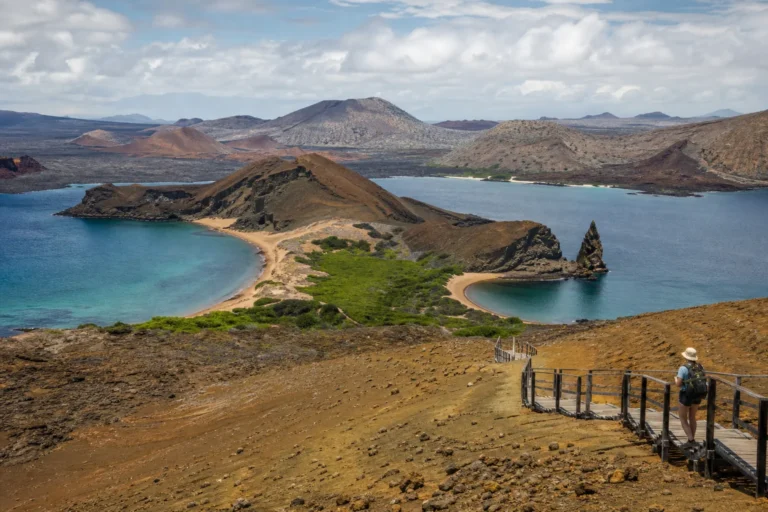
Bartolomé is a young volcanic islet best known for the iconic Pinnacle Rock, an eroded tuff cone rising near two small beaches. Visitors land by panga, climb a maintained wooden stairway to a 360‑degree viewpoint, and see layered lava types and plant adaptations in a sun‑baked environment.
The sheltered northern beach beside Pinnacle Rock is a popular snorkeling launch where Galápagos penguins, green turtles, sea lions and reef fish are commonly seen. The site pairs an accessible geological lesson with excellent marine wildlife viewing; permitted activities and landing rules are regulated by the National Park and naturalist guides.
Kicker Rock / León Dormido (San Cristóbal)
Kicker Rock, locally León Dormido, is a dramatic twin sea‑stack formation off San Cristóbal that split from an eroded tuff cone. Boats approach the narrow channel between two vertical pillars where snorkelers and divers enter the water to observe concentrated marine life.
The channel attracts reef and pelagic species—reef sharks, rays, sea turtles and schooling fish—and seabirds roost on the rock’s ledges. Currents can be strong and visibility variable; for safety, use reputable operators and certified guides who understand local dive and marine conditions.
Official Kicker Rock / León Dormido (San Cristóbal) website →
Sierra Negra Volcano (Isabela Island)
Sierra Negra is a broad shield volcano on Isabela with one of the archipelago’s largest, shallow calderas and extensive lava fields. Visitors view dark pahoehoe and ʻaʻā flows, scattered fumaroles and pioneer vegetation that illustrate recent volcanic processes and island building by hotspot volcanism.
Guided hikes and rim viewpoints reveal fresh lava surfaces, endemic plants recolonizing new substrate, and panoramic views toward neighboring volcanoes. Trail and weather conditions change rapidly; park access and permitted routes can be restricted after eruptions, so verify current advisories before traveling.
Darwin Bay (Genovesa Island)
Darwin Bay occupies a flooded crater on Genovesa with a coral‑pebble beach, mangroves and a short, mostly flat trail into dense seabird colonies. The site is famed for close encounters with red‑footed and Nazca boobies, frigatebirds and swallow‑tailed gulls, often nesting at eye level along the trail.
Tidal pools and shallow waters offer brief swims and snorkeling where sea lions, rays and reef fish appear. Access typically requires an overnight cruise and wet landings that can be tide‑dependent; confirm landing permissions and seasonal highlights with your naturalist guide.
Post Office Bay (Floreana Island)
Post Office Bay on Floreana preserves a historic maritime custom in which sailors left letters in a sealed barrel for others to deliver. Today visitors take and leave postcards as part of that informal tradition and learn about the bay’s maritime history from interpretive signs and guides.
The site includes a short lava‑tunnel trail, Baroness Lookout and adjacent shore habitat where sea lions may haul out. The tradition is informal and subject to park rules; follow National Park guidance, avoid disturbing wildlife and verify landing permissions with your guide.
San Cristóbal Interpretation Center
The San Cristóbal Interpretation Center (Centro de Interpretación Gianny Arismendi) offers layered exhibits on volcanic origins, ocean currents, species arrivals and human settlement. Panels, photographs and models explain Darwinian ideas, hotspot volcanism and the archipelago’s conservation challenges, giving visitors context before field visits.
Sited near Puerto Baquerizo Moreno, the center functions as an orientation stop for school groups, cruise guests and independent travelers and emphasizes invasive‑species control, monitoring and community education. Verify special displays or events with park staff before your visit.
Best Time to Visit Galapagos Islands
The Galápagos has a subtropical, ocean‑moderated climate with a warm, wetter season (roughly December–May) and a cooler, drier season (roughly June–November).
Wildlife viewing is excellent year‑round but highlights shift seasonally: the warm season brings clearer seas, greener highlands and breeding activity for many species, while the cooler season brings plankton‑rich waters that attract large marine fauna and often offer excellent diving visibility for pelagics.
Plan around biological seasons and allow flexibility for boat transfers and park visitor limits.
Getting Around Galapagos Islands
There are no public roads linking islands. Access between inhabited islands and visitor sites is by licensed flights, regular speedboats, or private charters and cruises.
On larger islands, taxis, short buses and walking connect towns and nearby sites. Most remote visitor sites require day boats or multi‑day cruises operating under park permits and licensed guides; plan itineraries around boat and flight schedules and park regulations.

Location
Map of Galapagos Islands, Ecuador
The interactive map loads only when you choose to view it.
Plan Your Visit to Galapagos Islands
Most visitors reach the Galápagos by flying from mainland Ecuador (Quito or Guayaquil) to Baltra or San Cristóbal. Inter‑island movement is by small aircraft, public speedboat, private charter or cruise.
Named sites and many landings are regulated by Galápagos National Park and often require a licensed naturalist guide and permits.
Services, fuel and medical facilities are limited on some islands, so plan transfers, bookings and contingencies well in advance.
Local Tips for Galapagos Islands
Pack for microclimates: light layers for hot, humid coastlines and sturdy shoes plus a warm layer for cooler highlands like El Chato and Sierra Negra. Bring reef‑safe sunscreen, a reusable water bottle, a dry bag for boat trips, and basic snorkeling gear if you prefer your own fit.
Carry some US dollars and small change for taxis and tips on remote islands. Observe strict biosecurity rules—clean footwear and equipment before arrival and between islands and follow guide briefings to avoid fines and protect habitats.
Live conditions
Current Weather

Updated 2026-09-20 13:00
- Feels like
- 30°C / 87°F
- Today’s high / low
- 29°C / 84°F · 24°C / 75°F
- Humidity
- 58%
- Wind
- ↘ 26 km/h
- Precipitation
- 0 mm
- Chance of rain
- 14%
- Local time
- 2026-09-20 13:00
Safety
Galápagos safety centers on respecting wildlife and marine conditions. Keep the recommended distance from animals, never feed or touch wildlife, and follow your guide and park rules.
Ocean activities can have strong currents and variable visibility—use reputable operators and flotation when advised. Highland and volcanic trails may be steep and changeable; carry water, sun protection and notify your guide of any health concerns.
Biosecurity controls are enforced to protect ecosystems—do not transport plants, animals, or soil between islands.